National flag guide
Flag of South Africa: Meaning, Symbols and History
Frederick Brownell designed South Africa’s present flag during the transition from apartheid to democratic government.
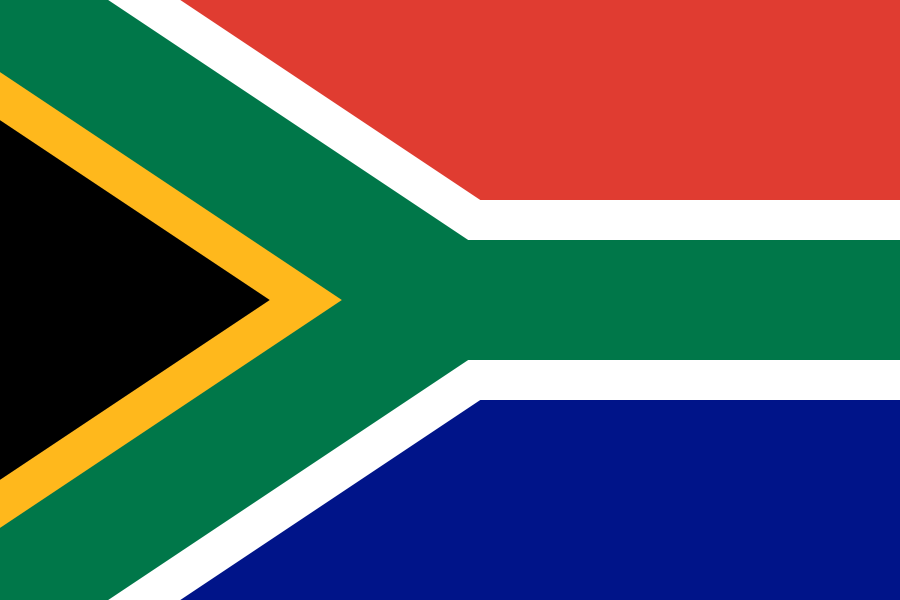
Two equal-width horizontal bands of red (top) and blue separated by a central green band that splits into a horizontal Y; a black isosceles triangle is in the Y, with narrow yellow bands around it; the red and blue bands are bordered by narrow white stripes.
The design and its details
Two equal-width horizontal bands of red (top) and blue separated by a central green band that splits into a horizontal Y; a black isosceles triangle is in the Y, with narrow yellow bands around it; the red and blue bands are bordered by narrow white stripes.
| Flag | South Africa |
|---|---|
| Collection | Country flags |
| Adoption or specification | 27 April 1994 |
| Browsing region | Africa · Southern Africa |
| Illustrated proportions (height:width) | 2:3 |
What the flag means
South Africa’s government does not assign an official separate meaning to each color. The central interpretation concerns convergence and unity. Popular color lists should be identified as interpretations rather than official definitions.
| Element | Meaning or historical connection |
|---|---|
| Converging Y-shaped arrangement | Different parts of society coming together and continuing along a shared path. |
| Six-color palette | Brings together colors with multiple historical and political associations. |
| Individual colors | The government does not prescribe one universal meaning for each color. A tidy chart assigning each color to a people, resource or virtue would misrepresent that official explanation. |
How the flag developed
Frederick Brownell designed South Africa’s present flag during the transition from apartheid to democratic government. It was first flown nationally on 27 April 1994, the opening day of the country’s first democratic general election.
The design replaced the orange-white-blue national flag used since 1928, which contained three small historical flags. Initially introduced for the transition, the new flag was retained in the democratic constitutional order. Its converging green shape expresses diverse elements of society joining on a shared path, a stronger official interpretation than a fixed one-to-one meaning for every color.
The earlier flag remains a sensitive historical symbol because of its association with apartheid. It belongs in a dated educational account with that context, rather than being presented as a current patriotic alternative.
Reading the flag without inventing a color code
The central green shape moves from two branches at the hoist into one band toward the fly. The government describes this as convergence, expressing different elements of society coming together and taking a common path.
The colors draw on several strands of South African flag history, which helps explain the design’s broad appeal during the 1994 transition. That historical background does not establish one legally fixed meaning for every individual color. Lists assigning a separate population group to each stripe oversimplify the national symbol.
The practical design also matters. Narrow white and gold borders separate strong neighboring colors and keep the converging shape legible. A small reproduction that loses those borders can blur the structure even if all six headline colors remain visible.
The main changes over time
1928–1994 — Earlier national flag
An orange-white-blue flag contained three smaller flags.
1994 — Democratic transition
Brownell’s six-color design was introduced.
1996 — Constitutional continuation
The democratic constitution retained the new flag.
How to recognise this flag
A green sideways Y, edged in white and gold, separates red above, blue below and a black hoist triangle.
Compare the relevant designs in these guides:
Earlier designs and other uses
The 1928–1994 flag is a historical apartheid-era national symbol. The current national flag has a different purpose and design.
Questions about this flag
When was the flag adopted?
27 April 1994. An adoption date can refer to a design, its restoration or a later legal specification; the timeline above separates those stages.
What should I check before identifying an older example?
The 1928–1994 flag is a historical apartheid-era national symbol. The current national flag has a different purpose and design.
What Did We Learn Today?
A green sideways Y, edged in white and gold, separates red above, blue below and a black hoist triangle. Its adoption and later changes reflect the national history described in the timeline, while older or specialist flags need their own labels.
Sources & Data Notes
This guide distinguishes first use, national adoption, restoration and later construction standards. Traditional or commonly reported interpretations are identified where they differ from a formal specification. It is a dated reference, not a live record of every change in official flag use.
- Government of South Africa: National flag.
- Archived World Factbook country record — background flag description and symbolic interpretations; later changes are explained above.
- Flagpedia: South Africa — flag artwork and comparison reference.
- Flag history reference and bibliography — chronology and links to underlying sources.
The main illustration preserves the selected flag artwork’s proportions; these are a reproduction guide, not a substitute for a legal construction drawing. Color names group shades for browsing.
Current flag artwork is supplied with the original flag collection; the package’s artwork register contains provenance and license details.