National flag guide
Flag of Solomon Islands: Meaning, Symbols and History
Solomon Islands adopted its present flag in 1977, before independence from Britain in July 1978.
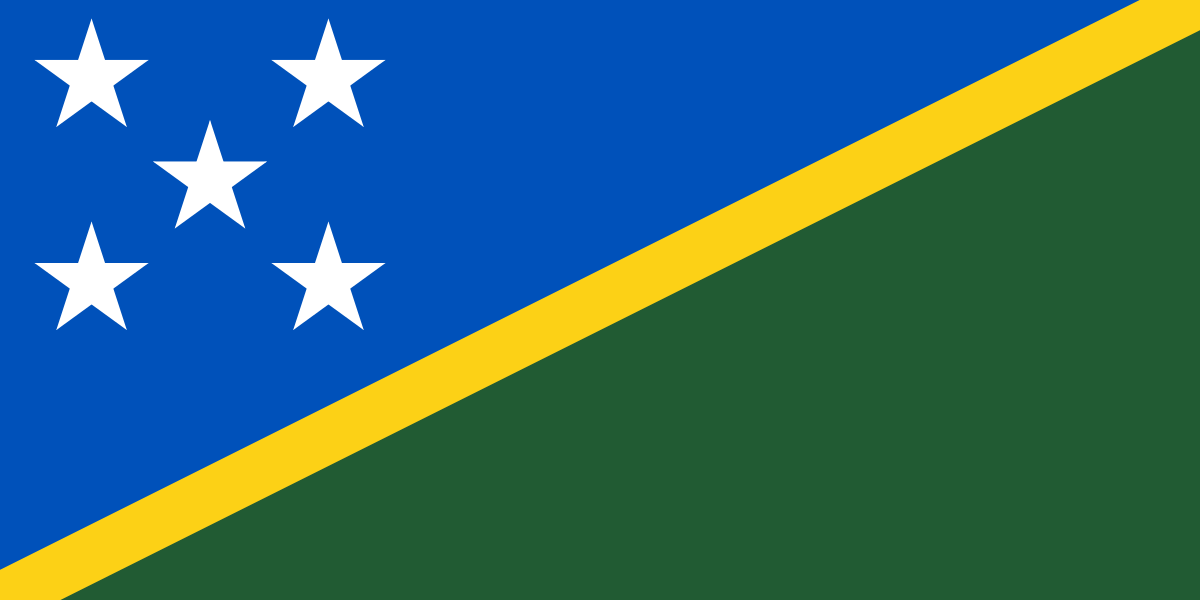
Divided diagonally by a yellow stripe from the lower-left corner; the upper triangle (left side) is blue with five five-pointed white stars in an "X" pattern; the lower triangle is green. Blue represents the ocean, green the land and yellow sunshine. The five stars are a retained symbolic grouping, not a current province count.
The design and its details
Divided diagonally by a yellow stripe from the lower-left corner; the upper triangle (left side) is blue with five five-pointed white stars in an "X" pattern; the lower triangle is green.
| Flag | Solomon Islands |
|---|---|
| Collection | Country flags |
| Adoption or specification | 18 November 1977 |
| Browsing region | Oceania · Melanesia |
| Illustrated proportions (height:width) | 1:2 |
What the flag means
Blue represents the ocean, green the land and yellow sunshine. The five stars are a retained symbolic grouping, not a current province count.
| Element | Meaning or historical connection |
|---|---|
| Blue | The sea surrounding the islands. |
| Green | The land and its vegetation. |
| Yellow diagonal band | Sunshine. |
| Five white stars | Originally the five district groupings. Their number remained when the administrative structure changed, so it is not a count of today’s provinces. |
How the flag developed
Solomon Islands adopted its present flag in 1977, before independence from Britain in July 1978. It replaced the colonial blue ensign and badge with a distinct blue-and-green diagonal design.
The five stars originally corresponded to the country’s principal district groupings. Administrative divisions later changed, but the flag retained its five-star arrangement. The design therefore preserves a historical count rather than displaying the current number of provinces or every island in the archipelago.
The main changes over time
1977 — National flag adopted
The present diagonal design replaced the colonial ensign.
1978 — Independence
The already adopted flag continued.
How to recognise this flag
A thin yellow diagonal separates blue above from green below. Five white stars form a compact group in the upper-hoist blue triangle.
Compare the relevant designs in these guides:
Earlier designs and other uses
Colonial badge ensigns belong to the pre-independence period.
Questions about this flag
When was the flag adopted?
18 November 1977. An adoption date can refer to a design, its restoration or a later legal specification; the timeline above separates those stages.
What should I check before identifying an older example?
Colonial badge ensigns belong to the pre-independence period.
What Did We Learn Today?
A thin yellow diagonal separates blue above from green below. Five white stars form a compact group in the upper-hoist blue triangle. Its adoption and later changes reflect the national history described in the timeline, while older or specialist flags need their own labels.
Sources & Data Notes
This guide distinguishes first use, national adoption, restoration and later construction standards. Traditional or commonly reported interpretations are identified where they differ from a formal specification. It is a dated reference, not a live record of every change in official flag use.
- Archived World Factbook country record — background flag description and symbolic interpretations; later changes are explained above.
- Flagpedia: Solomon Islands — flag artwork and comparison reference.
- Flag history reference and bibliography — chronology and links to underlying sources.
The main illustration preserves the selected flag artwork’s proportions; these are a reproduction guide, not a substitute for a legal construction drawing. Color names group shades for browsing.
Current flag artwork is supplied with the original flag collection; the package’s artwork register contains provenance and license details.