National flag guide
Flag of Namibia: Meaning, Symbols and History
Namibia selected its flag during the transition to independence from South African administration.
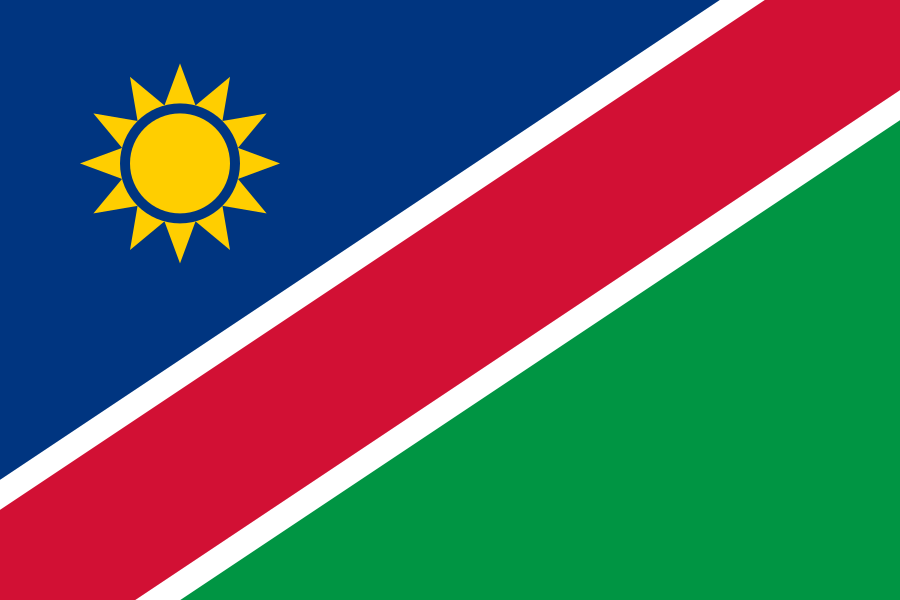
A wide red stripe edged with narrow white stripes divides the flag diagonally from lower-left corner to upper-right corner; the upper triangle is blue and has a golden-yellow, 12-ray sunburst, and the lower triangle is green. Blue is associated with sky, Atlantic waters and rain; green with vegetation; red with the people and their determination; white with peace; and the sun with life and energy.
The design and its details
A wide red stripe edged with narrow white stripes divides the flag diagonally from lower-left corner to upper-right corner; the upper triangle is blue and has a golden-yellow, 12-ray sunburst, and the lower triangle is green.
| Flag | Namibia |
|---|---|
| Collection | Country flags |
| Adoption or specification | 21 March 1990 |
| Browsing region | Africa · Southern Africa |
| Illustrated proportions (height:width) | 2:3 |
What the flag means
Blue is associated with sky, Atlantic waters and rain; green with vegetation; red with the people and their determination; white with peace; and the sun with life and energy.
| Element | Meaning or historical connection |
|---|---|
| Blue | Sky, rain and the Atlantic Ocean. |
| Red | The people’s courage and determination to build the country. |
| Green | Vegetation and agriculture. |
| White borders | Peace and unity. |
| Gold sun | Life and energy. Its twelve rays are a design feature, not a count of the country’s present regions. |
How the flag developed
Namibia selected its flag during the transition to independence from South African administration. A national committee reviewed hundreds of entries and combined features from shortlisted proposals rather than simply choosing a pre-existing party flag.
The flag was first used at independence in March 1990. Some colors also appeared in liberation-movement and community flags, but the national composition brought them into a new design with a twelve-rayed sun. Its diagonal red band and white borders are important parts of the construction, not a general imitation of another African diagonal flag.
The main changes over time
1989–1990 — National selection process
A committee developed a design from submitted proposals.
1990 — Independence
The present national flag was adopted.
How to recognise this flag
A white-edged red diagonal separates blue above from green below. A yellow twelve-rayed sun is in the blue upper-hoist area.
Compare the relevant designs in these guides:
Earlier designs and other uses
Liberation-movement flags are part of the background but are separate from the national design.
Questions about this flag
When was the flag adopted?
21 March 1990. An adoption date can refer to a design, its restoration or a later legal specification; the timeline above separates those stages.
What should I check before identifying an older example?
Liberation-movement flags are part of the background but are separate from the national design.
What Did We Learn Today?
A white-edged red diagonal separates blue above from green below. A yellow twelve-rayed sun is in the blue upper-hoist area. Its adoption and later changes reflect the national history described in the timeline, while older or specialist flags need their own labels.
Sources & Data Notes
This guide distinguishes first use, national adoption, restoration and later construction standards. Traditional or commonly reported interpretations are identified where they differ from a formal specification. It is a dated reference, not a live record of every change in official flag use.
- Archived World Factbook country record — background flag description and symbolic interpretations; later changes are explained above.
- Flagpedia: Namibia — flag artwork and comparison reference.
- Flag history reference and bibliography — chronology and links to underlying sources.
The main illustration preserves the selected flag artwork’s proportions; these are a reproduction guide, not a substitute for a legal construction drawing. Color names group shades for browsing.
Current flag artwork is supplied with the original flag collection; the package’s artwork register contains provenance and license details.