A country can publish official notices in a handful of languages and still have hundreds of languages in its communities. To compare countries fairly, start with the same catalogue and keep its decisions about dialects, sign languages and language vitality visible.
In Glottolog 5.4, Papua New Guinea leads with 851 assessed spoken first-language entries that are not listed as extinct, followed by Indonesia with 708 and Nigeria with 522. Including assessed signed entries raises those totals to 852, 713 and 527. These are catalogue links to countries, not a census of everyone’s language use.
How to use this article: Compare the ten leading countries, see which two change places when signed entries count, or check what a legal list measures instead.
What counts as one language in one country?
We use Glottolog 5.4, issued November 10, 2026, and count language-level catalogue entries with a documented country code and an endangerment assessment other than extinct. The base comparison uses only the catalogue’s Spoken L1 Language category: a spoken language traditionally used as a community’s first language. The second comparison adds assessed, non-extinct entries from Glottolog’s distinct Sign Language category. Neither is a headcount of speakers or signers.
Glottolog assigns a stable identifier, or Glottocode, to a language, dialect or family. Here a named dialect never adds a separate count unless the catalogue classifies it at language level. The editors look for evidence that a variety is distinct, using mutual intelligibility as one criterion. Where the evidence or classification changes, the count can change too, without a community suddenly gaining or losing a way to communicate.
Countries and territories are kept as the separate codes that Glottolog supplies; the ten leaders below are sovereign countries. This is a comparison of catalogue geography, not a decision about sovereignty, ethnicity, citizenship or which languages qualify as official. It excludes entries tracked in other categories, such as pidgins, mixed languages and artificial languages, rather than classifying those separately here.
The countries with the most catalogue entries
Top ten by assessed spoken first-language entries
| Spoken rank | Country | Spoken L1 | Signed entries added | Combined count | Combined rank |
|---|---|---|---|---|---|
| 1 | Papua New Guinea | 851 | 1 | 852 | 1 |
| 2 | Indonesia | 708 | 5 | 713 | 2 |
| 3 | Nigeria | 522 | 5 | 527 | 3 |
| 4 | India | 452 | 2 | 454 | 4 |
| 5 | China | 394 | 5 | 399 | 5 |
| 6 | Cameroon | 293 | 0 | 293 | 6 |
| 7 | Mexico | 278 | 4 | 282 | 7 |
| 8 | Democratic Republic of the Congo | 229 | 1 | 230 | 8 |
| 9 | Brazil | 173 | 4 | 177 | 9 |
| 10 | Philippines | 167 | 2 | 169 | 10 |
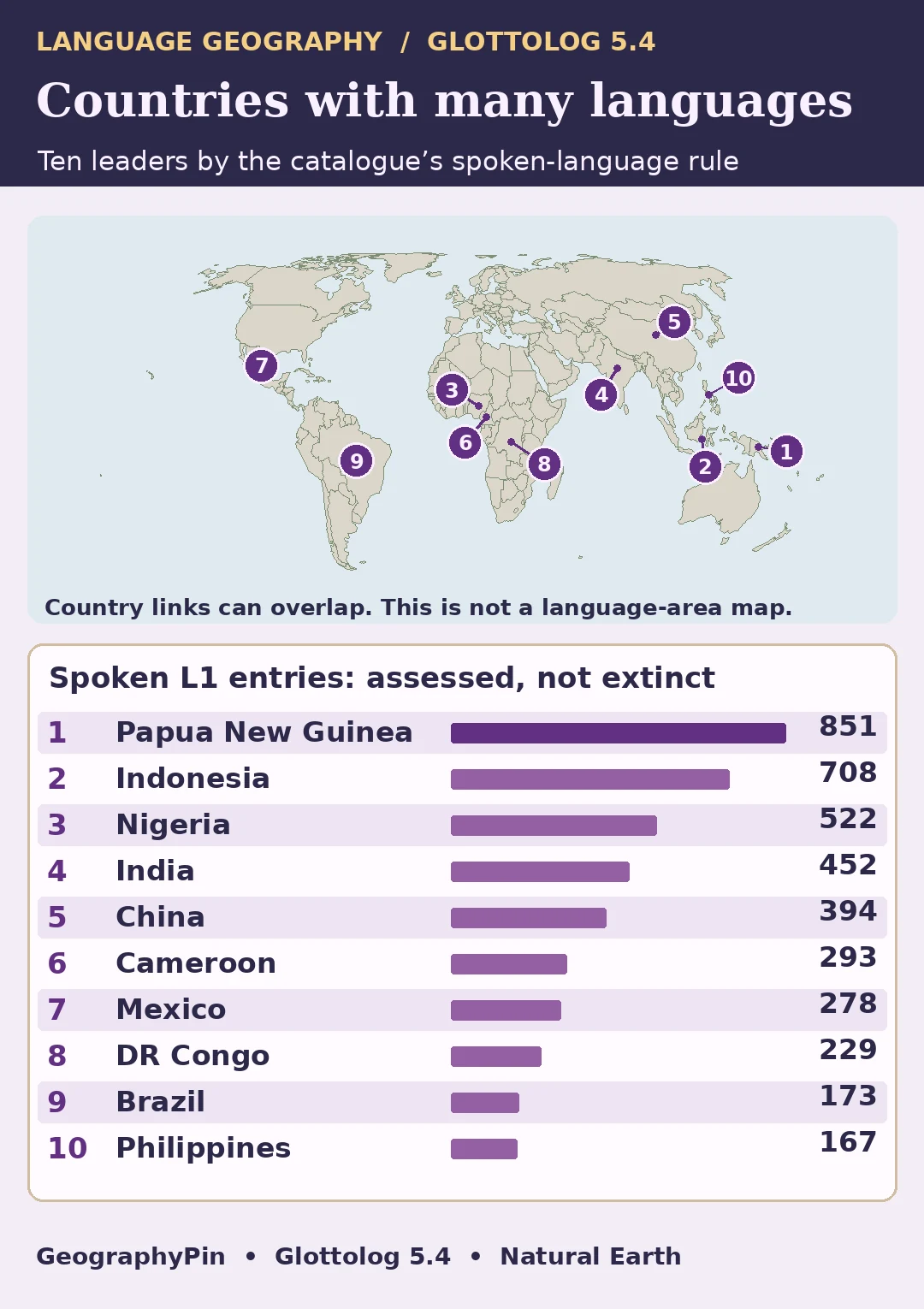
One language can be linked to several countries. Glottolog’s Spanish entry, for example, has the same Glottocode stan1288 in Spain and Mexico’s country links. It contributes once to each country, not a new language at the border. For that reason, a sum of country figures is not a world language total. A country link also does not show how many people use that language today or whether its status in that country differs from the entry’s catalogue-wide assessment.
What happens when sign languages are included?
Papua New Guinea gains one qualifying signed entry (851 → 852), while Indonesia gains five (708 → 713). Papua New Guinea remains first under both rules. The signed counts use the same assessed, non-extinct filter as the spoken counts.
Australia and Russia trade places
The top ten do not change order, but Australia and Russia do. The spoken comparison puts Russia at 141 (12th) and Australia at 139 (13th). Adding one signed entry for Russia and four for Australia brings them to 142 and 143, respectively. Australia moves to 12th and Russia to 13th. Auslan, aust1271, is one of Australia’s included entries.
That signed column is a count under the catalogue’s category and status rule, not a census of sign-language communities. Cameroon has zero included signed entries but three country-linked signed entries lacked an assessment. Across the release, 52 signed entries and 11 spoken L1 entries lacked a status. They are not assumed extinct or living. The sign category can also include some auxiliary or pidgin sign systems; the comparison does not claim it identifies only first-language signers.
Why official language lists give a different answer
One list recognizes languages; another records them
India’s Constitution lists 22 languages in its Eighth Schedule. Glottolog links 452 qualifying spoken L1 entries to India under this article’s rule. The schedule is a list of constitutional recognition, not a count of all languages people use or a list of which languages every government office uses. The catalogue entry count is not a competing legal list.
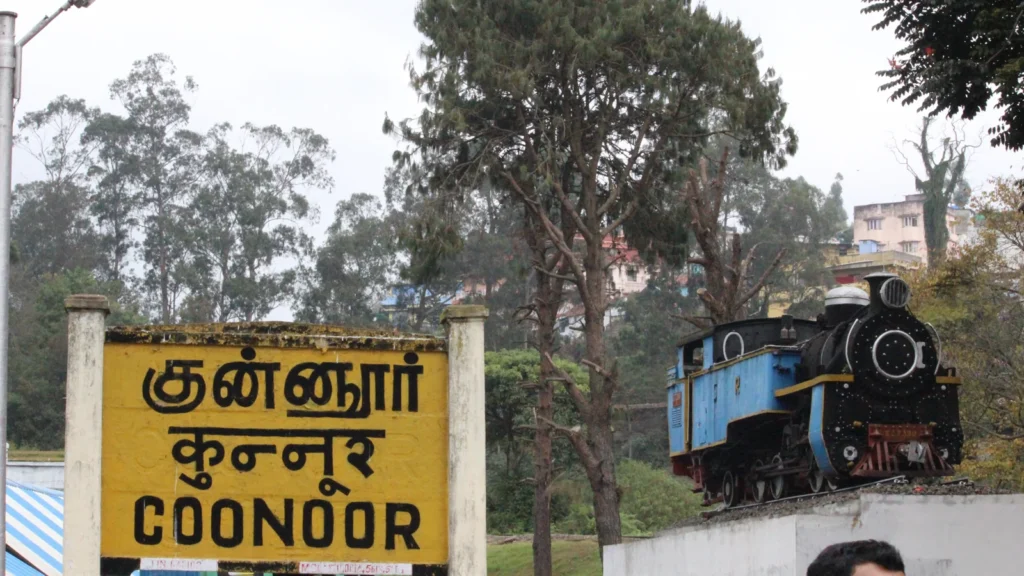
The Coonoor station sign in the photograph makes the difference easy to see. It shows the same place name in three written languages, not the number of languages passengers can speak or sign. Likewise, a census measure such as language spoken at home answers a different question from either a legal list or this catalogue ranking.
How to reproduce both rankings
- Use the tagged Glottolog CLDF 5.4 files. Select Level=language in languages.csv. Join by Glottocode to the category and Agglomerated Endangerment Status (AES) records in values.csv; decode entries using codes.csv.
- Keep Spoken L1 Language for the first measure. Include the five named AES states from not endangered through nearly extinct, and exclude source-extinct and missing-status records. In the combined measure add the Sign Language category under the same rule. The release’s extinct category can include dormant classifications under its source mappings; a missing status is not assigned to that category.
- Split the semicolon-separated country list, discard blank codes, and count each unique Glottocode and country pair once. Across both categories, one spoken L1 entry had no country code; its status was also missing. No signed entry lacked a country code. Codes with no qualifying records are not assigned a rank of zero.
- Sort the 244 coded jurisdictions on the selected count from high to low. Equal counts share a rank and skip the following position. In the example above, 139 + 4 = 143 for Australia and 141 + 1 = 142 for Russia. The download keeps the excluded status columns to make this rule visible.
Frequently Asked Questions
Does one language count for more than one country?
Yes. Glottolog 5.4 links Spanish (stan1288) to both Spain and Mexico, among other places, so it contributes one spoken entry to each of those country totals. Adding country totals would therefore count some languages more than once.
Can I use these totals to tell how many people use a sign language?
No. A qualifying signed language contributes one country-linked entry regardless of how many people use it. To compare numbers of users, look for a population survey with a stated year and a definition of use.
What Did We Learn Today?
A useful country ranking starts with a single release and says what counts, what is excluded and why. Adding signed entries can change positions, a shared language can count in multiple countries, and none of these counts tells you which languages a government recognizes or how many people use each one.
Sources & Data Notes
Open sources & methodology
Glottolog 5.4, edited by Harald Hammarström, Robert Forkel, Martin Haspelmath and Sebastian Bank, November 2026; CC BY 4.0. GeographyPin grouped unique country and Glottocode pairs and calculated both ranks. The catalogue’s global 7,685 spoken L1 entries are before these status and country-link filters.
- Glottolog CLDF v5.4, language level, country assignments, categories and assessment values.
- Glottolog 5.4 archived downloads, November 10, 2026, version and release date.
- Glottolog: Languoids and classification principles, scope, first languages, dialects and the sign-language category.
- GlottoScope: Agglomerated Endangerment Status, how the catalogue combines assessments.
- Government of India, Legislative Department: Constitution of India, Eighth Schedule.
- Glottolog, Spanish (stan1288), with the country links used in the FAQ.
Featured image: Marajozkee, Coonoor railway station, Tamil Nadu, India, January 12, 2018. Cropped and resized; the adapted photograph remains CC BY-SA 4.0.