What Is Capitalism? Ownership, Markets and Real-World Examples
Capitalism is easier to understand through the decisions behind an ordinary business than through a list of supposedly “pure” countries. Following an investment through…
Learn geography
Clear guides to political systems, sovereignty, recognition, citizenship, borders, and how power is organized across places.
Capitalism is easier to understand through the decisions behind an ordinary business than through a list of supposedly “pure” countries. Following an investment through…
The word “communism” appears in philosophy books, party names and country lists, but it does not mean exactly the same thing in each setting.…
The phrase “Marxism vs. communism” can make two related ideas sound like rival systems. The real distinction is about what each word names. Separating…
Calling a policy or country “socialist” often raises more questions than it answers. A clearer starting point is the organization of production: who owns…
A country can climb a democracy ranking without its own score improving. It can also receive different labels from different research organizations without either…
A country’s religious identity does not tell us who governs it. To understand theocracy, look at institutions: who holds power, how that person or…
A world map of monarchies includes far more than countries with a royal palace and a resident king. Canada, Japan, Malaysia and Vatican City…
Comparing capitalism, socialism, and communism is easier when the words are connected to ordinary economic questions. Who owns the tools? Who decides what gets…
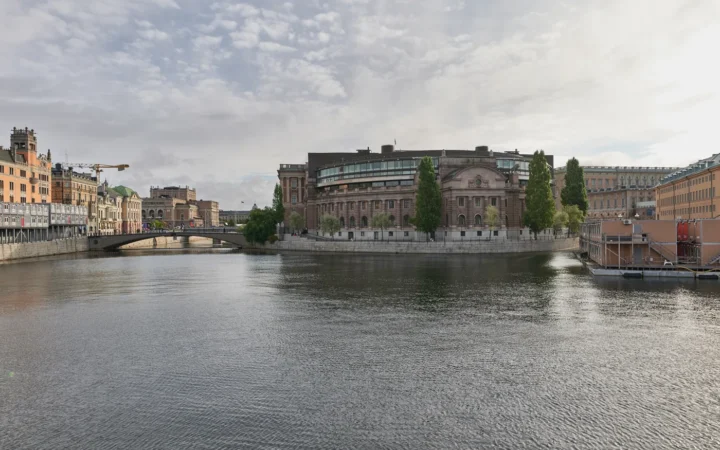
Sweden’s Parliament House in Stockholm, photographed September 20, 2022. Parliamentary institutions alone do not establish a country’s economic system.
Communism vs. capitalism sounds like a choice between two complete national systems. In practice, the comparison becomes clearer when you follow a business: who…