A world map of monarchies includes far more than countries with a royal palace and a resident king. Canada, Japan, Malaysia and Vatican City all belong in the discussion, but their head-of-state arrangements are very different. The useful starting point is to count countries consistently, then explain who occupies the office and what that office does.
Using a sovereign-state count of UN members plus Vatican City, this guide identifies 43 countries with monarchies: 12 in Europe, 13 in Asia, nine in the Americas, six in Oceania and three in Africa. They do not have 43 separate rulers: fifteen countries share King Charles III, while Andorra has two co-princes.
Use this guide: Start with the country-by-country table, compare different royal arrangements, or check why some places are not separate entries.
1. What the list counts
Countries, not crowns or royal families
The count uses one row per sovereign state: UN member states with national monarchical institutions, plus Vatican City State. Vatican City is included as a sovereign state even though it is not a UN member. The Holy See is not counted again as a second country. Dependencies, overseas territories and local royal houses inside republics are outside this list.
The distinction matters because a country and a monarch are different units. One person can hold several legally distinct crowns. A single country can have two joint heads of state, or a federal arrangement involving multiple rulers. None of these cases justifies multiplying the number of sovereign states.
The country list is a November 2026 snapshot, not a permanent membership roll. Changes of ruler usually leave the country count unchanged; abolition or restoration of a national monarchy changes the list. Institutional wording below describes the arrangement, not a score for democracy, freedom or the quality of government.
The regional totals also use a stated geographic convention: the Americas combine the Caribbean and mainland American states, while Oceania includes the Pacific monarchies. These are presentation groups, not constitutional categories. A differently arranged regional table can still describe the same worldwide roster.
2. World map and country-by-country list
Find a country and its head-of-state arrangement
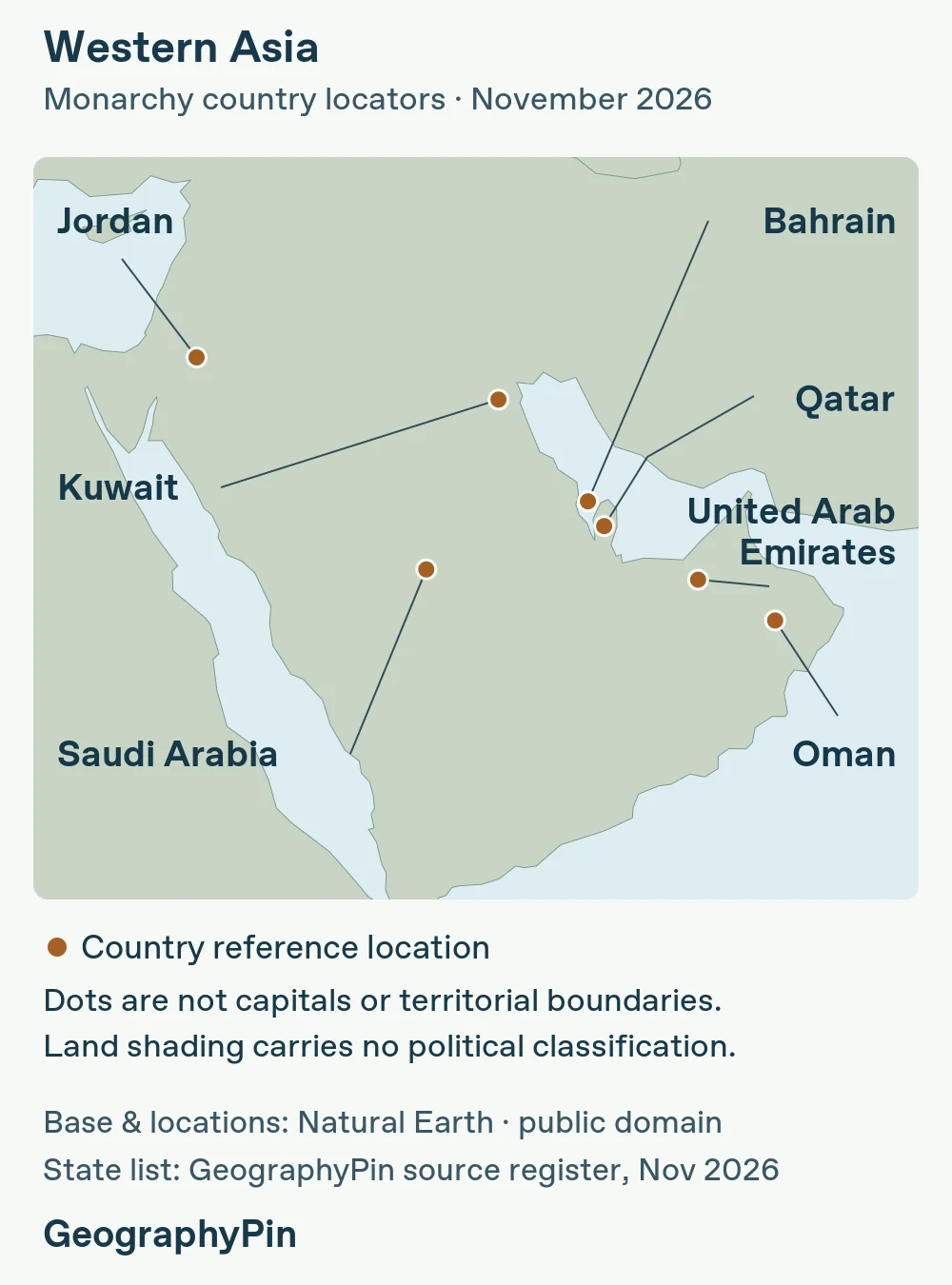
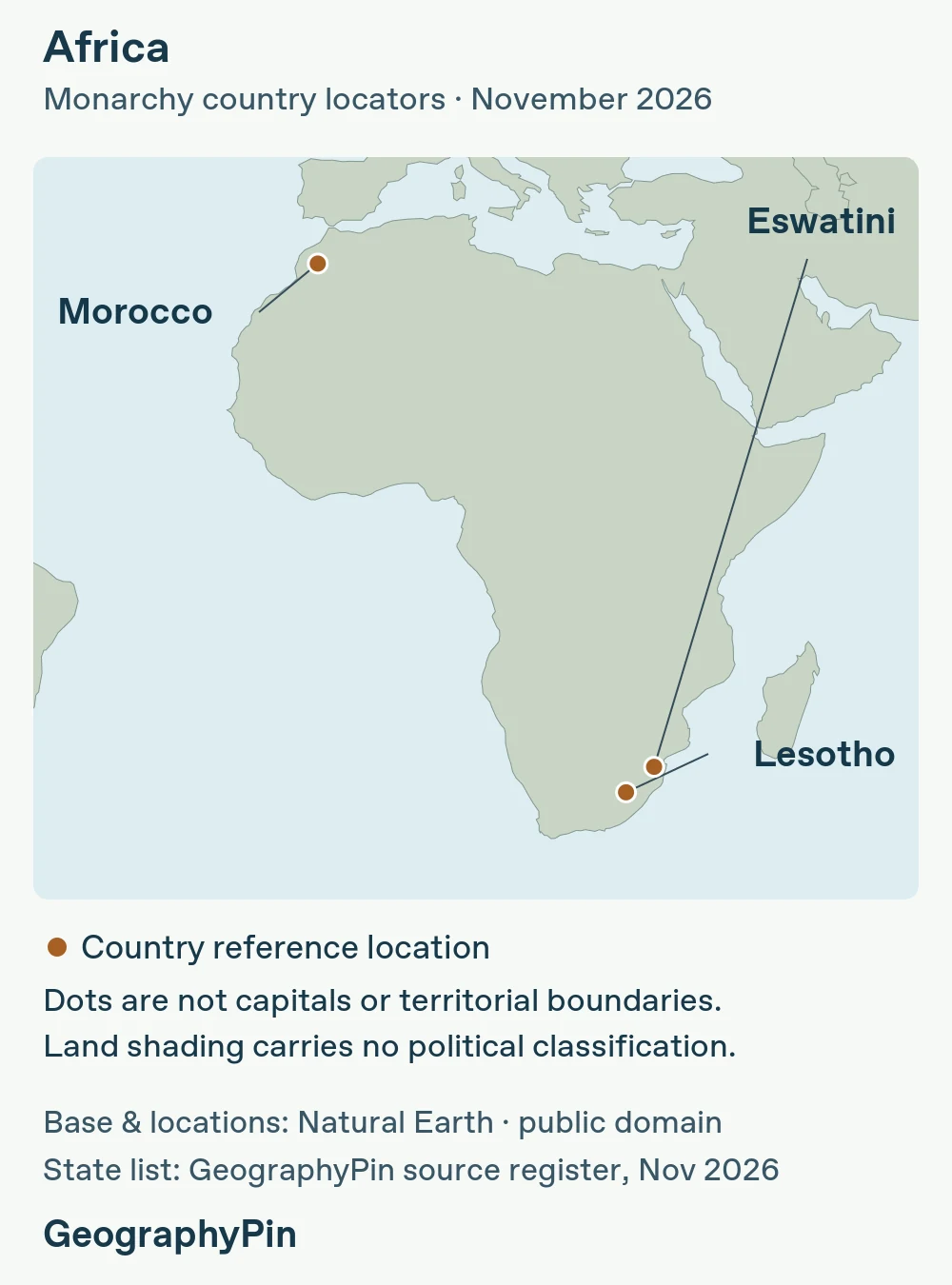
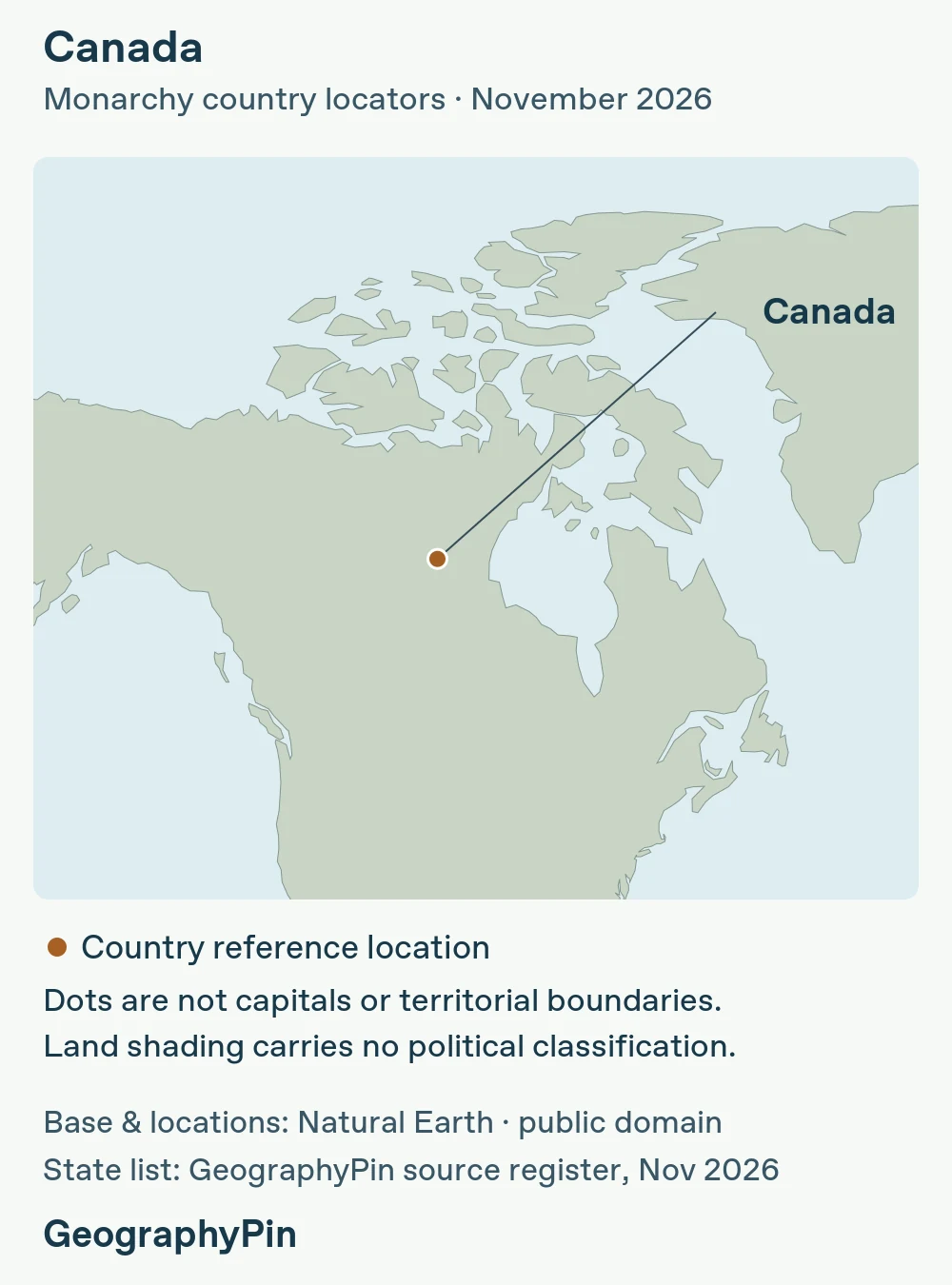
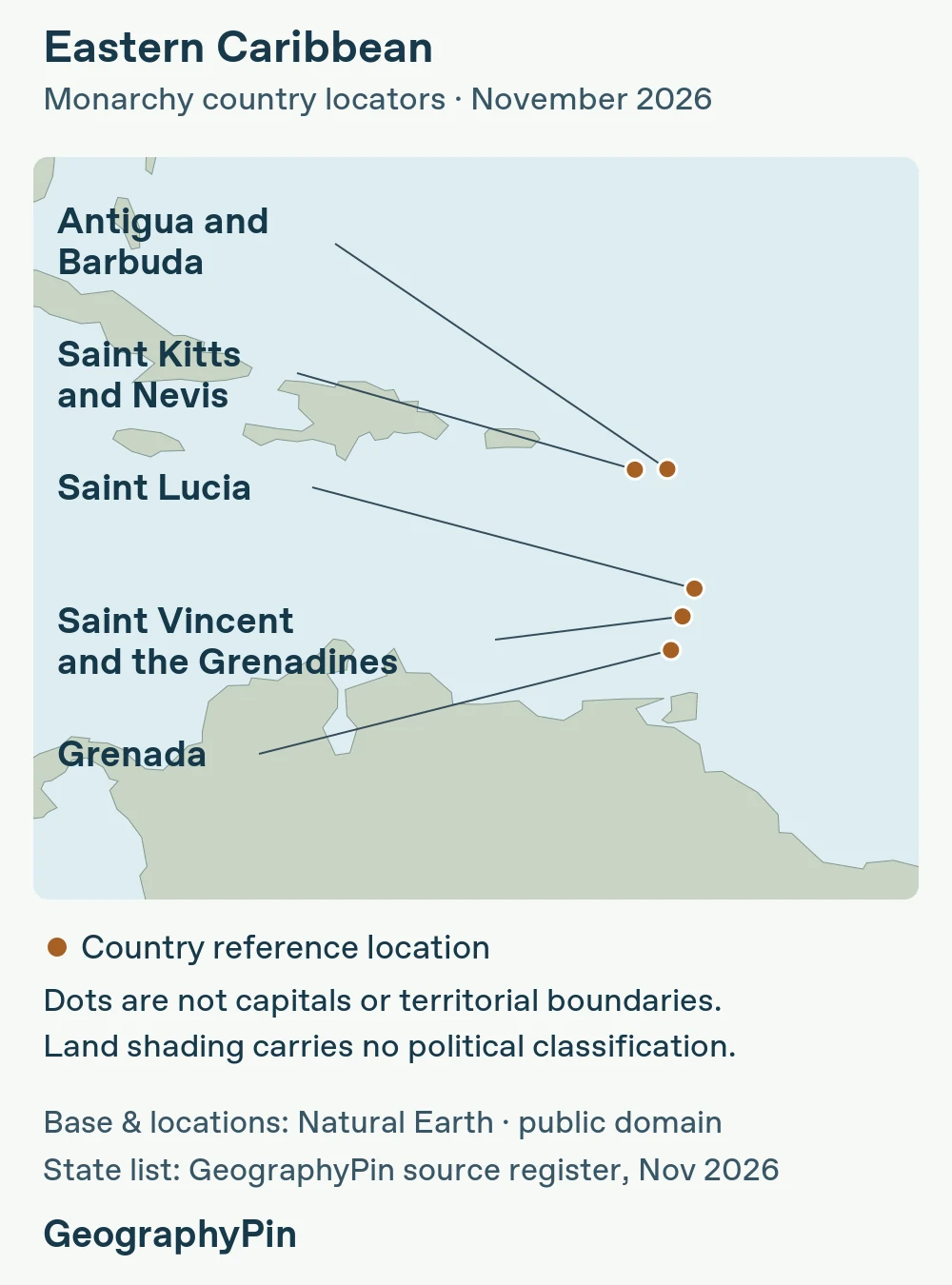
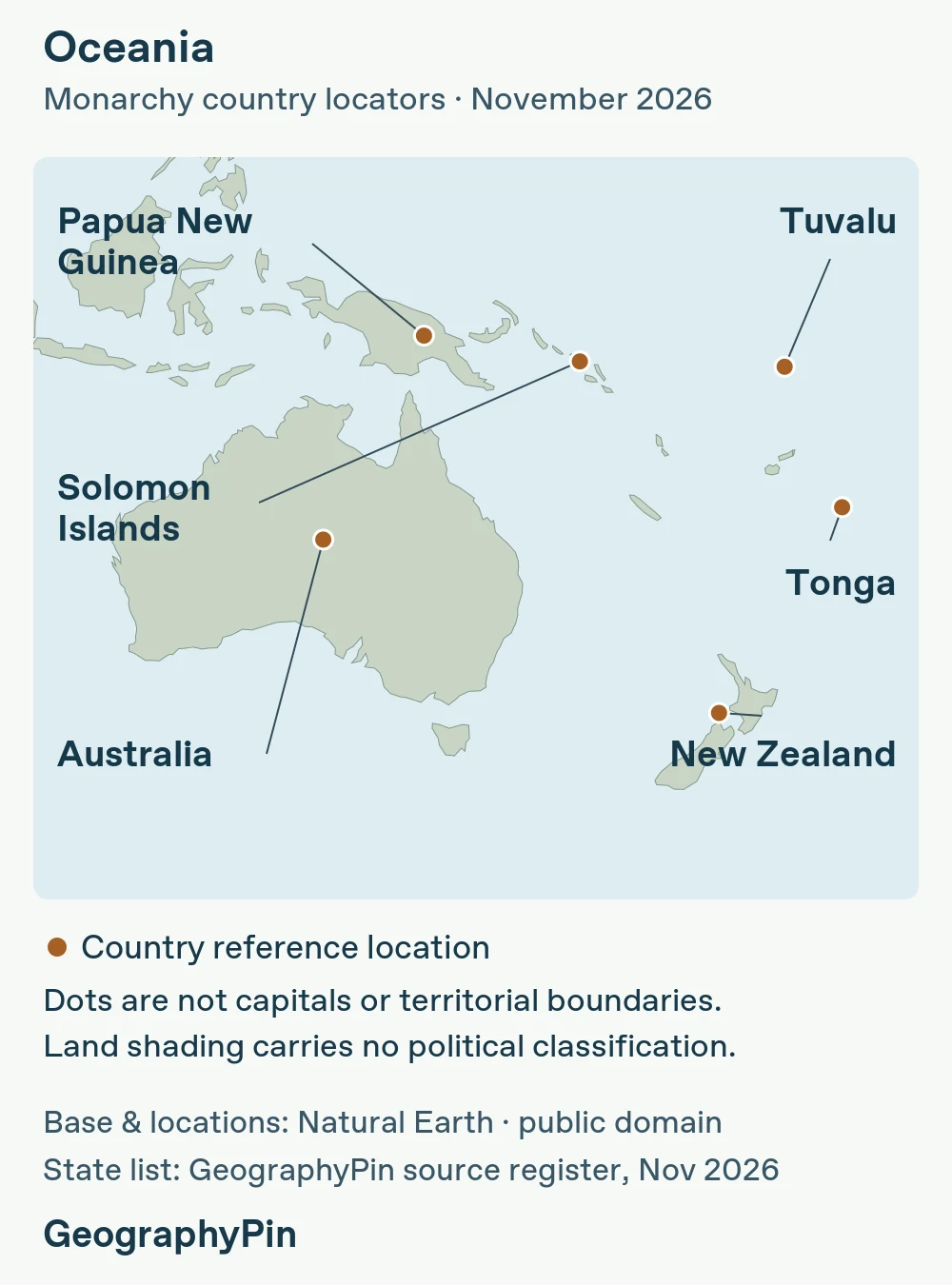
The regional locator atlas below accompanies the complete country table. Panels use different scales. Named dots identify country-reference positions, not capitals, sovereign boundaries or territorial control. Neutral land is not classified. Coastlines are generalized, and some small islands and microstates appear only as dots. Each panel uses the November 2026 roster.
Read each row as a country, not a separate royal person. “Constitutional” describes legal arrangements; it does not mean every listed monarch has the same powers. Sources are linked in each row. The shared-crown countries retain their own governments and constitutional systems.
Europe
| Country | Head-of-state office | Arrangement and source |
|---|---|---|
| Andorra | Two co-princes | Parliamentary co-principality; joint head of state Source |
| Belgium | King | Hereditary parliamentary constitutional monarchy Source |
| Denmark | King | Constitutional monarchy Source |
| Liechtenstein | Reigning prince | Hereditary constitutional monarchy; hereditary prince exercises delegated head-of-state duties Source |
| Luxembourg | Grand duke | Constitutional monarchy Source |
| Monaco | Sovereign prince | Hereditary constitutional monarchy Source |
| Netherlands | King | Constitutional monarchy; one sovereign kingdom Source |
| Norway | King | Constitutional monarchy Source |
| Spain | King | Parliamentary monarchy Source |
| Sweden | King | Constitutional monarchy Source |
| United Kingdom | King | Constitutional monarchy; shares its monarch with fourteen separate realms Source |
| Vatican City | Pope | Elective absolute monarchy; not hereditary Source |


Asia
| Country | Head-of-state office | Arrangement and source |
|---|---|---|
| Bahrain | King | Hereditary constitutional monarchy Source |
| Bhutan | King | Democratic constitutional monarchy in constitutional text Source |
| Brunei | Sultan | Absolute monarchy Source |
| Cambodia | King | Royal Council of the Throne selects king from eligible royal lineages Source |
| Japan | Emperor | Hereditary constitutional institution; emperor has no governmental powers Source |
| Jordan | King | Hereditary parliamentary monarchy with substantive royal powers Source |
| Kuwait | Emir | Hereditary emirate; see parliamentary-suspension qualification below Source |
| Malaysia | Yang di-Pertuan Agong | Federal king elected from the rulers for a five-year term Source |
| Oman | Sultan | Hereditary monarchy Source |
| Qatar | Emir | Hereditary Al Thani rule Source |
| Saudi Arabia | King | Monarchy with extensive royal executive authority Source |
| Thailand | King | King as head of state within constitutional framework Source |
| United Arab Emirates | President elected by emirate rulers | Federation of seven emirates; Supreme Council elects president from its members Source |

Africa
| Country | Head-of-state office | Arrangement and source |
|---|---|---|
| Eswatini | King | Separate monarchy; king holds executive authority Source |
| Lesotho | King | Separate constitutional monarchy Source |
| Morocco | King | Separate hereditary constitutional monarchy; substantial royal functions Source |
Americas
| Country | Head-of-state office | Arrangement and source |
|---|---|---|
| Antigua and Barbuda | King | Separate Commonwealth realm; Crown represented by a governor-general Source |
| Bahamas | King | Separate Commonwealth realm; Crown represented by a governor-general Source |
| Belize | King | Separate Commonwealth realm; Crown represented by a governor-general Source |
| Canada | King | Separate Commonwealth realm; Crown represented by a governor-general Source |
| Grenada | King | Separate Commonwealth realm; Crown represented by a governor-general Source |
| Jamaica | King | Separate Commonwealth realm; Crown represented by a governor-general Source |
| Saint Kitts and Nevis | King | Separate Commonwealth realm; Crown represented by a governor-general Source |
| Saint Lucia | King | Separate Commonwealth realm; Crown represented by a governor-general Source |
| Saint Vincent and the Grenadines | King | Separate Commonwealth realm; Crown represented by a governor-general Source |

Oceania
| Country | Head-of-state office | Arrangement and source |
|---|---|---|
| Australia | King | Separate Commonwealth realm; Crown represented by a governor-general Source |
| New Zealand | King | Separate Commonwealth realm; Crown represented by a governor-general Source |
| Papua New Guinea | King | Separate Commonwealth realm; Crown represented by a governor-general Source |
| Solomon Islands | King | Separate Commonwealth realm; Crown represented by a governor-general Source |
| Tonga | King | Separate hereditary monarchy with constitutional governmental roles Source |
| Tuvalu | King | Separate Commonwealth realm; Crown represented by a governor-general Source |
The institutional titles deliberately distinguish emperors, emirs, sultans, princes and a pope rather than calling every monarch a king. The UAE’s federal president belongs in this comparison because the office is chosen by a council of emirate rulers; a presidential title alone does not establish a republic.
3. Why fifteen countries share one king
The 2025–26 Sovereign Grant annual report identifies the United Kingdom and fourteen other independent countries as realms of the same sovereign. They are Antigua and Barbuda, Australia, the Bahamas, Belize, Canada, Grenada, Jamaica, New Zealand, Papua New Guinea, Saint Kitts and Nevis, Saint Lucia, Saint Vincent and the Grenadines, Solomon Islands and Tuvalu.
Charles III is therefore not simply the British head of state acting as an overseas governor. In each realm, the Crown operates within that country’s own constitutional arrangements. A governor-general represents the monarch in the fourteen realms outside the United Kingdom. The relevant prime minister, parliament and courts belong to the country concerned.
Canada’s official explanation of the Crown makes the distinction between the head of state and the elected government. Australia’s parliamentary education service similarly explains that the King’s powers are limited by the Constitution and that he does not run day-to-day government. Sharing a monarch does not merge their legislatures or national governments.
Nor is Commonwealth membership the same as being a realm. The Commonwealth includes republics and countries with separate monarchs. Check a country’s head-of-state arrangements rather than treating membership of this international association as a constitutional classification. Old lists can also retain former realms after their institutions have changed.
4. Monarchies differ in powers and succession
Separate the powers of the office from how it is filled
Two questions help organize the comparison: how is the head of state selected, and what powers does that office have? Hereditary succession answers the first question; it does not by itself answer the second. A monarch may inherit an office whose governmental powers are tightly restricted, or an office with substantial executive authority.
Japan provides a clear constitutional limit. The Imperial Household Agency’s presentation of the Constitution identifies the emperor as a symbol of the state and explicitly excludes governmental powers. Morocco’s constitutional text, by contrast, names the king head of state and assigns important institutional responsibilities. Both have constitutional frameworks, but the roles cannot be reduced to the same ceremonial label.
Eswatini’s official diplomatic explanation says executive authority is vested in the king and may be exercised directly or through the Cabinet. Brunei’s foreign ministry describes an absolute monarchy. Those descriptions should not be confused with parliamentary systems in which ministers exercise ordinary government responsibilities under democratic accountability.
Elective arrangements introduce another dimension. Malaysia’s Conference of Rulers elects the federal king from the rulers for a five-year term. Cambodia’s Royal Council of the Throne chooses the king from eligible royal lineages. Vatican City’s pope is elected rather than inheriting the office. Elections within a restricted royal or ecclesiastical institution are not the same thing as a popular presidential election.
The United Arab Emirates adds a federal case: its Supreme Council consists of the emirate rulers and elects a president from among its members for a renewable five-year term. Count the federation once. Counting each emirate as an additional sovereign country would mix domestic institutions with international statehood.
5. Cases that make simple lists misleading
Andorra is one state with two co-princes who jointly constitute its head of state. The offices are held by the French president and the bishop of Urgell. This does not make France a monarchy: the French president’s role in Andorra belongs to Andorra’s constitutional system, not France’s.
Liechtenstein also requires a distinction between holding the sovereign office and performing its duties. The princely house explains that the hereditary prince has exercised delegated head-of-state duties since 2004. That is not the same as saying a new reigning prince automatically succeeded at that date.
Kuwait illustrates why legal labels need context. Its Crown Prince Diwan identifies a hereditary emirate. A separate order of May 10, 2024 dissolved the National Assembly and suspended specified constitutional provisions for a period not exceeding four years, assigning Assembly functions to the emir and Cabinet. This is a dated account of that order, not a claim that every constitutional provision was suspended or a forecast about the institutions after the stated period.
Saudi Arabia’s monarchical inclusion is supported by its Basic Law and current official diplomatic descriptions. It is unnecessary to reproduce a detailed succession procedure to establish that fact. Older English legal compilations do not all incorporate later amendments, so the general country list should not be used as a legal guide to succession.
These cases explain why the table uses descriptive arrangements rather than presenting a single absolute-versus-constitutional divide as if it settled every political question. Legal text, current practice and democratic performance are related subjects, but they are not interchangeable.
6. Territories and other counting boundaries
The Kingdom of the Netherlands includes constituent countries, but those constituent units are not separate sovereign-state entries in this count. Greenland and the Faroe Islands likewise do not create additional sovereign monarchy rows alongside Denmark. British Crown Dependencies and overseas territories should not be added to the United Kingdom’s realm list as independent countries.
New Zealand needs an especially careful note. Its Governor-General’s constitutional explanation describes a wider Realm including New Zealand, Tokelau, the Ross Dependency, and the self-governing states of the Cook Islands and Niue. The latter two are not extra entries under this article’s UN-member-plus-Vatican convention. That counting choice does not imply that all these places have identical status.
The list does not treat Western Sahara as an additional part of Morocco’s sovereign-state entry or classify an Antarctic territorial claim as an independent monarchy. Territorial status is a separate question from the national head-of-state institution. The atlas uses named country-reference dots on neutral physical land rather than colored national territories. Those dots orient the reader; they do not resolve disputed boundaries, depict a country’s complete territory or establish sovereignty over surrounding land.
Traditional rulers within countries are another separate topic. A republic may recognize kings, chiefs or other hereditary authorities below the national level. Their presence does not automatically make the national head-of-state system a monarchy. This list concerns the state-level institution, not every surviving royal title.
Frequently Asked Questions
Does a queen consort count as a separate monarch?
No. A consort’s title is not itself a separate sovereign head-of-state office. Count the country and its constitutional institution, rather than adding every titled member of a royal family. A regent or representative may perform duties without becoming a separate sovereign country or an additional crown.
What Did We Learn Today?
Counting monarchies means counting states consistently, not counting royal people. Shared crowns, joint heads of state, elective monarchies and federal arrangements all require explanation. The list identifies countries and institutions; it does not claim that all monarchies govern alike or that a constitutional label measures democratic performance.
Sources & Data Notes
Roster reference date: November 2026. The table links country-level official royal, government, parliamentary and constitutional sources. The counting convention is UN member states plus Vatican City State, with one row per sovereign state. Constitutional wording is not treated as an independent assessment of democratic performance. The regional subtotals sum to the worldwide roster under that convention.
Shared realms: Sovereign Grant and Sovereign Grant Reserve Annual Report and Accounts 2025–26, printed page 2 and footnote 2. Legal qualifications: WIPO Lex records the Saudi compilation’s missing 2017 amendment; no outdated detailed succession rule is reproduced. Kuwait’s 2024 order is identified by date and is not treated as a complete account of all subsequent legal developments.
The source register separates institutional classification from changing officeholders. Lesotho’s section 44 is corroborated against the 2025 consolidated constitutional text. Sovereignty and territorial scope must be read with the counting-boundaries section rather than inferred from a royal title.
Atlas: GeographyPin original named-locator panels using Natural Earth country-label coordinates and generalized physical land, released as public-domain data. Reference positions are not capital coordinates or territorial boundaries. Each state appears once across nine regional panels; the accessible table supplies the institutional descriptions and their sources.
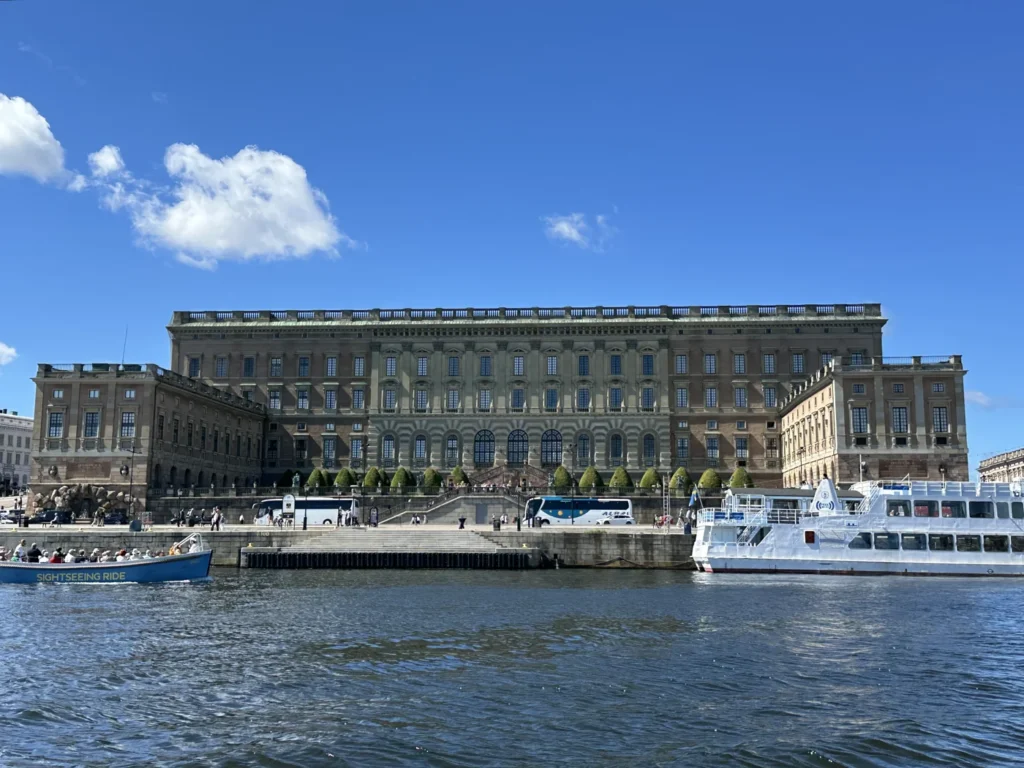
Featured photograph: Stockholm’s Royal Palace, photographed July 9, 2024. Photo by Ssu, Wikimedia Commons, CC BY-SA 4.0. Resized and converted to WebP; the photograph remains under that license. The palace provides context, not a comparison of monarchs’ political powers.
