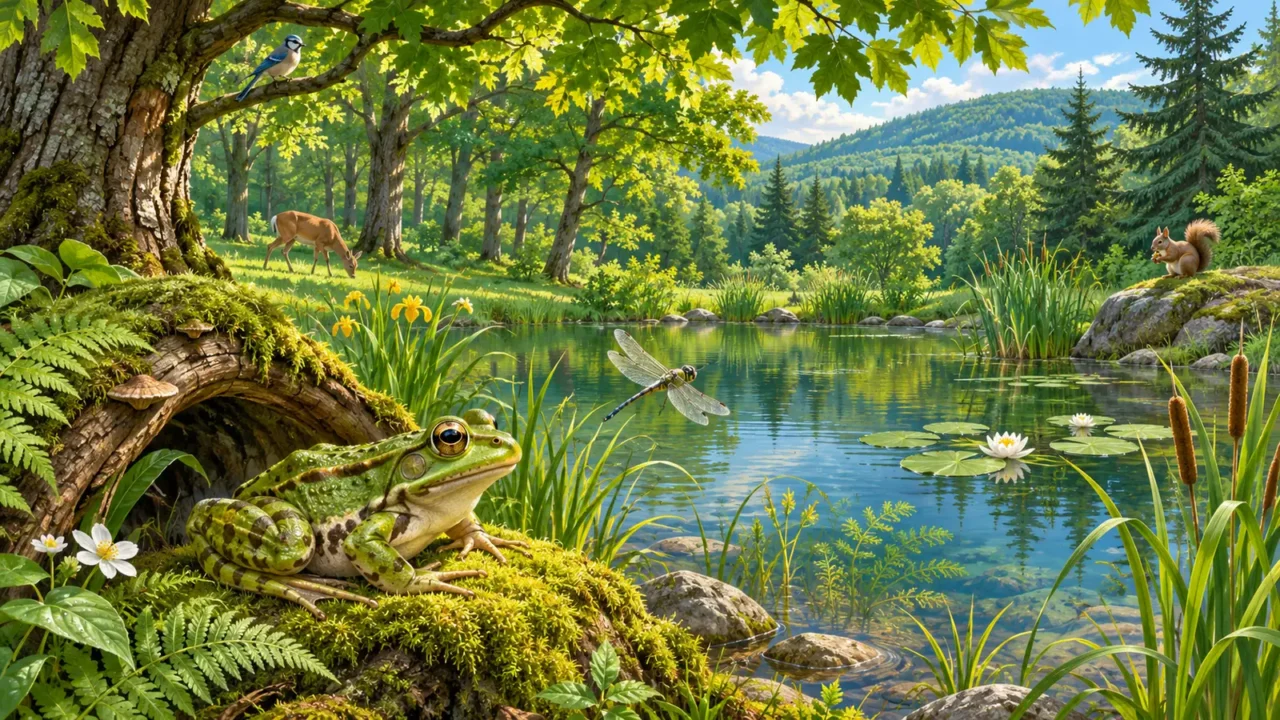
A forest can be part of a biome, function as an ecosystem and provide habitat. Those descriptions do not contradict one another: each answers a different question. The easiest way to separate the terms is to ask whether you are describing a broad pattern, a working system or a species’ living environment.
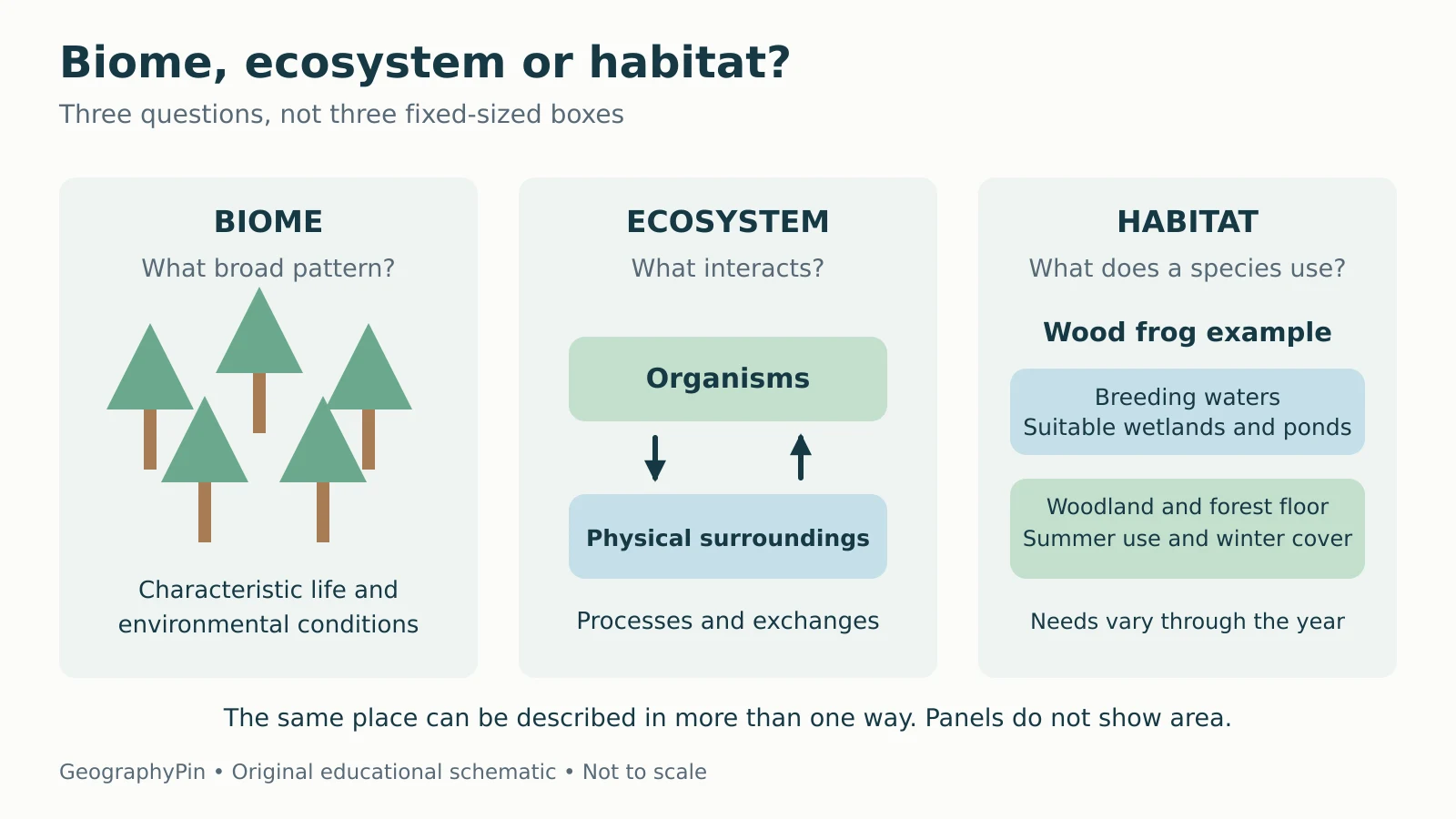
A biome is a broad ecological grouping associated with characteristic life and environmental conditions. An ecosystem includes organisms, their nonliving surroundings and the interactions among them. A habitat is the place or type of environment used by an organism or population. These concepts overlap, and they are not simply three boxes with fixed sizes.
How to use this article: You can compare the three questions, follow an ecosystem interaction, consider habitat through a species, or read ecological maps carefully.
Start With the Question, Not Just the Size
Pattern, interactions or a place to live?
The Smithsonian’s comparison distinguishes a large ecological region, a system of interacting living and nonliving components, and the place organisms live. That is a useful starting point.
| Term | Main question | Illustrative example |
|---|---|---|
| Biome | What broad ecological pattern does this landscape belong to? | A boreal-forest region |
| Ecosystem | How do organisms and the physical environment interact? | A pond, its organisms, water and nutrient exchanges |
| Habitat | Where and under what conditions does this organism live? | The breeding water and woodland used by a wood frog |
These examples are not exclusive labels. The pond can be studied as an ecosystem while also providing habitat for particular organisms. Its surrounding landscape may be classified within a terrestrial biome even though the pond itself is aquatic.
Instead of asking which label is the only correct one, state the purpose: “I am mapping broad vegetation patterns,” “I am studying nutrient movement,” or “I am identifying a species’ breeding habitat.”
A Biome Describes Broad Ecological Patterns
Biomes group large-scale similarities in living communities and environmental conditions. On land, climate and the structure of vegetation are especially useful: a forest, grassland and tundra present different patterns of plant growth.
Temperature, moisture and seasonality influence which plants can thrive. Local soils, drainage, disturbance and human activity also matter, so a biome label cannot tell you every condition at every point inside its mapped boundary.
The UCAR Center for Science Education describes how broad biome groups can be subdivided. A map with five broad categories and another with more detailed forest or grassland types may both be useful if their classification rules are stated.
There is no single universally agreed number of biomes. National Geographic’s explanation also notes that aquatic classifications use factors such as water depth, temperature and salinity. A terrestrial vegetation scheme should not be applied mechanically to the sea.
For a specific example, GeographyPin’s taiga guide explores the boreal-forest pattern. Its tundra–taiga comparison examines a landscape transition rather than defining the three concepts in this article.
An Ecosystem Includes Relationships and Processes
A list of species is only the beginning
The Convention on Biological Diversity defines an ecosystem through living communities and their nonliving environment interacting as a functional unit. Plants, animals and microorganisms are part of it, together with water, air, minerals and other physical conditions.
Imagine a fictional woodland pond. Sunlight supports photosynthesis; organisms feed and grow; dead material decomposes; nutrients move through water, sediments and living things. A useful ecosystem description follows these relationships rather than stopping at a list of frogs, insects and plants.
The pond is not sealed off from its surroundings. Leaves can enter from nearby trees, runoff can carry material into the water, and animals can move between water and land. Choosing a study boundary helps organize the question; it does not make exchanges across that boundary disappear.
Ecosystems also need not be pristine. The U.S. Environmental Protection Agency includes agricultural systems among its examples and explicitly includes humans among living organisms in ecological systems. Management changes the system, not whether interactions exist.
Habitat Depends on the Organism and Its Needs
One species can use more than one setting
Habitat directs attention to an organism or population. Suitable places offer the conditions and resources needed at a particular time or life stage. The same pond edge may be useful habitat for one species and unsuitable for another.
Wood frogs provide a concrete example. The Minnesota Department of Natural Resources describes breeding in wetlands and other suitable waters, summer use of woodland and forest, and overwintering in forest-floor leaf litter.
That means a breeding-water location alone does not describe every setting the frog uses throughout the year. It also shows why habitat should not automatically be drawn as a tiny circle permanently contained within one pond ecosystem.

Habitat is not the same as a niche. The National Park Service glossary distinguishes an organism’s place from its ecological way of life. Where it lives and how it uses resources are related questions, but not interchangeable ones.
Scale and Boundaries Depend on the Study
School diagrams often place habitat inside ecosystem inside biome. This can help introduce a local example, but it is not an absolute law about size.
The CBD’s ecosystem-approach explanation explicitly says an ecosystem can be analyzed at different scales, from a small functioning unit to an entire biome or biosphere. The important point is the interactions being studied.
Boundaries may also be gradual. An ecotone is a transition between ecological communities, ecosystems or biomes. A map line simplifies that transition; it does not necessarily mark a sharp change on the ground.
Before comparing two maps, check their rules
- Purpose: biome classification, ecosystem monitoring or species habitat?
- Definitions: what qualifies for each category?
- Scale: does the map show regional patterns or local detail?
- Date: current conditions, a past reference period or a projection?
- Scope: all habitat uses or only a season or life stage?
Test the Distinction With Three Descriptions
Try identifying the main focus in these statements before reading the answers:
- A map groups broad regions by vegetation and environmental conditions.
- A study follows how leaf material, microbes and water chemistry interact in a pond.
- A survey identifies breeding waters and forest-floor cover used by wood frogs.
The first is a biome-classification question, the second an ecosystem question and the third a habitat question. Each could connect to the others, but the immediate purpose differs.
Use that purpose test when reading an article or labeling a map. It is more reliable than deciding that the largest-looking place must always be the biome and the smallest must always be the habitat.
What Did We Learn Today?
Biome, ecosystem and habitat describe different aspects of living landscapes. Biomes organize broad ecological patterns; ecosystems emphasize organisms, physical conditions and their interactions; habitats identify the environments used by particular organisms. State the question, scale and classification rules, and avoid treating the terms as a rigid hierarchy of fixed-sized places.
Sources & Data Notes
Definitions vary among scientific and educational classification systems. This article uses the cited institutional explanations and makes no claim that one universal biome count or fixed spatial hierarchy exists. The woodland pond is an illustrative scenario, not a surveyed site; the wood-frog habitat example is grounded in Minnesota DNR guidance. The original diagram is conceptual, not a geographic map.
- Smithsonian Gardens: Biomes, Life in the Balance
- Convention on Biological Diversity: Article 2, Use of Terms
- Convention on Biological Diversity: Ecosystem Approach, Description
- U.S. EPA: Ecological Condition
- National Park Service: A Biodiversity Glossary
- UCAR Center for Science Education: Earth’s Changing Biomes
- National Geographic Society: What Makes a Biome?
- Minnesota Department of Natural Resources: Wood Frog