Abidjan rewards a visit built around its lagoon-side districts, contemporary art and forest, rather than a race between landmarks. For a first stay, choose two or three focused outings and leave the crossings between them to planned transport.
Plan Abidjan one district at a time
Give Abidjan two full days for a Plateau visit, a separate art or forest outing, and time for a meal rather than constant transfers. Choose your base around the districts you will revisit. Check current travel advice, arrange airport transport and treat lagoon crossings as journeys, not an all-city walking route.
How to use this article: Start with a shorter visit, compare where to stay, or go straight to the airport transfer.
1. Spend two days in a few districts, not all of Abidjan
For the lagoon setting and city–district distinction, see the Abidjan city profile.
Before booking: at the November 18, 2026 check, the U.S. advisory was Level 2, “Exercise increased caution,” issued February 18, 2026. Higher-risk northern areas have separate warnings. This city itinerary is not a safety guarantee; review the full advice for your nationality and any onward travel.
| Visit block | Main focus | Keep it realistic |
|---|---|---|
| First day: Plateau | Saint Paul’s Cathedral and the lagoon-side business district | A daylight outing with a meal break; add museum rooms only after confirming access |
| Second day: Cocody | A current contemporary-art exhibition | Confirm the gallery visit, then leave time for lunch rather than adding several districts |
| Nature alternative | Banco National Park | Replace the art outing with a separately arranged forest visit and return ride |
With one day, choose Plateau plus one interest
Keep the cathedral and nearby Plateau orientation as one block, then choose art in Cocody or a relaxed meal. Save Banco for a visit with enough time to arrange the entrance, route and return. On a flight day, choose one outing near your base.
2. Choose a base around your repeated journeys
Plateau, Cocody or the airport side?
Plateau: the business district suits a stay organized around central appointments and the cathedral. It is a practical starting point for the first-day plan, not a promise that every evening destination is within a comfortable walk. Compare the actual hotel entrance with your meeting points.
Cocody: consider it when art visits, hosts or appointments on this side of the lagoon shape the trip. The commune covers more than one small neighborhood: a hotel labeled “Cocody” is not necessarily beside the gallery. Use the exact address, not the district name alone, when comparing transfers.
Port-Bouët, near the airport: makes most sense for a late arrival, early departure or brief stopover. The trade-off is a separate journey to the Plateau and Cocody outings. For two nights of sightseeing, avoid changing hotels solely to shave a small part of one airport journey.
Before paying, check reception hours, the pickup location, security arrangements and any essential lift or bathroom access. A district name alone establishes neither accessibility nor security.
3. Make room for architecture, art and the forest
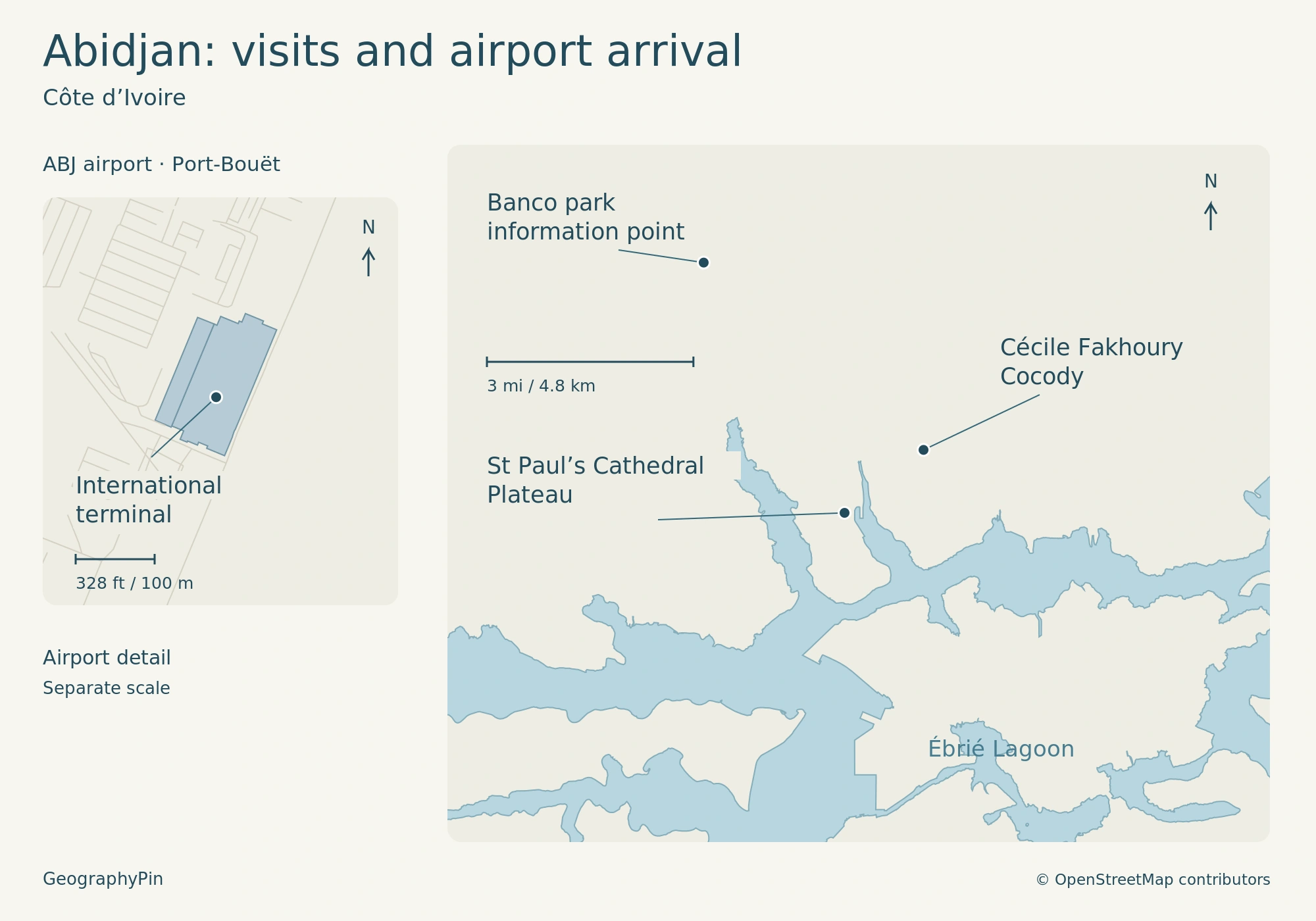
Saint Paul’s Cathedral, Plateau: the cathedral’s tilted form and large cross make it a distinctive architectural stop. The African Development Bank’s city guide identifies it among Abidjan’s principal landmarks. Plan around worship and ask before photographing inside; this is a functioning religious place, not an unrestricted viewing platform.
Contemporary art in Cocody: Galerie Cécile Fakhoury gives the second day a clear purpose beyond another skyline view. Its published Abidjan address is Boulevard Latrille, between Sodemi and Immeuble Carbone. Contact the gallery for visiting arrangements instead of transferring directory hours to your trip.
At the November check, the gallery listed Roméo Mivekannin’s Dieu n’est pas obligé for November 5, 2026–January 9, 2027. For later travel, use the current program rather than expecting that exhibition to remain in place.
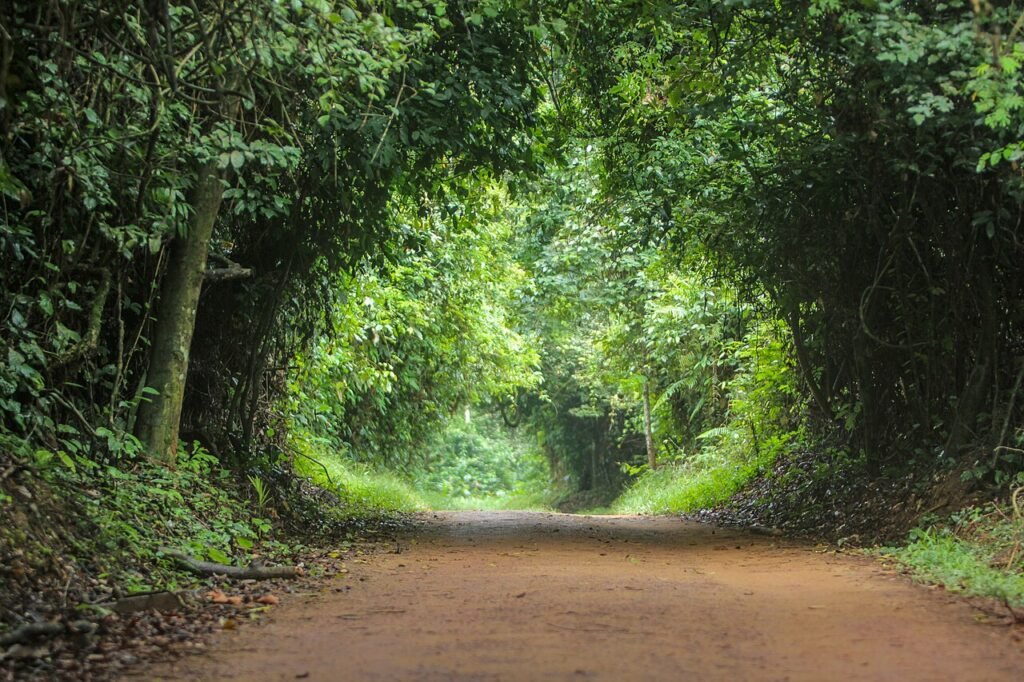
Banco National Park: choose it for the forest itself, not a promised wildlife sighting. OIPR describes an arboretum, forest tracks and environmental-education features within the urban setting. Arrange the visit through the park’s responsible southern-zone office: confirm the entrance, guide arrangements, current charges and a route suited to your group before traveling.
Musée des Civilisations: keep it conditional rather than making it the day’s anchor. UNESCO documents a rehabilitation project, but that project record does not establish which rooms are currently open to ordinary visitors. Confirm public access before adding it to the Plateau block.
Leave room for a meal, too. UNESCO describes attiéké as a steamed cassava dish and recognizes the production skills associated with it. Ask what accompanies the serving you order, and discuss any dietary restriction directly rather than assuming the side dish determines the whole meal.
4. Arrive with a transfer plan and cross the lagoon deliberately
Arrange the airport pickup before landing
Félix Houphouët-Boigny International Airport is in Port-Bouët. The official aeronautical publication lists taxis, hotel buses and rental cars among its passenger transport options. A hotel bus listing is not a universal free shuttle: confirm your own property’s service, price and meeting instructions.
Send the driver or hotel your flight details and exact destination, and agree how you will reconnect if the arrival changes. Keep the first evening simple. Immigration, baggage collection and the road transfer are separate parts of the journey, so a fixed airport-to-hotel time is a poor basis for a dinner reservation.
The UK’s security advice favors taxi apps or prearranged private taxis, advises against walking after dark and recommends avoiding public transport after dark. Arrange the ride home as deliberately as the outward trip; a pleasant afternoon stop does not solve the evening return.
STL’s lagoon services include stations at Plateau, Treichville, Abobodoumé, Azito, M’Pouto and Koumassi. A passenger crossing can add a water-level view, but use the actual station pair and operating information for that day. Confirm the return before boarding, especially when the boat is part of a sightseeing outing rather than a necessary commute.
STL also advertises leisure excursions separately from its commuter services. Do not assume a regular ticket buys a narrated cruise or a round trip. Ask about boarding steps, gaps and assistance if mobility needs affect your choice; this guide does not certify a step-free boat journey.
5. Check entry documents and health requirements before flying
Visa: check the rule for your passport, purpose and length of stay with the Ivorian authorities. For U.S. tourist travelers, the State Department says a visa is required and an airport e-visa must be requested before arrival. Do not generalize that nationality-specific advice into a rule for every visitor.
For travelers using SNEDAI’s e-visa process, submitting an application is not approval. The procedure calls for the approved pre-enrollment document and payment receipt to be printed before boarding, followed by biometric enrollment at Abidjan airport. Allow time for processing; do not treat the advertised turnaround as a guarantee.
Health paperwork: the CDC’s Côte d’Ivoire page lists a yellow-fever vaccination requirement for arriving travelers aged nine months or older. Discuss vaccination, malaria prevention and any medical contraindication with a travel-health clinician; ask the authorities how an individual exception would be handled rather than assuming a waiver ensures entry.
The UK entry page, updated November 9, 2026, also reports an online health declaration for travelers arriving from another African country, alongside Ebola-related screening. Check the linked official procedure for your itinerary close to departure. This is a changing arrival measure, not evidence of an outbreak in Abidjan.
6. Adapt the day to rain, access and evening transport
Heavy rain can change both the forest outing and road transfers. The FCDO warns of flooding and landslides during the rainy season. If conditions deteriorate, switch the outdoor block for a confirmed indoor visit rather than trying to preserve every stop. Never use a flooded road or path as a shortcut.
For Banco, ask about current ground conditions and choose footwear for the agreed route; an arboretum listing does not make every track accessible. For the city, arrange breaks near the places you are actually visiting. Cross-district transfers should not depend on finding a walkable bridge approach at the last minute.
Coastal scenery is not a swimming recommendation: the FCDO warns of strong currents and rip tides. Do not add an improvised swim to a coastal outing.
What Did We Learn Today?
A useful Abidjan visit groups interests into a few district-based outings. Plateau, a Cocody art visit and a separately arranged forest trip serve different purposes; they need not all fit into one day. Choose your base around repeated journeys, verify access before setting out and leave room for the meal, transfer and rest that make the plan workable.
Sources & Data Notes
View visitor, operator and entry sources
Checked November 18, 2026. The two-day plan and base comparisons are editorial suggestions, not surveyed walking routes or guaranteed journey times. Exhibition dates, health declarations, transport and public access can change. No museum reopening date, fixed airport fare, forest ticket price or step-free route is asserted.
- U.S. Department of State: advisory and U.S. traveler entry guidance
- FCDO: security, transport, rain and coastal risks
- FCDO: entry requirements and current health declaration
- SNEDAI: e-visa procedure
- CDC: Côte d’Ivoire traveler health
- African Development Bank: Abidjan visitor orientation
- OIPR: Banco National Park
- OIPR: responsible park offices
- Cécile Fakhoury: Abidjan address and gallery information
- Cécile Fakhoury: dated Roméo Mivekannin exhibition
- UNESCO: museum rehabilitation project
- ASECNA: Abidjan airport passenger facilities, effective October 29, 2026
- STL: passenger and leisure lagoon services
- UNESCO DataHub: attiéké production skills
Map: original GeographyPin cartography using © OpenStreetMap contributors, ODbL. Checked November 18, 2026; points do not establish public access, administrative boundaries or step-free journeys.
Featured photograph: Banco forest, HAMIEN NGORAN YANICK, 2019, Wikimedia Commons, CC BY-SA 4.0. Resized and cropped by the theme; not a claim about current track conditions.