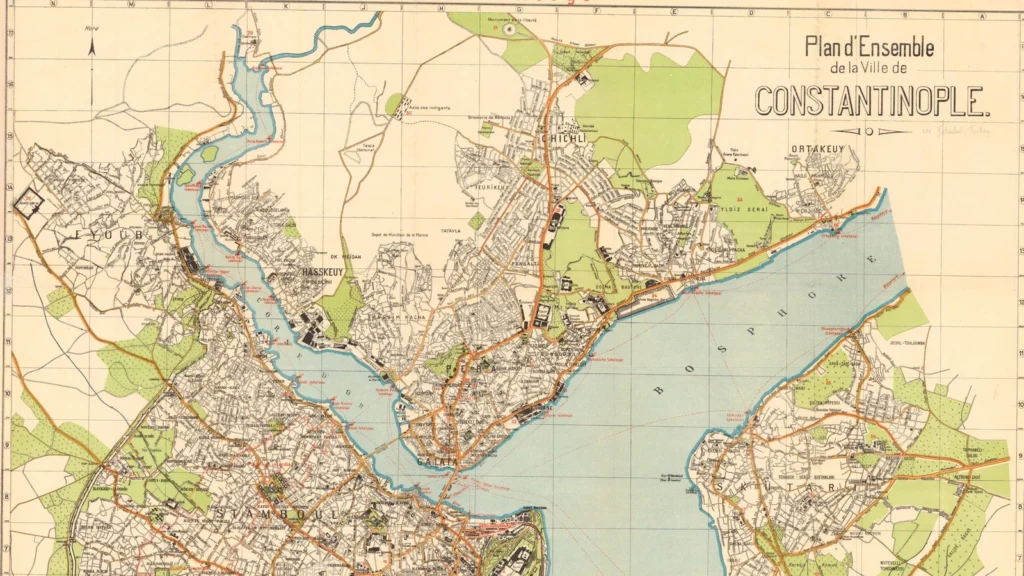
A French-language map from 1922 calls the city Constantinople and labels part of it Stamboul. Neither name is a mistake. They tell you who made the map, which language they were writing in and which part of the city they meant. The dates 1453 and 1930 tell different stories, too.
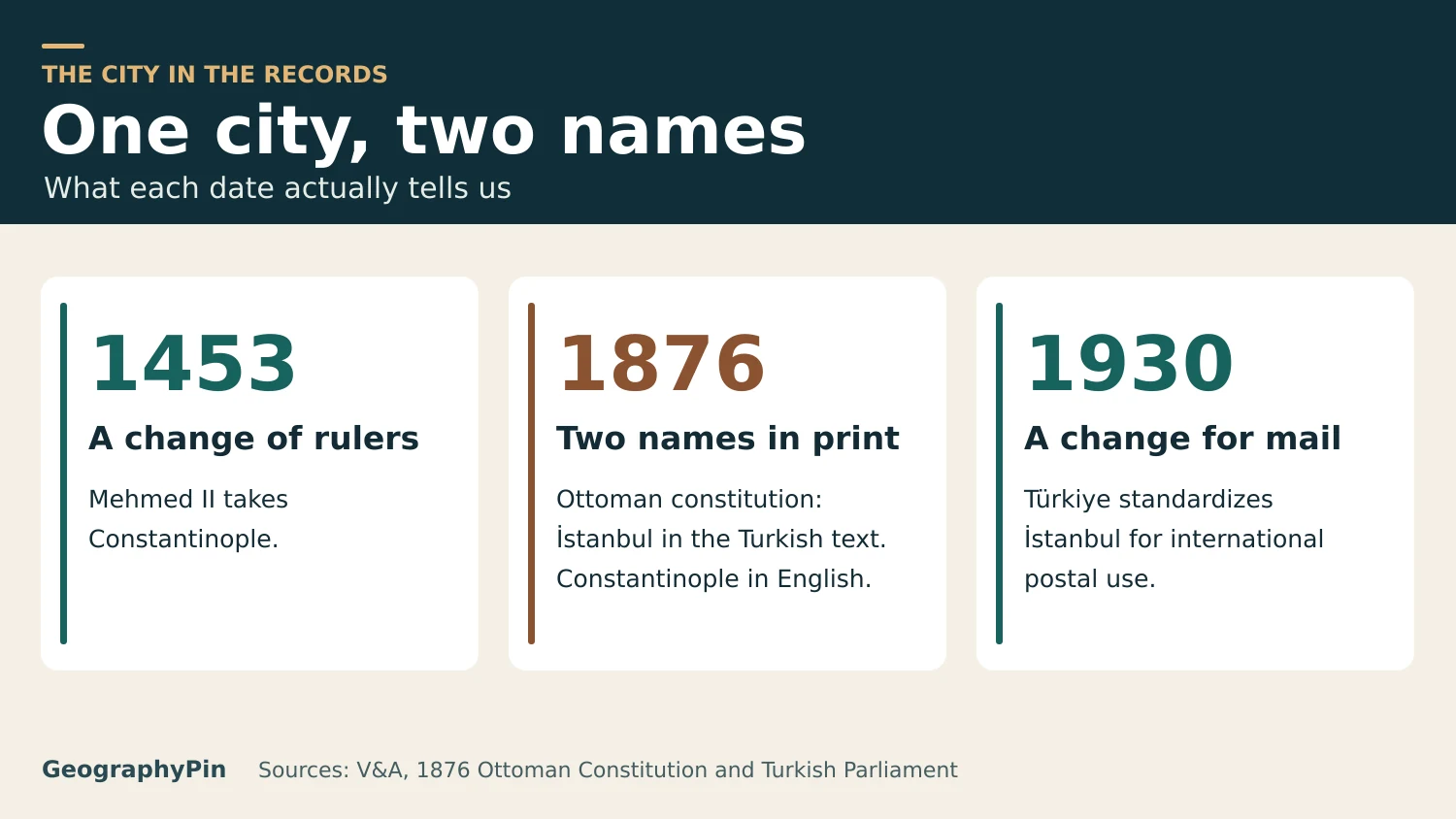
March 28, 1930, is the date Türkiye’s parliament associates with standardizing İstanbul for international mail. The name was already in official Ottoman use: the 1876 constitution names İstanbul as the capital. In 1453, the Ottomans conquered Constantinople. That date marks a change of rulers, not the point at which everyone changed the name.
How to use this article: Start with what changed in 1453, compare one constitutional clause in two languages, or see when U.S. telegrams switched names.
1. What changed in 1453
A conquest, not an overnight change of name
Sultan Mehmed II took Constantinople on May 29, 1453. The city stopped being the Byzantine capital and became the seat of the Ottoman Empire. Historians sometimes use Constantinople for the Byzantine period and Istanbul for the Ottoman period. That convention helps a reader follow the change of rule. It is not evidence that the people living there or the people writing about it switched names on the day of the conquest.

2. How both names survived
What Article 2 calls the Ottoman capital
Read Article 2 of the Ottoman constitution of December 1876 in Turkish (transcribed into modern letters), and the city named as the capital is İstanbul. Read the English translation included with a U.S. diplomatic dispatch of December 26, 1876, and the equivalent sentence reads: “Constantinople is the capital of the Ottoman Empire.” This is the same clause about the same capital. The translation uses the familiar English name rather than carrying the Turkish form over into English.
The constitution proves the name İstanbul was already used in an official Ottoman document. It does not tell us when the name first appeared, or mean that it had already replaced every other form. Türkiye’s parliament notes that Ottoman documents also used Konstantiniyye, an Ottoman Turkish form of Constantinople.
How a 1922 map used Constantinople and Stamboul
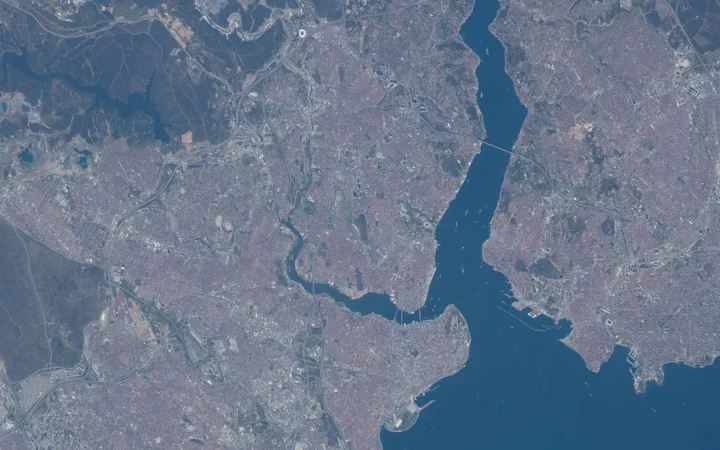
The full 1922 city plan shows how names could describe different areas. Its French title calls the whole mapped city Constantinople; its legend groups places on the Historic Peninsula under Stamboul, separately from Péra–Galata across the Golden Horn. In this particular map, Stamboul means the old city, not both sides of the Bosporus. Compare those locations on our modern map of Istanbul’s European and Asian sides.
3. Why 1930 is the date you usually see
By the time of the Turkish Republic, İstanbul was not a new name. The issue was what to call the city in international correspondence. A historical chronology published by Türkiye’s Grand National Assembly dates a notification to the international postal authorities in Bern to January 3, 1929. It identifies March 28, 1930, as the postal milestone and reports that letters addressed from abroad under the old name were returned. Postal standardization affected what senders had to write on the envelope; it did not establish the first use of the name.
One U.S. ambassador, two different datelines
Even overseas usage did not switch all at once. In the U.S. State Department’s published records, an October 2, 1929, telegram from Ambassador Joseph Grew carries the dateline Constantinople. A telegram from the same ambassador on March 18, 1930, appears under Istanbul, ten days before the postal date. Those two records do not establish the first use of Istanbul in English. They do show why you should not expect all foreign documents to change at the same time.
Frequently Asked Questions
What does the name Istanbul mean?
The Victoria and Albert Museum traces it to the Greek phrase eis tēn polin, meaning “to the city.” That explains the name’s linguistic roots, not the date it was adopted in official documents or abroad.
What was Constantinople called before Constantine?
It stood on the site of the ancient Greek city of Byzantion, often written Byzantium in English. Constantine made it his capital in 330 CE. The V&A distinguishes the name New Rome from Constantinople, the name by which the capital soon became known.
What Did We Learn Today?
Constantinople and Istanbul are names for the same city, but the dates are not interchangeable. The Ottoman conquest in 1453 changed who ruled it. The 1876 constitution shows İstanbul in official Ottoman use alongside an English translation that says Constantinople. The 1930 milestone is about the name the Turkish Republic wanted used on international mail.
Sources & Data Notes
Show sources and notes
- Victoria and Albert Museum: Constantinople to Istanbul, “A note on names” and “The end of Constantinople”: linguistic background, earlier names and the conquest date.
- Ottoman Constitution, original Ottoman Turkish facsimile, Düstur vol. 4; modern-script transcription of Article 2; and English translation enclosed in the 1876 dispatch, printed in American Journal of International Law, 1908, p. 367. A modern-script transcription is not a claim that the 1876 text was printed in the modern Turkish alphabet.
- Grand National Assembly of Türkiye: historical chronology, March 28 entry, printed p. 34: the Bern notification and the postal milestone. This is a retrospective account, not an assertion that 1930 was the name’s first use.
- U.S. Department of State, Foreign Relations of the United States: Ambassador Grew’s October 1929 telegram headed Constantinople and March 1930 telegram headed Istanbul. The comparison uses the published datelines.
- Cover image and map source: Plan d’ensemble de la ville de Constantinople, Société anonyme ottomane d’études et d’entreprises urbaines, 1922. Princeton Library scan via Wikimedia Commons, public domain; cropped for the cover. Timeline: GeographyPin.