A glass of tap water can start in the Mediterranean. But the system that supplies an Israeli farm with reclaimed water can start in a city sewer instead. Sorek I and Shafdan, two projects on Israel’s coastal plain, show why these stories are easy to mix up and why their pipes lead to different places.
Israel turns seawater into drinking water using reverse osmosis: pressure pushes water through membranes that leave most dissolved salt behind. The plant then adjusts the water’s chemistry before sending it into the supply network. Shafdan’s reclaimed wastewater follows a different route: it starts in sewers and goes to irrigate crops.
How to use this article: Follow the five steps from intake to water network, see how Shafdan uses the aquifer, or check what the national percentages actually measure.
What happens to seawater at Sorek I
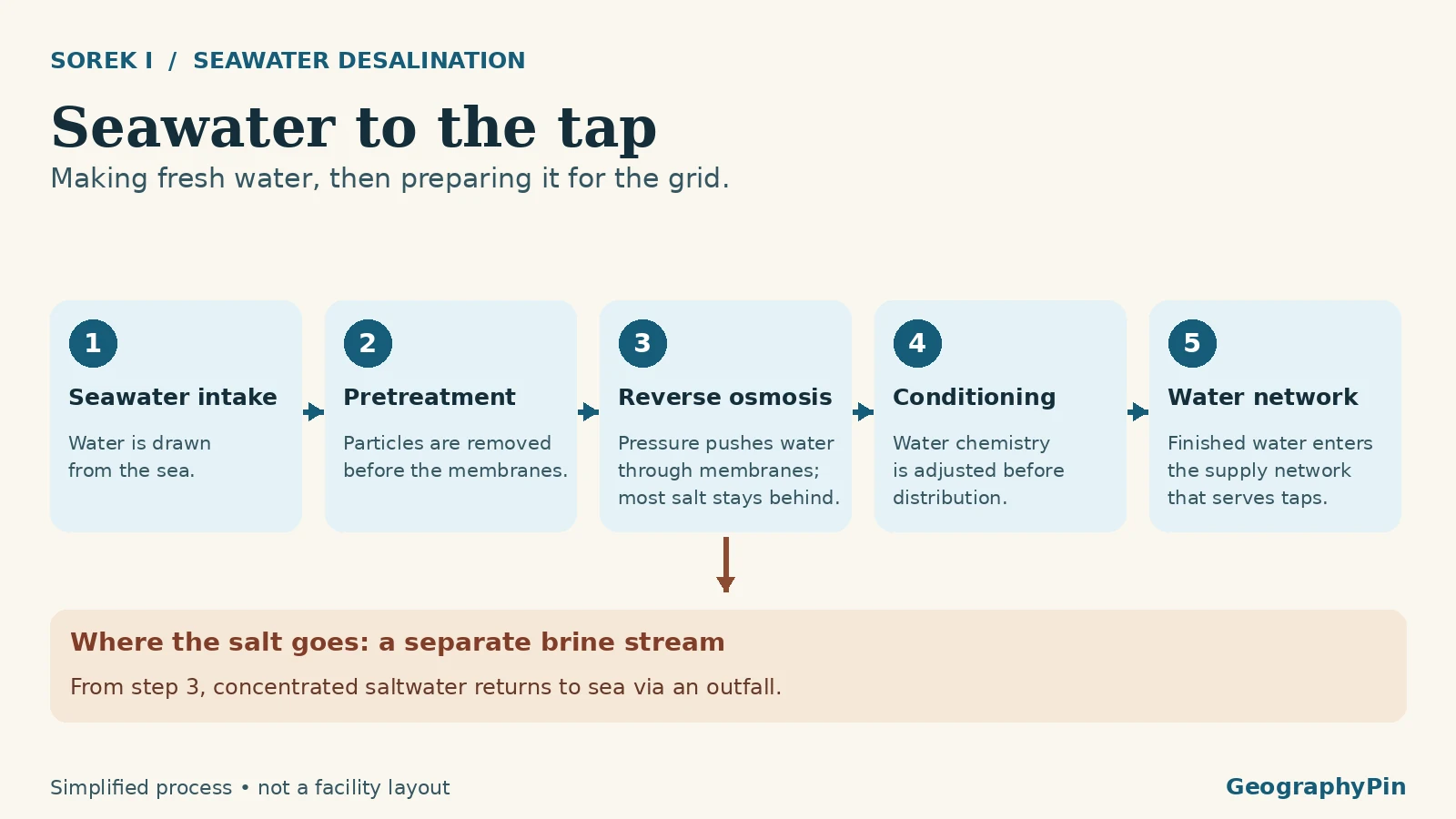
Sorek I, also called Sorek A, takes in water from the Mediterranean near Rishon LeZion. IDE lists 2013 as its commissioning year. The European Investment Bank’s original project documents specified annual production capacity of at least about 39.6 billion U.S. gallons (150 million cubic meters). That is an original capacity target, not a meter reading for a recent year. Israel’s 2025 report to the UN climate convention attributes 28.6% of the desalination it describes for 2022 to Sorek; that is a share for one historical year, not Sorek’s share of water coming out of every tap.
Five steps from intake to water network

- Intake: A pipe brings seawater to the plant. The salt at this point is dissolved in the water, so an ordinary screen will not remove it.
- Pretreatment: Filtration removes suspended material that would otherwise foul the membranes. Fouling is the buildup of material that makes it harder for water to pass.
- Reverse osmosis: Pumps put seawater under pressure. Water passes through selective membranes while most of the dissolved salts stay on the feed side. The plant ends up with a low-salt stream and a separate, saltier one.
- Conditioning: The low-salt water is treated further. Adjusting its mineral content and chemistry helps meet supply requirements and makes it more compatible with pipes.
- Distribution: The finished water enters the supply network, where it can mix with other supplies before reaching local mains. The distribution system, rather than a dedicated pipe from Sorek, connects the plant’s output to users.
Where the salt goes
Reverse osmosis separates salt; it does not destroy it. As fresh water crosses the membranes, the remaining liquid becomes more concentrated. This stream is called brine. At Sorek I, the project includes an outfall to discharge that stream into the Mediterranean. The branch in the diagram starts at the membrane, not at the city network.
That discharge is one of the trade-offs of making fresh water from the sea. Saltier water can affect conditions near the discharge point, and high-pressure pumping takes energy. The concentration and movement of the discharge, rather than its mere presence, are why the location and design of the outfall and environmental oversight matter.
How Shafdan sends used city water to farms
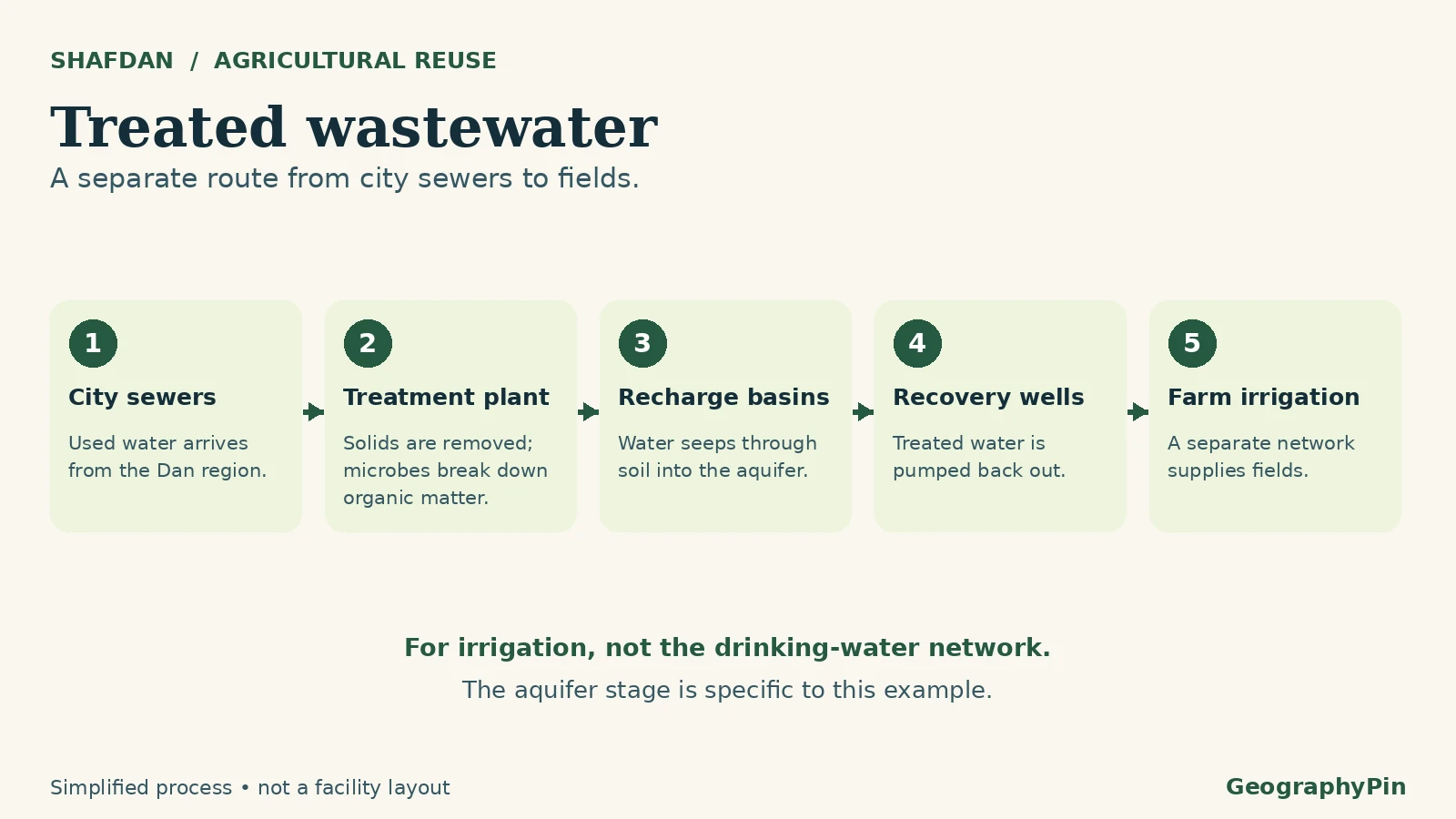
Shafdan starts with wastewater from the Tel Aviv metropolitan area, not seawater. A first treatment stage removes solids and uses microbes to break down organic matter. The treated water then moves to infiltration basins, where it can enter the ground gradually. This is not another stage of Sorek’s desalination process.
What the ground does between the plant and the farm

In soil-aquifer treatment, water moves through soil into an aquifer, a layer of permeable rock or sediment that holds groundwater. At Shafdan, that passage gives the already-treated wastewater further treatment before recovery wells pump it out. Mekorot’s Third Line carries reclaimed water south for irrigation in the Negev. Other reuse projects need not use exactly the same treatment sequence.
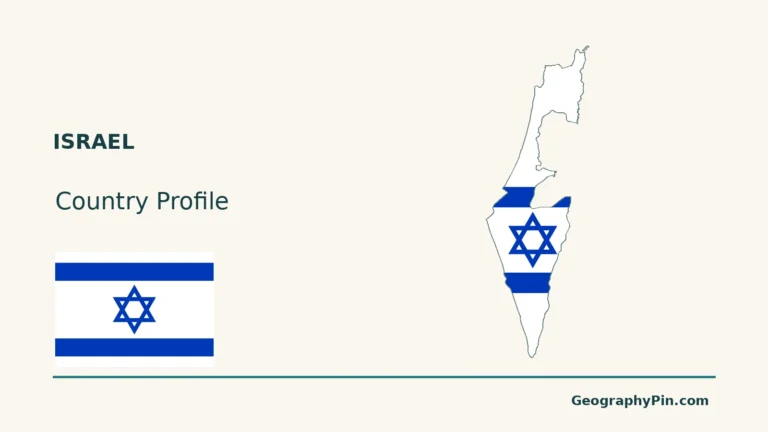
The two systems can help meet demand without delivering the same product. Using reclaimed water on fields can leave more fresh water available for other uses. To see why supply geography matters, compare the Mediterranean coast, the Negev and the freshwater sources described in the Israel country profile and the explainer on the Sea of Galilee.
What the 2024 water figures actually count
One percentage for production, another for farm use
About 21% of all recorded water production came from seawater desalination in the Central Bureau of Statistics’ 2024 production table. That is 560 out of 2,652 million cubic meters in the original units. The denominator includes water produced for uses other than household drinking. It is not the desalinated fraction of tap water.
About 52% of agricultural water use in the provisional 2024 table was in the Shafdan-water and other-effluent categories combined. The two rows add to 677 out of 1,313 million cubic meters of agricultural consumption. This measures how much water the agricultural sector used from those categories, not what fraction of Israel’s sewage was recycled.
Those two figures cannot be added: one describes where water production came from, and the other describes what farms consumed. Neither gives the percentage of desalinated water at a particular address.
Frequently Asked Questions
Does desalinated water go straight to the tap?
No. It is conditioned before entering the supply network. By the time it reaches a household, it may be mixed with water from other sources; national production totals do not tell you the mix at your tap.
Is Shafdan’s reclaimed wastewater the same product?
No. Shafdan’s recovered water in this example is supplied to agriculture through a separate network. The aquifer in that route is a further treatment step, not an indication that the water is being sent into household mains.
What Did We Learn Today?
The easiest way to tell the systems apart is to follow their pipes. Sorek begins at sea and makes water for the drinking-water network, with a separate outlet for brine. Shafdan begins with used city water and recovers it for irrigation. Once the routes are clear, it is easier to see why the share of water produced by desalination and the share of farm water supplied by reuse tell different stories.
Sources & Data Notes
Engineering, water statistics and illustration notes
The diagrams simplify flows and do not show facility layouts. The rounded national shares are calculated from CBS production and consumption rows respectively. Table 13’s 2024 figures are provisional. The two CBS calculations use each table’s original units so the numerators and denominators can be checked directly.
- European Investment Bank: Sorek desalination plant, original annual design objective and marine outfall.
- IDE Technologies: Sorek I, commissioning year and process; Battus Associates’ project record, treatment stages.
- Israel’s 2025 Biennial Transparency Report and National Communication, Sorek’s reported 2022 share.
- Ministry of Environmental Protection: desalination facilities policy, marine discharge and environmental oversight.
- Field study of soil-aquifer treatment, section 2.1, and Mekorot: Shafdan Wastewater Treatment Plant, delivery to the Negev.
- Central Bureau of Statistics, Agriculture in Israel, 2023–2024 (published June 2026), table 12 production rows and table 13 agricultural consumption.
- Cover and process diagrams: original GeographyPin illustrations.