A November afternoon in Queenstown gives you more daylight to work with than a March afternoon, but March is usually warmer at the airport. Neither fact tells you whether the Routeburn Track is safe that day. Keeping the same stops on both islands makes it easier to see what you gain by moving your trip from one month to the other.
Choose March if you want warmer typical afternoons on an Auckland and Queenstown trip. Choose November if longer days matter more: Queenstown gets about 2 hours 19 minutes more daylight on the sample November date. Both months fall within the published 2026–27 Routeburn Great Walks season. The track’s actual conditions still decide whether you walk.
How to use this article: Compare typical highs and rain at both stops, check how much daylight each month gives you, or see how to plan the same Routeburn day walk.
1. Keep the Stops, Change the Month
In New Zealand, November is late spring and March is early autumn. The calendar is the reverse of the one most U.S. visitors use for seasons. November is closer to the summer solstice, so it can offer more daylight even though March comes after summer and is warmer on average at these two stations.
Picture two or three days in Auckland for the harbor, neighborhoods and museums, then three days based in Queenstown. Hold one day for a walk from the Routeburn Shelter to the Flats Hut and back, and leave another day open so you can move the walk. The stops and activities do not change in the comparison; only the month does.
2. What the Auckland and Queenstown Numbers Actually Show
March is warmer at both airport stations
A climate normal is a reference average, not a forecast. The NIWA tables average measurements available within the 1991–2020 period. The temperature column is the average of daily highs; it is not the hottest reading or the temperature during an entire day. Rainfall adds up the typical month, not the chance a particular afternoon will be wet.
| Station and month | Average daily high | Mean monthly rain |
|---|---|---|
| Auckland Aero (agent 1962) · November | 67°F (19.6°C) | 2.7 in (68.9 mm) |
| Auckland Aero (agent 1962) · March | 73°F (22.9°C) | 3.0 in (75.0 mm) |
| Queenstown Aero AWS (agent 5451) · November | 64°F (17.5°C) | 2.4 in (60.7 mm) |
| Queenstown Aero AWS (agent 5451) · March | 66°F (19.1°C) | 1.9 in (49.3 mm) |
March was a little wetter in the Auckland averages and drier at Queenstown. That is a reason not to call either month the dry choice for both islands. In Queenstown the temperature difference is modest. Do not carry the airport’s rainfall or temperature up the mountain to the Routeburn; the stations answer a question about the two bases, not the track.
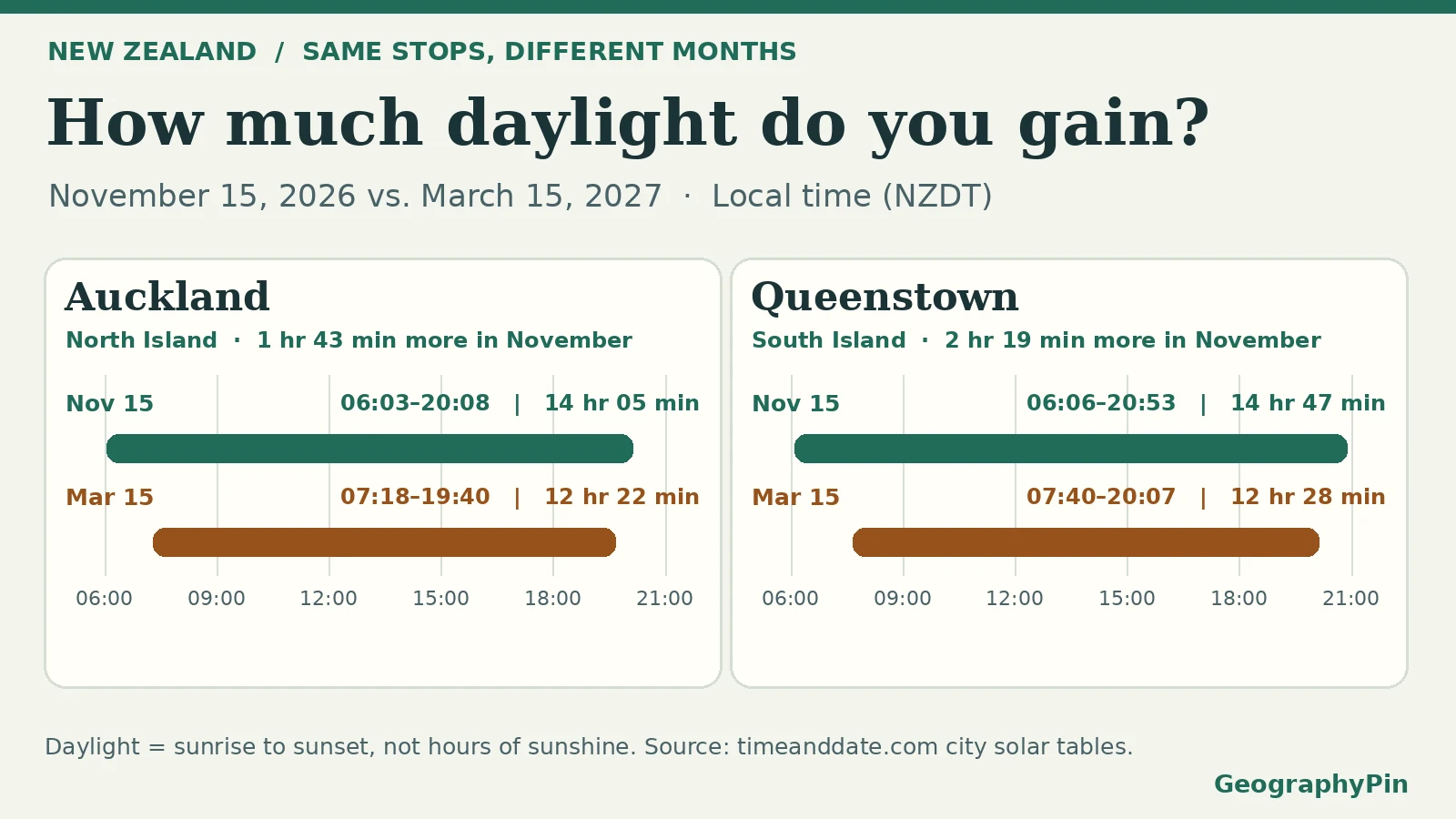
More November daylight means an earlier sunrise as well as a later sunset
At Auckland, the November 15 example gives about 14 hours 5 minutes between sunrise and sunset, versus 12 hours 22 minutes on March 15. At Queenstown it is about 14 hours 47 minutes versus 12 hours 28 minutes. There is about 46 minutes more evening daylight in Queenstown on the November date, with the rest of the 2-hour-19-minute difference coming in the morning.

3. The Same Routeburn Day Walk in Both Months
Walk to Routeburn Flats Hut and return to the same trailhead
Start on the Glenorchy side at Routeburn Shelter, not at The Divide near Te Anau. The Department of Conservation (DOC) lists 4.7 miles (7.5 km) one way and 1½–2½ hours to Routeburn Flats Hut. Turning around there makes it roughly 9.3 miles (15 km) out and back. Allow a rough 3–5 hours of walking as a starting estimate, plus stops and a margin for conditions. DOC’s quoted time is for the outward leg; your return may take a different amount of time.
DOC lists November 1, 2026 to April 30, 2027 as the Routeburn’s Great Walks season, covering both examples. The in-season huts provide services and have rangers in residence. The published booking requirement is for hut and campsite stays, not for the day-walk example. Those dates are an operating season, not an assurance that any specific part of the track or access road will be available and safe.
Check DOC’s Routeburn information and the mountain weather guidance before going. Use local advice and leave enough light for the whole return, not just the route to the hut. If conditions do not suit the longer walk, the Routeburn Nature Walk is a shorter option from the same trailhead if its access and conditions are suitable.
DOC seasonal information checked November 27, 2026. Confirm the dates again if you are booking for a later season.
4. Which Month Fits Your Trip?
- City first: March. Auckland has a warmer typical afternoon, and indoor stops leave room to adjust if it rains. Queenstown still has more than 12 hours of daylight on the mid-March example.
- Walking and long outdoor days first: November. Pick it if more usable daylight matters to you, especially for an earlier start or a slower afternoon back. Keep a weather backup in either month. Longer daylight is not a promise of a better trail day.
- Flexible two-island trip: choose the better dates and keep a spare day. Both months support the same basic itinerary. A spare day in Queenstown lets you move the track outing to a more suitable window; it is more useful than treating a small airport average as a guarantee.
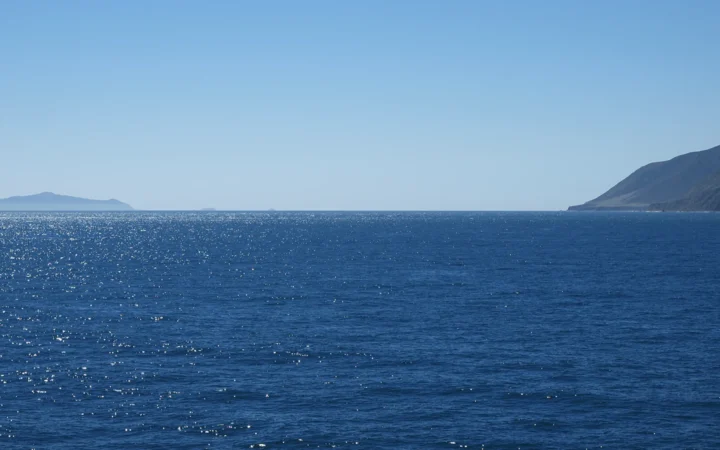
The comparison is specific to the two chosen bases. Lake Wānaka’s setting offers useful South Island context if you change the stops, but it is not a substitute for the Routeburn forecast. The Cook Strait map shows how the two main islands fit together if you are building a longer route.
Frequently Asked Questions
Does the daylight-saving change explain the March difference?
No. Both sample dates use New Zealand daylight time (UTC+13). A clock change can move the displayed time of sunrise and sunset, but it does not change the number of minutes between them.
Can I use the average monthly rain to decide which day to hike?
No. A monthly total does not show when rain will fall or how heavy it will be on the track. Check mountain forecasts and track conditions for your specific date.
What Did We Learn Today?
November buys daylight; March buys milder typical afternoons at the two bases. Neither picks the walking day for you. Compare the stations for the trip, the daylight for your schedule and the mountain conditions for the actual decision to start.
Sources & Data Notes
Airport normals, daylight tables, DOC and photo source
Both climate metrics use Auckland Aero (agent 1962) and Queenstown Aero AWS (agent 5451). The NIWA sheets use available complete years in 1991–2020, with at least five needed for inclusion; they do not give a station-specific completeness count. Fahrenheit is rounded to a whole degree, rainfall in inches to one decimal. Daylength is rounded from the published timeanddate.com durations; subtracting two rounded clock times may differ by a minute. The city horizon model is not a trail forecast.
- Earth Sciences New Zealand / NIWA climate downloads: average daily maximum temperatures and mean monthly rainfall, both with station metadata; Stats NZ: New Zealand’s meteorological seasons.
- timeanddate.com: Auckland November 2026, Auckland March 2027, Queenstown November 2026 and Queenstown March 2027.
- Department of Conservation: Routeburn Walk description and season; Routeburn Flats Hut day-walk segment.
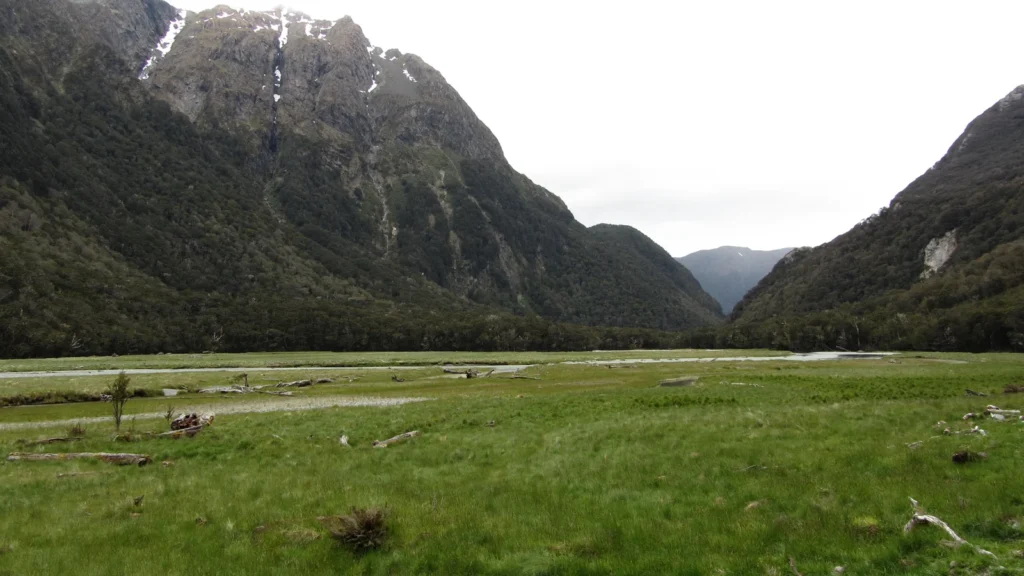
- Cover: Grassy flat along the Routeburn Track, Akos Kokai, December 2011, cropped and resized, CC BY 2.0. The photo is not a comparison-day observation. Chart by GeographyPin.