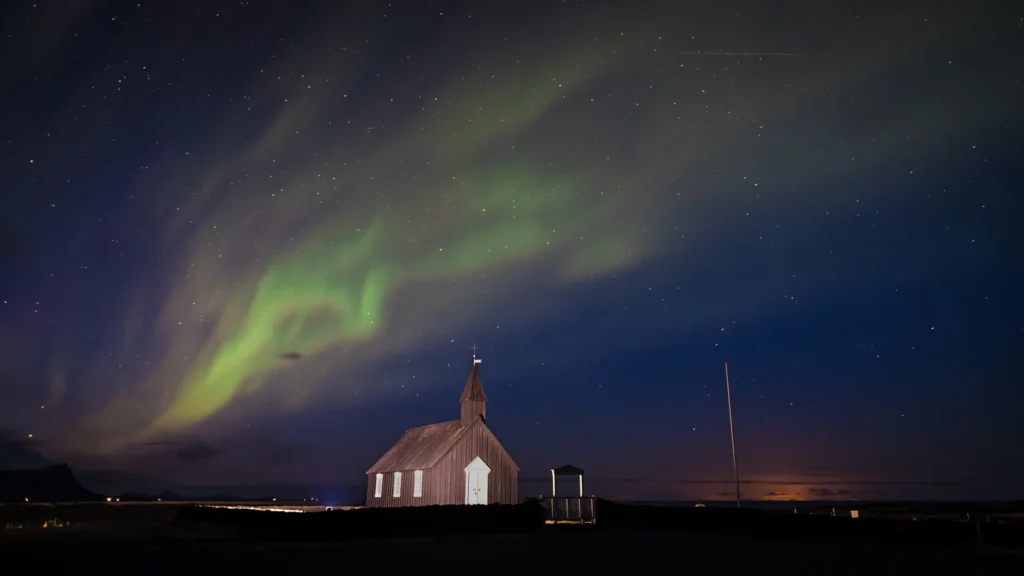
December gives you a long night in Iceland, but an overcast December evening is no better for seeing the northern lights than a clear summer sky that never gets dark. For a trip, choose a month with dark evenings. Once you arrive, look for darkness and a break in the clouds at the same time.
The best time to see the northern lights in Iceland is generally September through April. December and January give you the longest nights; late September and March leave more daylight for sightseeing. During your trip, look for a safely reachable spot with a dark sky and little cloud. A high activity forecast cannot make a cloudy sky clear.
How to use this article: Compare dark hours in September, December and March, see how to read two cloud layers for one night, or decide when to wait, stay close or go out.
1. Choose a Month for Your Trip
For a first trip that isn’t only about the aurora, start with late September or March. Both give you genuinely dark hours as well as a longer day for seeing the rest of Iceland. December and January make more sense if you want a long stretch of darkness and don’t mind shorter sightseeing days. That is a choice about how to spend the trip, not a claim that one month has a higher probability of clear skies.
If the lights are a priority, leave more than one evening open. A fixed one-night outing can coincide with a cloud bank; a flexible itinerary lets you use the first promising window instead of counting on your last night. From May through much of August, bright nights make the aurora a poor reason to choose those dates.
2. How Dark Does Reykjavík Get?
Three nights measured by the same twilight rule
Sunset is when the Sun disappears, not when the remaining light disappears. For a consistent trip comparison, the table counts astronomical darkness, when the center of the Sun is at least 18° below the horizon. It’s a useful planning yardstick for faint displays, not a rule that makes a bright aurora impossible during twilight.
| Night starting | Sunset | Astronomical darkness | Dark hours |
|---|---|---|---|
| September 21, 2026 | 7:35 p.m. | 10:30 p.m.–4:10 a.m. | About 5 hr 40 min |
| December 21, 2026 | 3:30 p.m. | 7:00 p.m.–7:55 a.m. | About 12 hr 55 min |
| March 21, 2026 | 7:45 p.m. | 10:35 p.m.–4:35 a.m. | About 6 hr |
On the December example, more than three hours separate sunset from full astronomical darkness, but the darkest part of the night still starts well before midnight. The September and March dates leave less room for an early evening outing. The morning time is on the following day. These are Reykjavík estimates, not island-wide hours or predictions of visibility. See how twilight changes with latitude and season for the broader comparison.
3. Read the Cloud and Aurora Forecast Together
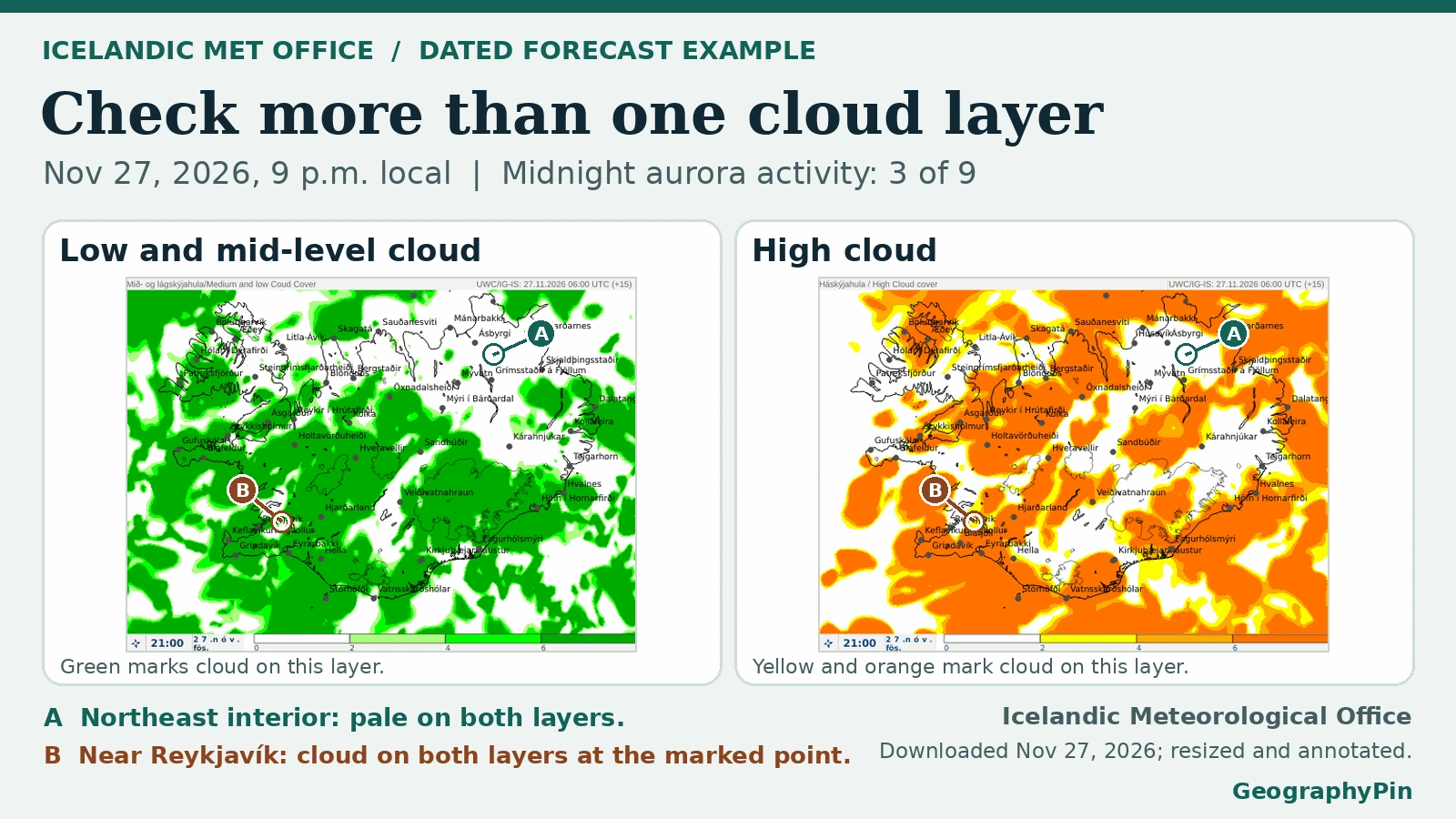
A real November forecast, read one layer at a time
Open the Icelandic Met Office aurora forecast, select your date, then move the cloud map to the local hour when you plan to go outside. Compare the low and mid-level map with the high-cloud map for the same hour. The maps use different cloud colors, so read the legend for the layer you’re on.

- Cloud cover at 9 p.m.: The marked patch in the northeast interior (A) is pale on both maps. The marked location near Reykjavík (B) shows cloud on both layers. The northeast patch was a better sky candidate at that hour, not a recommendation to drive there.
- Darkness: The Met Office box listed sunset at 3:57 p.m. and the start of its Reykjavík darkness window at 5:03 p.m. The 9 p.m. cloud snapshot was well after both. The Met Office’s darkness line and the table’s strict 18° cutoff are not interchangeable.
- Activity: The date’s activity estimate was 3 of 9, which the office calls moderate. Its activity rating is for midnight, not specifically for the 9 p.m. cloud map. That rating describes the potential for auroral activity. Our guide to what causes the northern lights explains why the atmosphere glows. Whether you could see it from Reykjavík that night also depended on the clouds.
4. Decide Whether to Go Out or Wait
Start with a clear patch you can reach safely
If there’s a clear patch near you at a dark hour, try an open view away from direct lights, with safe access and designated parking. If clouds cover your location now but a break is forecast later, check again closer to the hour. If the nearest clearing is far away or requires a risky drive, stay put and try another night. Check SafeTravel and the Icelandic Road and Coastal Administration’s road conditions and closures before setting out. A clear patch on a cloud map does not tell you how safe the roads are beneath it.
Frequently Asked Questions
Can I see the northern lights on a low-activity night?
Yes. The Icelandic Met Office says its grade 2 can still produce a visible display. A dark, mostly clear sky gives you a better chance of seeing a faint aurora than waiting for a bigger number under solid cloud. Neither condition guarantees a sighting.
Do I need to avoid the full Moon?
Not necessarily. Moonlight can make a faint display harder to distinguish, but it need not rule out a clear night. Use the Moon information on the forecast to see whether it will actually be up during your viewing window.
Can I try from Reykjavík without renting a car?
Yes. Start by checking the sky over the city, then choose an accessible spot away from lamps with a clear view. Visit Iceland suggests Öskjuhlíð as a place where trees and terrain can screen streetlights. Don’t leave the city simply because the activity number is high.
What Did We Learn Today?
Choose your travel month for the amount of darkness and daylight you want. Choose the night itself by comparing cloud layers at the hour you plan to go out, then check activity and road conditions separately. A nearby break in the clouds is more useful than a higher number you can’t see through.
Sources & Data Notes
Forecast, darkness calculation and image credits
The Reykjavík calculation uses a representative point at 64.13°N, 21.94°W, NOAA’s approximate solar-position equations, a geometric horizon and the U.S. Naval Observatory’s 18° astronomical twilight threshold. Sunset uses the standard apparent upper-limb convention. Boundaries are rounded to the nearest five minutes; lengths are approximate from the same intervals. Terrain, clouds, moonlight and artificial light aren’t part of the calculation. The November forecast is from the November 27, 2026, 06:00 UTC run, 21:00 valid time, and was downloaded November 27, 2026. Original model coloring, place labels and data were retained; marked callouts and panel labels were added.
- Icelandic Meteorological Office: live cloud and aurora forecast, reading the time and activity, and data-reuse terms.
- NOAA solar-position equations and NOAA Reykjavík observing-point coordinates; U.S. Naval Observatory twilight and sunset definitions.
- Visit Iceland: dark-sky season and local observing advice; ICE-SAR SafeTravel alerts; Icelandic Road and Coastal Administration traffic map.
- Cover: northern lights over Búðir, Giuseppe Milo, April 23, 2017, CC BY 2.0, resized. It does not depict the dated forecast.