A longer Alaska day does not always give you more daylight in port. The ship may arrive well after sunrise and depart before sunset. Comparing three sailings on the same Inside Passage route shows why the month matters more in Juneau than it does in Ketchikan.
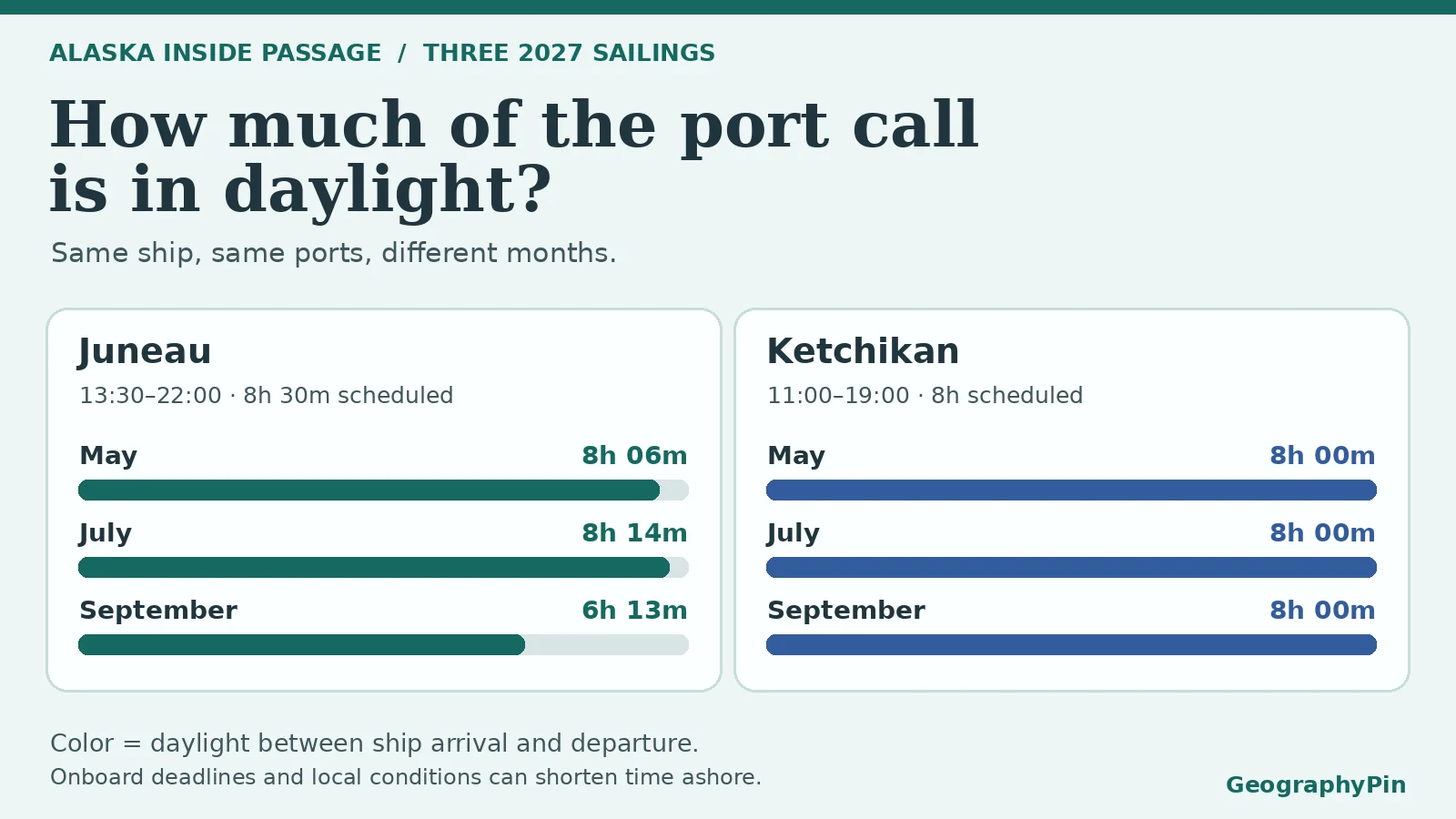
For this Inside Passage itinerary, July gives the most daylight during the Juneau call, but May trails by just eight minutes and has lower average precipitation there. Early September loses about two hours of Juneau daylight compared with July. In Ketchikan, the full eight-hour scheduled call is in daylight on all three dates.
How to use this article: Start with which month fits your plans, check the Juneau daylight calculation, or see when the route matters more than the date.
1. Choose the Month by What You Want to Do
Choose around the port where you need daylight
- May: A good fit for Juneau if you want almost the same daylight as July with a lower monthly precipitation normal. Plan an afternoon outing rather than expecting to use the long morning before the ship arrives.
- July: The best of the three for the latest Juneau sunset, but the gain over May is only eight minutes during this actual call. Ketchikan’s July precipitation normal is the lowest of the three months compared.
- Early September: The Ketchikan call still fits between sunrise and sunset, but the Juneau evening is substantially shorter. Put the outing that needs daylight first and keep a weather option for either port.
If the choice is May versus July and your one priority is daytime in Juneau, the schedules give almost no daylight reason to prefer July. If you are choosing between July and September, the same afternoon arrival in Juneau makes the date more consequential.
2. Three Sailings on the Same Route
The comparison uses Holland America’s Koningsdam on three seven-night round trips from Vancouver. All three examples call at Juneau, Skagway and Ketchikan. The route also lists scenic cruising at Tracy Arm and Glacier Bay; those are not treated as time ashore. Holding the ship and ports fixed avoids passing off a change in itinerary as a seasonal effect.
| Sailing | Juneau call | Ketchikan call |
|---|---|---|
| May 22–29 (K731) | May 24, 13:30–22:00 | May 27, 11:00–19:00 |
| July 17–24 (K747) | July 19, 13:30–22:00 | July 22, 11:00–19:00 |
| September 4–11 (K762) | September 6, 13:30–22:00 | September 9, 11:00–19:00 |
The port times are the published windows from Cruise Line Agencies of Alaska, checked November 27, 2026. Times in the table and chart are local to the Alaska ports: Alaska Daylight Time (AKDT, UTC−08:00). Vancouver departure and return dates are local Canadian dates. Operator itineraries and the all-aboard time can change, so match your booking to the current ship schedule.
3. Daylight and Precipitation by Port
Juneau: subtract the hours before arrival and after sunset
On July 19, calculated sunrise and sunset in Juneau are about 04:23 and 21:44. The ship arrives at 13:30 and is scheduled out at 22:00. Start at the later of sunrise and arrival, then end at the earlier of sunset and departure. The overlap is 13:30 to 21:44, or 8 hours 14 minutes. In September the same arrival meets a 19:43 sunset, so the result is 6 hours 13 minutes.

| Port and call date | Sunrise–sunset (AKDT) | Daylight during call | 1991–2020 mean precipitation |
|---|---|---|---|
| Juneau, May 24 | 04:14–21:36 | 8 h 06 min | 3.51 in (89 mm) |
| Juneau, July 19 | 04:23–21:44 | 8 h 14 min | 5.14 in (131 mm) |
| Juneau, September 6 | 06:08–19:43 | 6 h 13 min | 9.15 in (232 mm) |
| Ketchikan, May 27 | 04:19–21:10 | 8 h 00 min | 8.68 in (220 mm) |
| Ketchikan, July 22 | 04:37–21:08 | 8 h 00 min | 7.33 in (186 mm) |
| Ketchikan, September 9 | 06:07–19:19 | 8 h 00 min | 14.30 in (363 mm) |
Table downloads (2)
- Same Vancouver round trip, three 2027 departures (4 × 3)View tableDownload CSV
- Calculated port-call daylight and average monthly precipitation (7 × 4)View tableDownload CSV
Juneau International Airport is station USW00025309; Ketchikan International Airport is station USW00025325. These NOAA figures average entire months over 1991–2020. They are not rainfall predictions for those port days, and conditions at a dock, glacier or upland trail may differ from conditions at the airport.
4. When a Different Route Is the Better Choice
Decide whether you want port time, glaciers or inland Alaska
If the priority is a late outdoor stop in Juneau, first look for a sailing with a port call that covers the hours you want. A different ship may dock earlier or leave sooner. For Ketchikan, on this schedule the issue is more likely to be weather or the actual all-aboard deadline than sunset.
Glacier Bay is not another walk-off port. The National Park Service says large cruise ships do not dock there, and not every Alaska itinerary enters the park. If watching glaciers is the priority, check which scenic day the line actually lists; our Glacier Bay map and tidewater glacier guide shows what is inside the inlets. The Vancouver round trip does not include a stay in interior Alaska. Compare one-way cruises and separate land trips if you want time inland.
Frequently Asked Questions
Does sunset mean it is immediately dark?
No. Twilight continues after sunset. The comparison ends at sunset to keep the definition the same for every port and date. Local hills, weather and the activity itself matter more than a calculated twilight allowance.
Why not count the entire scheduled call as time ashore?
The arrival time is not necessarily when the gangway opens, and the ship can require passengers back before departure. For a particular excursion, work from the first allowed disembarkation and the ship’s published all-aboard deadline rather than the berth window alone.
What Did We Learn Today?
Once the ship, route and schedule stay fixed, the month matters most where the call runs into the evening. Juneau loses useful daylight in September, while daylight covers the full Ketchikan window in all three examples. Compare the hours that overlap your plans, then use the climate normals for context rather than as a forecast.
Sources & Data Notes
Ship schedules, solar calculations, station normals and photo credit
Route and berth schedules were checked November 27, 2026. Sunrise and sunset are rounded to the nearest minute using NOAA’s solar calculation at city coordinates (Juneau 58.3019° N, 134.4197° W; Ketchikan 55.3422° N, 131.6461° W). We use a standard horizon, not twilight, mountain shadows, cloud cover or disembarkation time. Some retail listings show a later Juneau departure; 22:00 is from the port schedule. A later departure would not change these daylight overlaps.
- Holland America Line: 2027 Koningsdam sailings from Vancouver on May 22 (K731), July 17 (K747), September 4 (K762). See also the 2027 Alaska planner and routes.
- Cruise Line Agencies of Alaska: Juneau port calendar and Ketchikan port calendar.
- NOAA: solar methods, Juneau station normals, and Ketchikan station normals.
- National Park Service: Glacier Bay by cruise ship.
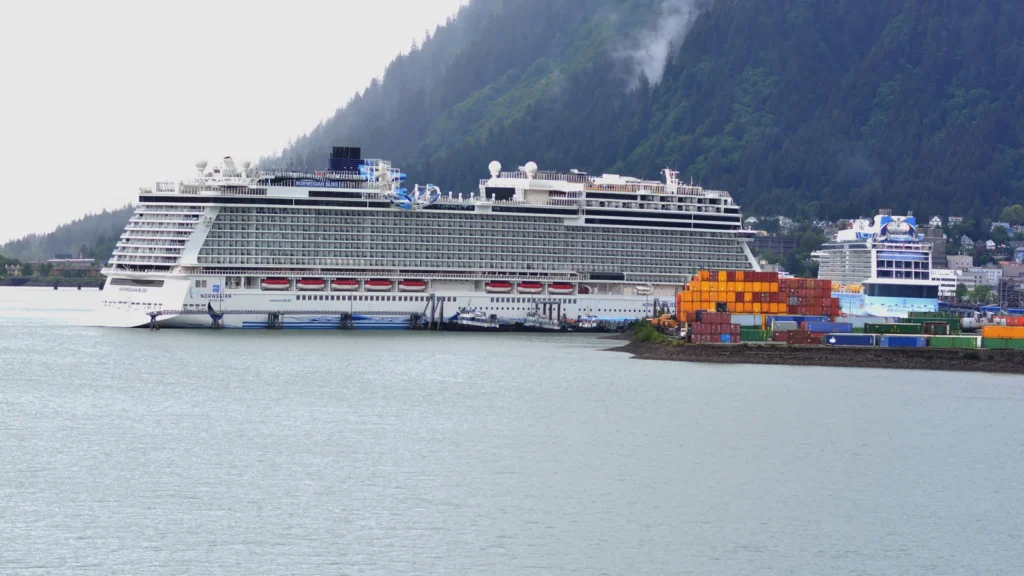
- Cover: Juneau cruise ship port by Joe Mabel, August 2023, cropped under CC BY-SA 4.0. The photograph illustrates the port, not one of the voyages compared. Chart by GeographyPin.