In one household, the presents are already being opened on December 5. In another, children go to bed that evening with a shoe by the fireplace. Both are celebrating Sinterklaas. The two dates tell you when different parts of the celebration happen.
Saint Nicholas Day is December 6. In the Netherlands, many families open Sinterklaas presents on December 5, a gift evening called pakjesavond. In Flanders, in northern Belgium, children often leave out a shoe on December 5 and discover their gifts the next morning. Public arrival parades usually happen earlier.
How to use this article: Separate the November arrival from the December celebration, then follow a Dutch family’s gift evening and a Flemish family’s overnight shoe tradition.
From the arrival parade to December 6
Sinterklaas is the Dutch name for Saint Nicholas and the name used for the celebration around his feast. The timeline compares common traditions in the European Netherlands and in Flanders, the Dutch-speaking region of northern Belgium. It describes customs, not rules every household follows.
Netherlands
Dec. 5 · Evening: Families commonly exchange and open presents at pakjesavond. A gift can come with a poem.
Dec. 6 · Morning: It is Saint Nicholas Day, but the main gift exchange for families who held pakjesavond has already happened.
Flanders, northern Belgium
Dec. 5 · Evening: Children may leave a shoe, a note or a drawing before bed.
Dec. 6 · Morning: Children look for the sweets or presents left during the night.
The arrival parade comes before gift night
An intocht is a public welcome, not the feast itself. In 2026, the Dutch national arrival took place on November 14 in Grave. The municipality recorded a steamboat landing on the Maas River followed by a procession into town. The Flemish heritage inventory describes local arrivals by ship, train, carriage or horse. The mode of arrival depends on the town; the parade date does not tell you when families open presents.
Two homes, two ways of giving
A Dutch gift evening with poems by the fireplace
In a 2018 account, Dutch writer Hanneke van Almelo remembers making presents for family members and secretly adding them to a pile by the fireplace. The family wrote teasing verses to go with the gifts. That is part of what can make pakjesavond, literally “package evening,” an exchange among family members rather than just a gift delivery to children.
A Flemish night with a drawing in a shoe
In a contribution to the Flemish heritage collection, Annemie Van Daele describes putting a letter and a drawing in a shoe in front of the fireplace. What she remembers most is the wait, followed by the rush downstairs in pajamas to see what had been left. The shoe can mark the spot even if the toys or sweets don’t fit inside it.
A shoe is not an exclusively Flemish custom: the Meertens Institute documents children setting out shoes in the Netherlands, too. Nor does the December pattern cover every part of Belgium. The Flemish inventory notes that in areas around Ieper and Aalst, Saint Martin is the main gift-bringer, with local celebrations around November 11.
Why Sinterklaas sounds like Santa Claus
The names are related. The U.S. Library of Congress traces Santa Claus to Dutch Sinterklaas, a form of Sint-Nikolaas. But the American Christmas figure took shape from several traditions. A bishop’s hat and a gift evening in early December are clues that a story or photograph depicts Sinterklaas, not the familiar American Santa on Christmas Eve.
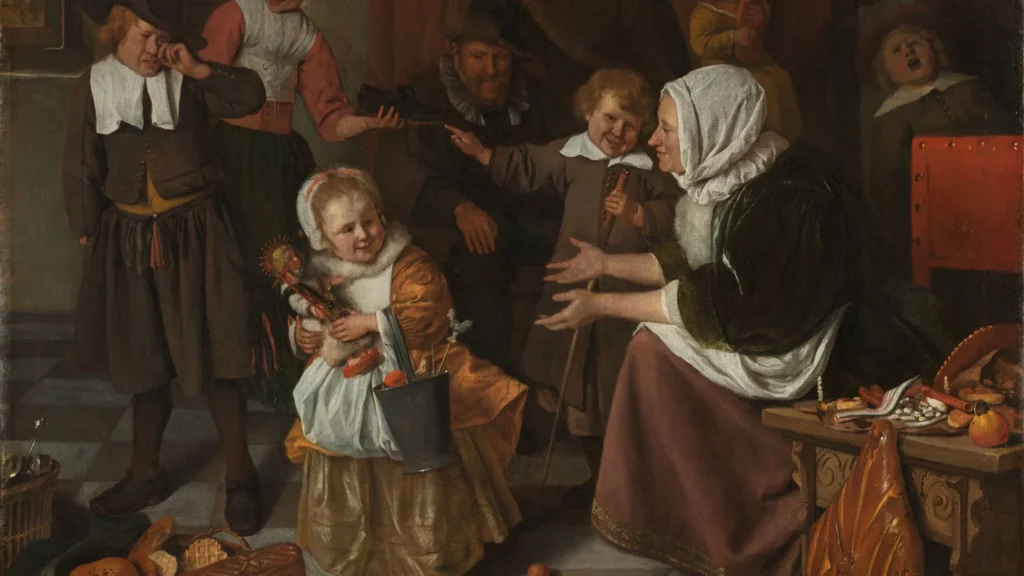
The family in Jan Steen’s painting at the top of this page looks different from either household today. Yet the Rijksmuseum points to a detail that still makes sense: a shoe at the center of the suspense. It is a seventeenth-century scene, not a guide to what every family does now.
Frequently Asked Questions
Do children put out a shoe only on December 5?
No. December 5 is the evening before Saint Nicholas Day, but some families put out shoes on earlier nights after the public arrival. The number of nights depends on the household.
What might go beside the shoe?
The Flemish heritage inventory records drawings and letters for Sinterklaas, as well as carrots or sugar for his horse. Those are examples, not a required list.
What Did We Learn Today?
December 6 is the feast day. December 5 is when many Dutch families open presents and when many Flemish children set out a shoe for the morning. Read parade dates, feast dates and family gift times separately, and the apparent contradiction disappears.
Sources & Data Notes
Household accounts, heritage records and artwork
The timeline pairs a common Dutch practice with a documented Flemish practice. The two personal accounts illustrate how families celebrate; they are not a survey of household practice.
- Hanneke van Almelo, “Pakjesavond” (2018), and Annemie Van Daele, “Het feest van Sinterklaas”, first-person accounts.
- Flemish heritage inventory, Sinterklaas and Saint Martin; Meertens Institute, shoe customs through the centuries.
- Municipality of Land van Cuijk, the 2026 national arrival in Grave; Library of Congress, Saint Nicholas in American print.
- Cover: Jan Havicksz. Steen, The Feast of St Nicholas, 1665–1668, Rijksmuseum SK-A-385. Public-domain painting reproduced as a crop.