On day 26 of his logbook, an Egyptian inspector named Merer set out from Tura with a boatload of stone. By the next night, his crew was at Khufu’s pyramid complex. Their trip answers one question about the Great Pyramid of Giza: how did stone from across the Nile get to the builders?
Ancient Egyptian crews quarried most of the limestone for Khufu’s Great Pyramid on the Giza Plateau and shipped finer limestone from Tura for its outer casing. Merer’s logbook records the voyage. Quarry cuts and lever sockets reveal how workers handled stone at Giza, but the route and equipment used to raise the highest blocks remain unproven.
How to use this article: Follow three days in Merer’s logbook, see what workers left in the bedrock, or find out what the Hatnub ramp can tell us.
1. One Boatload of Limestone, Three Days
Merer supervised a transport crew late in Khufu’s reign. The papyrus recording their work turned up at Wadi al-Jarf, an ancient Red Sea port, during excavations in 2013. That is where the logbook survived, not where this trip took place. The entries in Papyrus B, section B I, describe a route from the Tura quarries to Giza by inland waterways.
Days 26 to 28: from Tura South to Akhet-Khufu
- Day 26: The crew left Tura South with a load of stone and stopped for the night at She-Khufu, a place Tallet associates with a basin serving Khufu’s works.
- Day 27: They sailed on with the stone and spent the night at Akhet-Khufu, the name of Khufu’s pyramid complex.
- Day 28: They left Akhet-Khufu in the morning and headed back upriver toward Tura South.

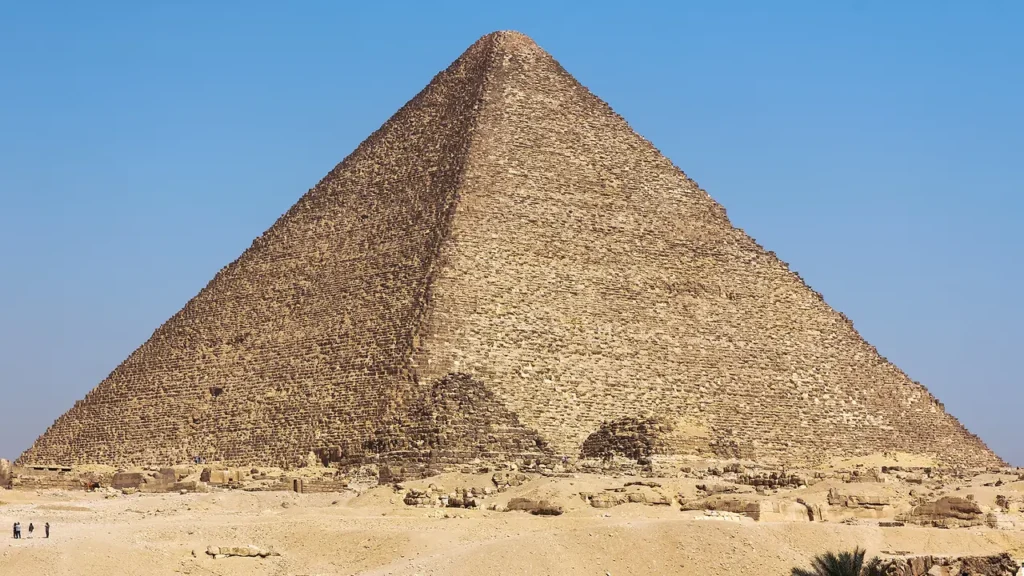
The record tells us where a specific cargo went. It doesn’t tell us which wall or layer received it. Egyptologist Pierre Tallet identifies the shipments as fine limestone of the kind used for the casing, the smooth outer skin the pyramid once had. He notes that the stone could also have been used elsewhere in the complex.
2. How Stone Reached the Giza Plateau
The Tura quarries lay on the east side of the Nile, south of modern Cairo. The pyramids stand on the west side, on the edge of the desert plateau. A map of Cairo, Giza and the Nile shows that basic geography, but the river system did not look quite the same in Khufu’s day. A 2022 study of pollen preserved in floodplain sediments reconstructed a now-vanished Nile branch that gave boats access to Giza’s harbor area. The sediment supports the water route; it cannot locate Merer’s exact mooring.
What the quarry cuts show
Much of the stone did not need to cross the river at all. Egypt’s antiquities ministry identifies local limestone in the core, and a quarry just south of Khufu’s pyramid is a likely major source. Investigators from Ancient Egypt Research Associates traced cuts separating blocks in the bedrock. Sockets beneath them show where workers could insert levers to pry the stone free. Those marks are direct evidence for how a block was freed from the quarry face. They do not tell us how the block reached the highest layers.
| Stage | Evidence and confidence |
|---|---|
| Quarrying | Strong: Local quarry cuts and lever sockets show how workers freed limestone blocks. |
| Water transport | Documented: Merer names a Tura shipment to Khufu’s complex. Floodplain sediments help explain the harbor access. |
| Movement on site | Partial: Bedrock marks record work at the pyramid’s base. The complete overland route is not known. |
| Final lifting | Unresolved: No surviving evidence establishes how the highest blocks were raised and set. |
3. What We Know About the Workforce
Merer’s crew was one part of the project. A boat crew could bring the stone to Giza; unloading it and moving it uphill were separate jobs. The entries do not tell us who took over the cargo after landing. The surviving records show crews working at named locations and on particular tasks. They do not give us a head count for the whole construction site or the names of the people who set the blocks.
Heit al-Ghurab, a settlement excavated southeast of the plateau, shows what it took to sustain large building crews. Archaeologists found streets, storage buildings and extensive food remains. Egypt’s antiquities ministry links the excavated town most securely to the later Giza projects of Khafre and Menkaure; traces of an earlier settlement may date to Khufu. It is evidence of how the royal building program housed and fed people, not a census of Khufu’s workers.
The sources answer different questions. Merer gives us a delivery crew at work. The town shows that building at Giza also meant organizing supplies and feeding people. The same Nile corridor that shapes Egypt’s geography connected settlements, quarries and building sites.
4. How Did Workers Raise the Blocks?
At the Great Pyramid itself, excavators have recorded quarry channels, postholes and lever sockets in the bedrock around the structure. They reveal work at ground level, from preparing the site to maneuvering blocks. But a hole that helped a builder shift a block beside the pyramid does not tell us how a crew moved stone to the upper courses, the horizontal layers of masonry nearer the top.
The Hatnub ramp was in a quarry, not at the pyramid
At Hatnub, a separate quarry in Egypt’s Eastern Desert, excavators found a ramp flanked by stairs with rows of postholes. The team proposed that workers used ropes and wooden posts to help pull sledges loaded with Egyptian alabaster up out of the quarry. The ramp and postholes are real; the rigging is a reconstruction. Neither shows that the same setup raised Khufu’s limestone at Giza.
Even if workers used ramps at Giza, their shape and sequence matter. A shallow straight ramp needs a longer approach as the building gets higher. A ramp that turns can fit into a smaller footprint, but crews then need room to steer heavy loads around corners. Builders could also have changed methods as the pyramid rose. The evidence does not settle which approach they took to reach the top.
Frequently Asked Questions
Does Merer describe how the top stones were lifted?
No. The logbook describes what the transport crew did. It records a cargo reaching Khufu’s complex, not how builders raised and set stones into the highest courses.
Did all the stone come from the same quarry?
No. The rougher core used local Giza limestone, while the smooth outer casing used finer limestone from Tura. Merer’s crew carried imported stone, not all the stone needed to build the pyramid.
What Did We Learn Today?
We can follow Merer’s crew to Khufu’s complex, see where workers freed local limestone, and find traces of how they moved blocks at ground level. The Hatnub quarry shows one way ancient Egyptians hauled stone uphill, not how builders reached the top at Giza. The supply chain is better documented than the final lift.
Sources & Data Notes
Research sources and photo credit
The day numbers are from Merer’s logbook, not modern calendar dates. The shipment account follows Papyrus B, section B I, in Colin Clement’s English translation. Port geography and the Hatnub rigging are archaeological reconstructions, not additional details recorded by the crew.
- Pierre Tallet, Les Papyrus de la mer Rouge I: Le « Journal de Merer » (2017), pp. 150–152
- Egypt’s Ministry of Tourism and Antiquities: The Great Pyramid and Workers’ Town and Cemetery
- Ancient Egypt Research Associates: The Great Pyramid Quarry and Giza fieldwork, 2023–2024
- Hader Sheisha and colleagues, Nile waterscapes and pyramid construction at Giza (PNAS, 2022)
- French Institute for Oriental Archaeology: Hatnub field project and University of Liverpool: the excavation team’s ramp findings
Cover photograph: Douwe C. van der Zee, Great Pyramid of Giza – Pyramid of Khufu, CC BY-SA 4.0. Resized and converted to WebP; the cover image is shared under the same license.