On Monday, August 2, 2027, the total solar eclipse will cross northern Morocco. The reference points for Tangier and Tétouan get nearly five minutes of totality. Fès, farther south, gets only a partial eclipse. Two towns near the southern edge show why the address matters more than the region on a booking.
Predictions and Morocco’s time rule checked: November 23, 2026
At the Tangier reference point, totality is predicted to start around 08:45 UTC and last about 4 minutes 50 seconds. That would be 8:45 a.m. in Tangier if the GMT rule checked on November 23, 2026, is still in force on eclipse day.
How to use this article: Find two towns on opposite sides of the edge, compare the six city times, or check the Moroccan clock rule.
1. Locate the path across northern Morocco
Two towns about eight miles apart, two different eclipses
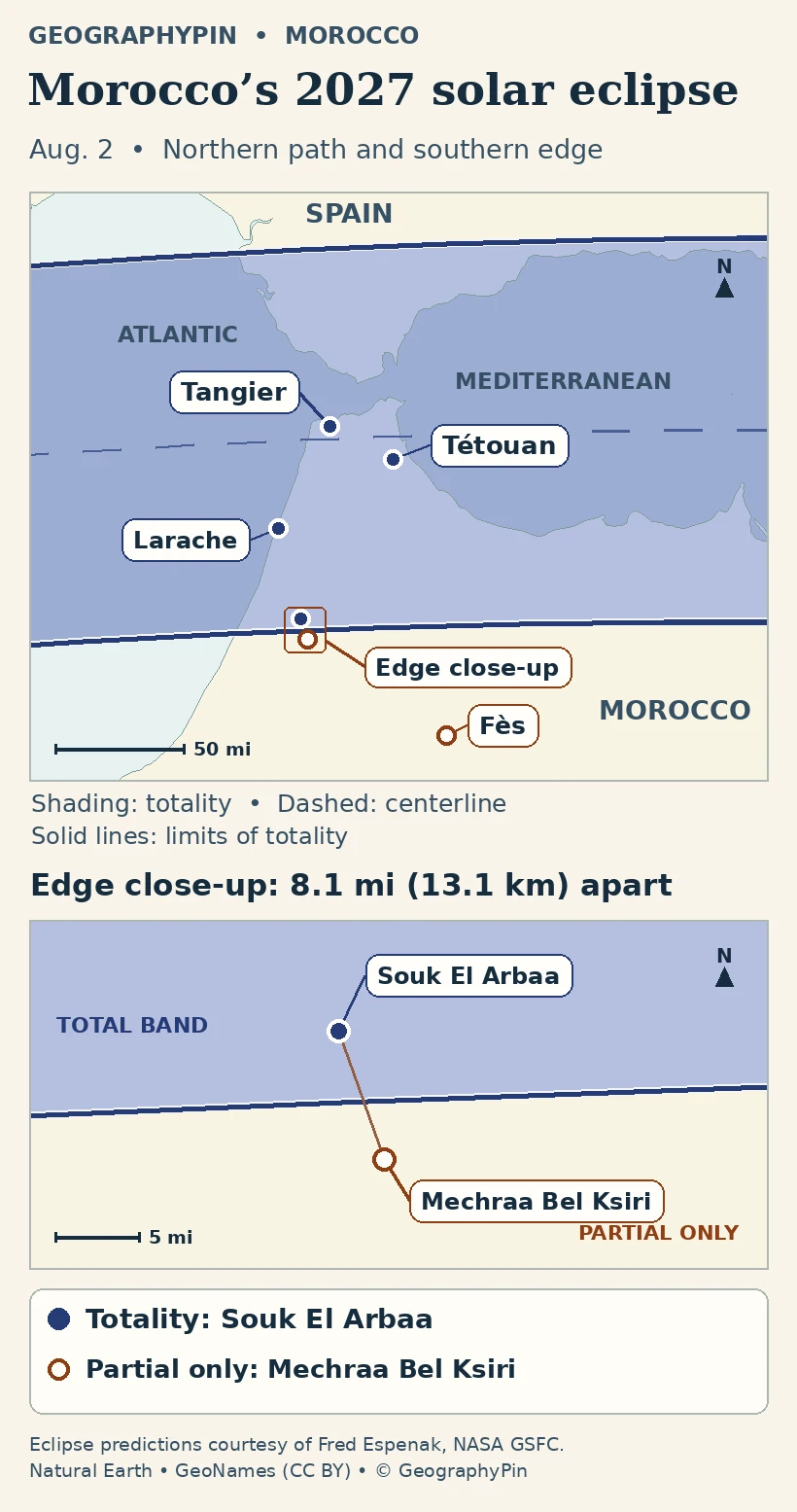
The Moon’s full shadow sweeps in from the Atlantic, crosses the Strait of Gibraltar and covers a band of northern Morocco. The southern edge cuts across the land rather than following the coastline.
Souk El Arbaa falls inside the predicted path, while Mechraa Bel Ksiri falls just outside it. Their reference points are only 8.1 mi (13.1 km) apart in a straight line. Souk El Arbaa gets about 1½ minutes of totality. Mechraa Bel Ksiri gets no total phase, even though the Sun is almost entirely covered. If you’re traveling to see the total phase, the Tangier or Tétouan reference points are the clearer choice: both models show a much longer total phase there. At the edge, check the actual coordinates of where you’ll stand. A rounded coverage percentage isn’t enough to establish totality.
2. Compare six city points on August 2
Predicted start, total phase and end
| Reference point (latitude, longitude) | First to last contact (UTC) | Total phase (UTC) |
|---|---|---|
| Tangier (35.76727°N, 5.79975°W) | 07:41–10:00 | 08:45–08:50 · about 4m 50s |
| Tétouan (35.57845°N, 5.36837°W) | 07:41–10:01 | 08:45–08:50 · about 4m 50s |
| Larache (35.19321°N, 6.15572°W) | 07:40–10:00 | 08:44–08:49 · about 4m 25s |
| Souk El Arbaa (34.68473°N, 6.00344°W) | 07:40–10:00 | 08:46–08:47 · about 1m 35s |
| Mechraa Bel Ksiri (34.57373°N, 5.95585°W) | 07:40–10:00 | None · partial only |
| Fès (34.03313°N, 5.00028°W) | 07:40–10:02 | None · partial only |
Each coordinate is a reference point, not a recommended place to stand. Both astronomical models agree on which points get totality. These times are for planning only: never use the clock or the map to decide when to take off eclipse glasses. For a broader look at the shadow’s route, see the World Heritage sites in the path of totality.
3. Use the Moroccan clock and check conditions
Why an older listing may be an hour later
Decree 2.26.530 restored GMT from September 20, 2026, and repealed the previous GMT+1 rule. Older listings may still use GMT+1. Use UTC as your reference, and recheck Morocco’s official time rule before the event, especially if you are also consulting Spain’s eclipse map and local times.
A place in the shadow still needs a clear view
The two coastal weather stations tell a different story from the eclipse map. In the 1991–2020 climate normals, August averaged 0.08 in (2.0 mm) of precipitation at Larache and 0.19 in (4.7 mm) at Tétouan. Neither number measures cloud cover during the eclipse. Check the local forecast closer to August 2 and confirm that the place you choose is open to visitors and has an unobstructed view toward the Sun.
Eye safety: Use undamaged solar viewers that meet ISO 12312-2 during every partial phase, or view the projected image indirectly. Ordinary sunglasses and clouds don’t protect your eyes. The only exception for unaided viewing is during confirmed totality, when the Moon completely covers the Sun’s bright face. Put the viewers back on as soon as any bright part of the Sun reappears. Near the edge or unsure? Keep them on. Eclipse glasses don’t make a camera, telescope or binoculars safe: the instrument needs a solar filter designed for it and secured over the front.
Frequently Asked Questions
Does the Sun rise eclipsed in Tangier that day?
No. At the city’s reference point the Sun is already about 25° above the horizon when the partial phase starts. A view of the sunrise itself is not required.
Does the end of totality mean the eclipse is over?
No. The bright portion of the Sun returns first, then the Moon continues moving away from it. In Tangier, that leaves a final partial phase of roughly 70 minutes, when you still need protection.
What Did We Learn Today?
A coast or a province is not an eclipse category. The Moon’s shadow has a narrow boundary of its own, which is why two nearby reference points can see different eclipses. The map tells you which phase to expect, the clock tells you when to be there, and the forecast tells you whether you might actually see it.
Sources & Data Notes
The table uses Paris Observatory estimates at the listed GeoNames points and zero modeled elevation, checked against NASA at the same coordinates. Clock times are rounded to a minute; durations are rounded separately to about five seconds. NASA’s modeled path limits and a generalized coastline are for regional orientation, not a street-level or safety guide.
View predictions, clock rules, safety and map credits
- Fred Espenak, NASA/Goddard Space Flight Center: August 2, 2027 path table, modeled path and local circumstances, and reuse and credit terms.
- OPALE – Space Service of the Paris Observatory, INPOP19A eclipse calculations, UTC; data refreshed November 23, 2026, under the Open Licence / Licence Ouverte 2.0. Display times rounded for this article.
- Government of Morocco: return to legal GMT under Decree 2.26.530. The table retains UTC as a reference if a later civil-time rule changes.
- WMO climate normals, 1991–2020, Morocco stations Larache (60105) and Tétouan (60318), via NOAA NCEI. Morocco’s meteorological service for local forecasts near the event.
- NASA eclipse eye safety and American Astronomical Society viewing guidance.
- GeoNames city points (CC BY); Natural Earth 1:10m land v5.1.1 (public domain).
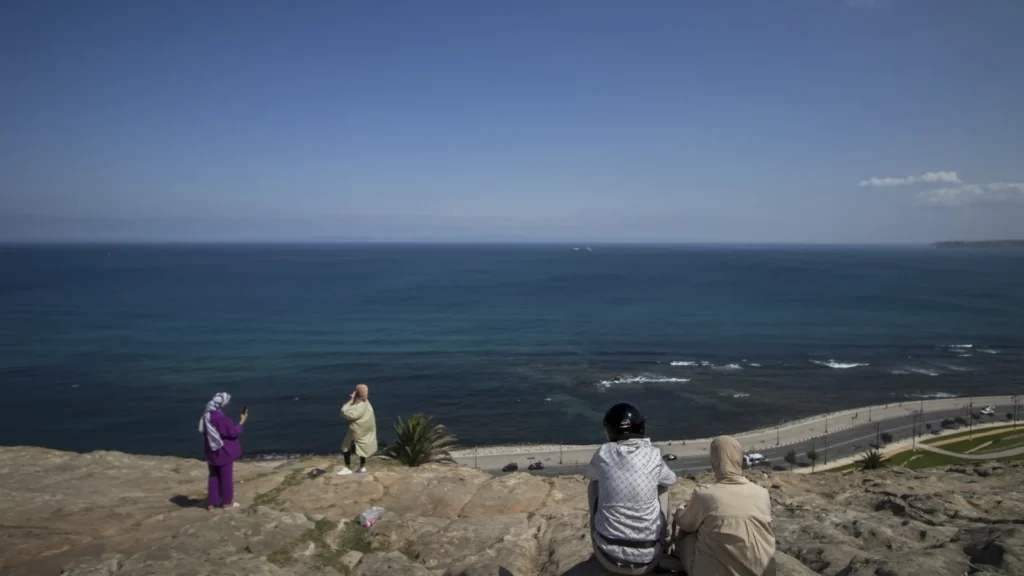
- Cover: Buiobuione, panoramic view from Tangier, September 15, 2023, CC BY-SA 4.0. Cropped, resized and re-encoded under the same license. This is a photo of Tangier, not the 2027 eclipse.