Take a direct Tōbu train if you’re starting in Asakusa. From Tokyo Station, take the Shinkansen to Utsunomiya and change to the JR Nikkō Line. The two routes arrive at different stations in Nikkō, but you don’t need to change stations to reach the shrines: the same local bus calls at both.
Practical information checked: November 2026
At JR Nikkō, board World Heritage Bus W at bay 1B. At Tōbu-Nikkō, use bay 2B. On the normal loop, get off at Omotesandō (83) and walk uphill to Tōshō-gū. If you walk from the station instead, cross the Daiya River on Nikkō Bridge beside the red Shinkyō bridge.
How to use this article: Compare Tokyo departures and fares, use the station bay and detour instructions, or check the last bus and trains back to Tokyo.
Choose a Tokyo Departure
Asakusa for a direct Tōbu train, Tokyo Station for JR
From Tōbu Asakusa: Look for a limited express that actually lists Tōbu-Nikkō. Some SPACIA X trains branch off at Shimo-Imaichi for Kinugawa Onsen. The published regular-season one-way adult fare to Tōbu-Nikkō on SPACIA X is ¥3,340 in a standard seat: ¥1,400 base fare and a ¥1,940 reserved limited-express charge. Check your date and seat class before booking. A pass that only covers the base fare does not reserve your seat.
From Tokyo Station: Take a Tōhoku Shinkansen that stops at Utsunomiya, then change to the conventional JR Nikkō Line. Check that the local train goes all the way to JR Nikkō; some end at Kanuma. JR lists ¥4,930 for a regular-season ordinary reserved e-ticket from Tokyo to Utsunomiya. That is for the Shinkansen only. Check whether your ticket or pass also covers the local train; don’t assume your Shinkansen e-ticket does.
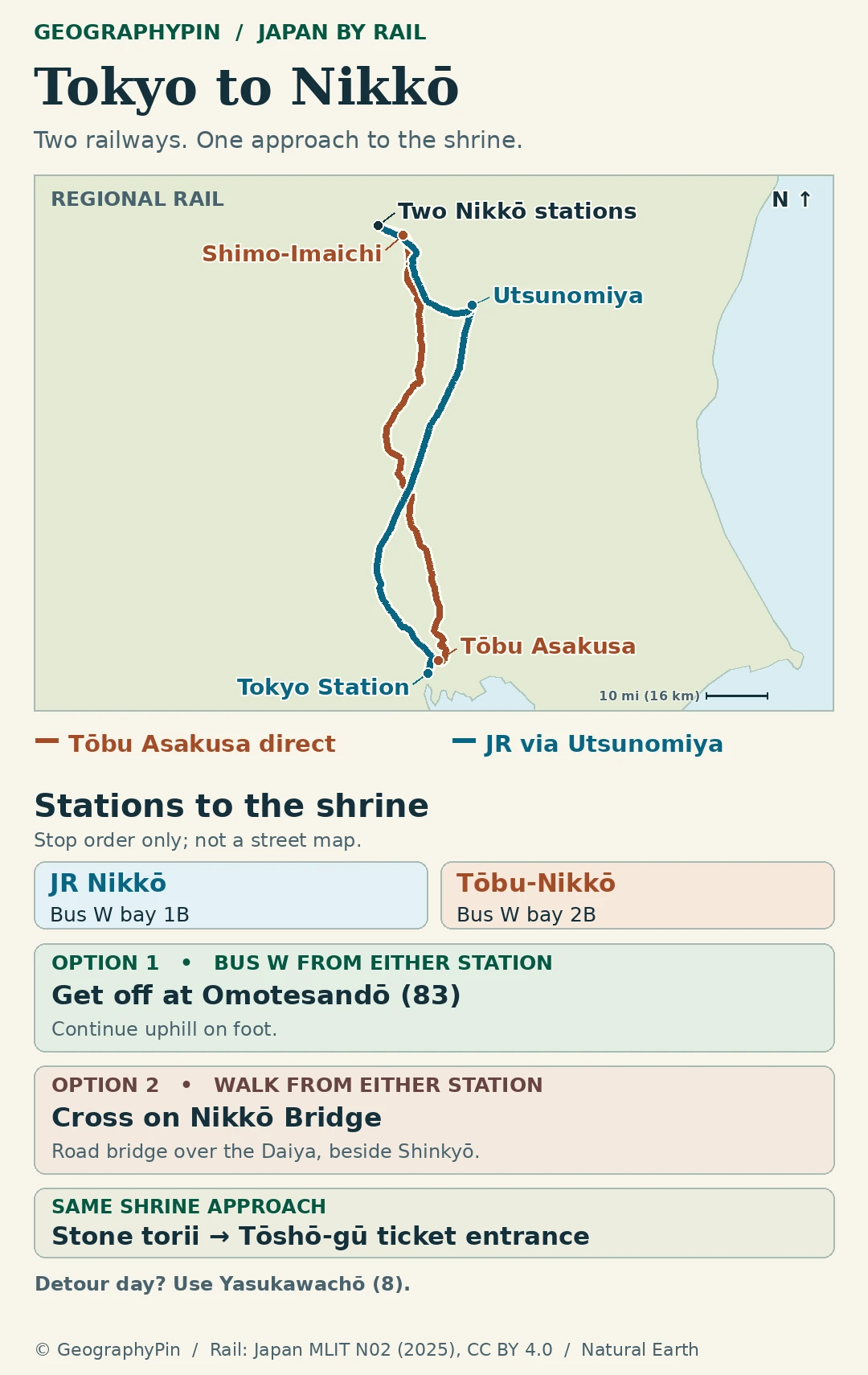
Enlarge map: Phone version · Desktop version
Starting in Shinjuku? The direct JR–Tōbu limited express named Nikkō arrives at Tōbu-Nikkō, even though it starts at a JR station. Buy the through ticket and reservation for that service. Don’t pick a train named Kinugawa for this itinerary or expect to board the through express with an IC-card tap alone.
One December weekday on both routes
| Rail option | Scheduled trains | Bus W to Omotesandō |
|---|---|---|
| Tōbu direct | 09:00 Tōbu Asakusa → 10:50 Tōbu-Nikkō (SPACIA X No. 3) | 11:15 Tōbu-Nikkō → 11:22 Omotesandō |
| JR via Utsunomiya | 08:26 Tokyo → 09:18 Utsunomiya (Nasuno 253); 09:36 Utsunomiya → 10:18 JR Nikkō | 10:47 JR Nikkō → 10:57 Omotesandō |
The JR example allows 18 minutes to change trains at Utsunomiya. These are separate scheduled legs, not a protected connection. Leave more time if you need help making the transfer.
Locate the Two Nikkō Stations
Two forecourts, the same World Heritage Bus W
The stations are a short walk apart, but you can board beside the one where you arrive: JR Nikkō bay 1B or Tōbu-Nikkō bay 2B. Those are stops 1 and 2 in the bus timetable. On the normal loop, the adult single fare to Omotesandō (83) is ¥350 from either station.
Check Tōbu Bus’s detour calendar and service notices before leaving your station. On designated winter detour days, Bus W skips Omotesandō and the operator directs Tōshō-gū visitors to Yasukawachō (8) instead. This affects your return pickup too. December 1 is a regular-route day in the published calendar.
Continue to the Heritage Precinct
Which bridge and which entrance?
From the railway stations, follow the main street toward Shinkyō and cross the Daiya on Nikkō Bridge, the road bridge beside the red historic crossing. Follow the signs uphill toward Tōshō-gū’s stone torii. Japan’s national tourism office allows about 45 minutes from JR Nikkō to Tōshō-gū. If you take the bus to Omotesandō, you skip most of that climb, but there is still a short uphill walk. Neither description is a step-free itinerary.
The first stone torii is not the ticket checkpoint. In November–March, Tōshō-gū’s paid precinct is scheduled to close at 4 p.m., with last entry at 3:30 p.m. Adult admission is ¥1,600. Leave time to get from the torii to the ticket entrance rather than timing your arrival at the bus stop for 3:30.
Match the bus to the correct return train
On December 1, the last scheduled W loop from Omotesandō leaves at 16:45, calls at Tōbu-Nikkō at 17:01 and arrives at JR Nikkō at 17:05. Make the bus an option, not your only plan: the last W is not the last train or necessarily the last bus on other routes.
Back to Tōbu Asakusa: SPACIA X No. 12 leaves 17:44 and arrives 19:35. The last direct Asakusa express in the regular weekday table is Kegon No. 52, 18:41 → 20:35; reserve ahead and check your date.
Back to Tokyo Station: Take the 17:19 JR local to Utsunomiya, arriving 18:02, then Nasuno 280 at 18:21 for a 19:16 Tokyo arrival. The late scheduled option is the final weekday Nikkō Line departure at 21:52, arriving Utsunomiya at 22:32, then Yamabiko 72 at 22:54 for Tokyo at 23:44. Those are planned trains, not an assurance that a delay will hold the connection.
Nikkō is on Honshū. The Japan country profile shows how this rail corridor fits into the country’s wider geography.
Frequently Asked Questions
Is the World Heritage bus day pass worth buying?
On the normal Omotesandō route, two ¥350 adult singles cost ¥700, so the ¥600 same-day World Heritage bus pass saves ¥100 for a round trip. It does not cover the ride to Lake Chūzenji.
Can I take an online Tōshō-gū voucher straight to the shrine?
For the online vouchers listed by Nikkō’s official visitor guide, no. Exchange the voucher for a ticket at the Tōbu-Nikkō Station Tourist Center before you head to the shrine, even if you arrived at JR Nikkō. Follow the instructions on your own booking if you use a different seller.
What Did We Learn Today?
Choose your train by the Tokyo departure station, not by which end of Nikkō you want to visit. The same bus stops at both arrival stations, and both approaches end at Tōshō-gū. For a day trip, check the shrine’s admission cutoff first, then plan the bus and the train home separately.
Sources & Data Notes
December 1 is a scheduled Japan-local-time example, checked November 23, 2026 against operator calendars and the December 2026–March 2027 winter bus timetable. Rail locations come from the 2025 Japan MLIT dataset; the local diagram shows choices and stop order only, not walking distances or wheelchair access.
View timetables, visitor information and image credits
- Tōbu Railway: SPACIA X services, fare tables and the limited express timetable. JR East: Shinjuku–Tōbu-Nikkō service.
- JR East: Nasuno 253 and outbound Nikkō Line example, weekday Nikkō Line returns, Nasuno 280 and Yamabiko 72. Eki-net: normal-season e-ticket price table.
- Tōbu Bus: winter timetable, route and boarding bays, winter detour calendar and day-pass fares and validity.
- Tōshō-gū: official hours and ticket prices. Japan National Tourism Organization: station-to-shrine access. Nikkō Official Guide: Shinkyō and the Daiya River and where to exchange shrine vouchers.
- Rail map: Japan MLIT National Land Numerical Information railway dataset N02, 2025 edition, clipped and styled, CC BY 4.0. Land polygons: Natural Earth, public domain.
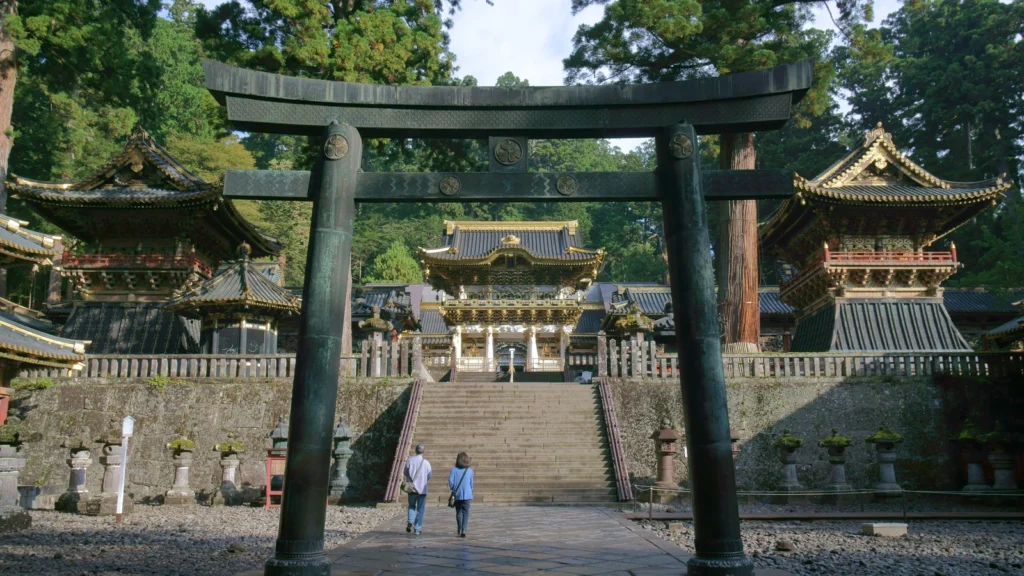
- Cover: Torii and Yōmeimon inside Tōshō-gū, Koichi Sato, October 12, 2017, CC BY-SA 4.0. Cropped and resized under the same license. The cover does not show the first stone torii.