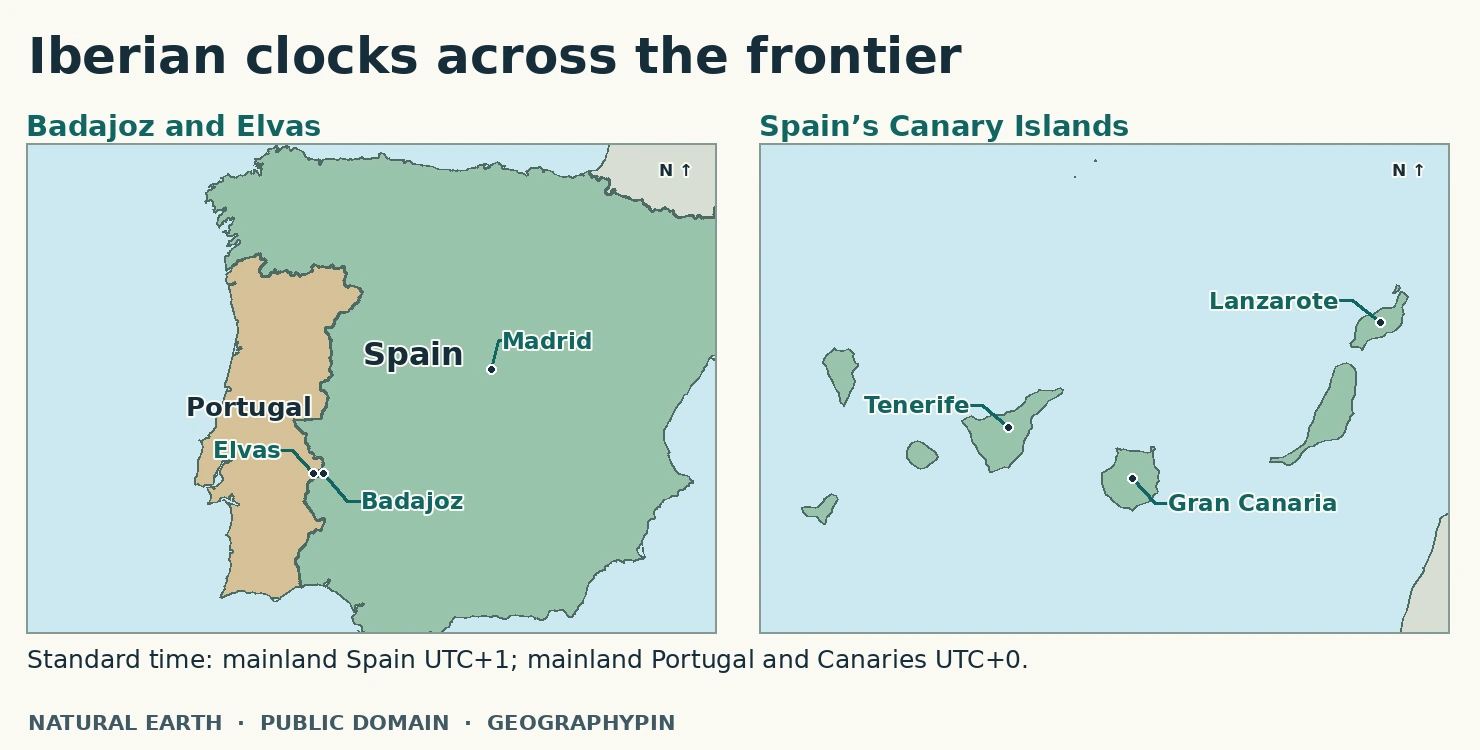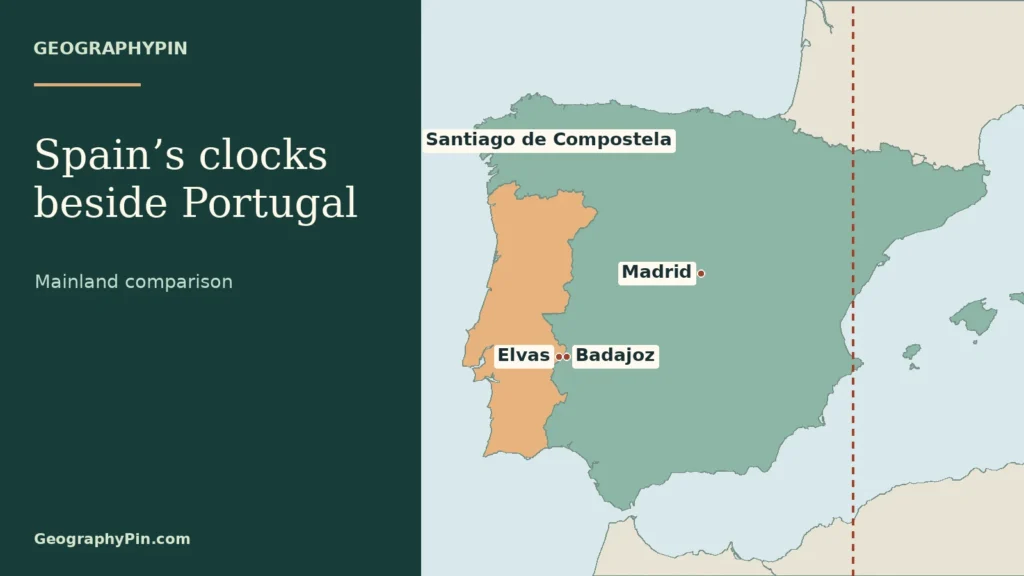
At astronomical noon in Badajoz, Spain, a Portuguese clock across the border in Elvas reads nearly an hour earlier. The two cities lie almost on the same meridian. It is the clock convention that changes abruptly.
Mainland Spain uses UTC+1 in winter and UTC+2 in summer. A March 1940 order advanced the civil clock, and Spain subsequently retained alignment with Central European standard time. Mainland Portugal uses a clock one hour earlier. Spain’s Canary Islands also normally keep one hour behind mainland Spain. Longitude helps explain late solar noon, while the civil time rules explain the hour on the dial.
How to use this article: Jump to the discussion you need: Why western Spain’s summer noon is so late, A one-hour jump near the Portuguese border or The Canary Islands and the Balearics.
One solar event, two clock readings
| City | Longitude | Local clock and zone |
|---|---|---|
| Badajoz, Spain | 6.97° W | 2:30 p.m. CEST, UTC+2 |
| Elvas, Portugal | 7.16° W | 1:30 p.m. WEST, UTC+1 |
| Santiago de Compostela, Spain | 8.54° W | 2:36 p.m. CEST, UTC+2 |
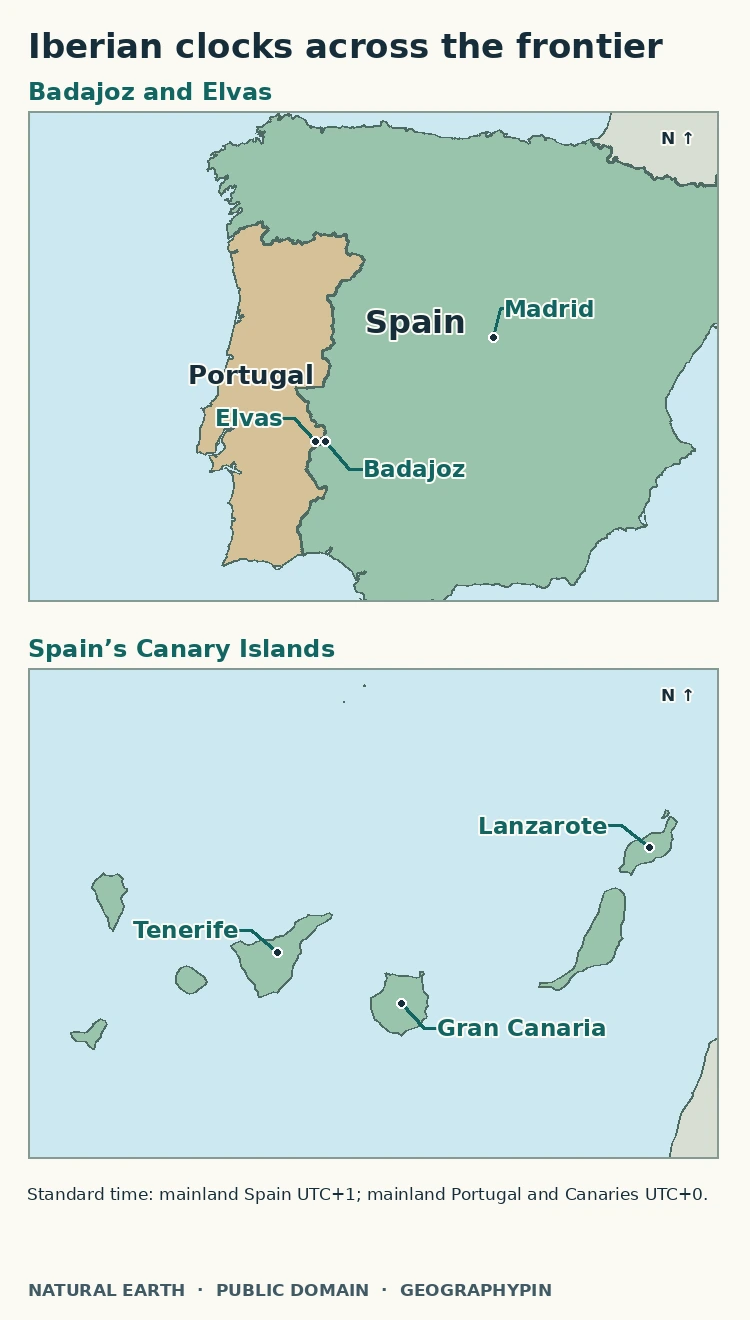
Badajoz and Elvas are separated by only about one fifth of a degree of longitude. That amounts to less than a minute of mean solar time. Their legal summer offsets differ by a full hour. Rounding brings the clock minutes in the table into line, while the hour differs. A watch crossing the border changes much faster than the sun’s position.
Why western Spain’s summer noon is so late
Central European standard time is nominally tied to 15° E. Santiago de Compostela lies west of Greenwich. Its longitude pushes solar noon later by the clock, and summer time adds another hour. The exact date also matters because apparent solar time varies through the year. On this June date solar noon is about two hours and thirty-six minutes after 12:00 on the civil clock.
A one-hour jump near the Portuguese border
Badajoz in Spain and Elvas in Portugal are close enough for a short road trip. Driving west across the border can turn the civil clock back an hour even though the sun’s position changes very little. Most of that clock change comes from the legal choice of zone. The small east–west separation accounts for only minutes of solar difference.
What the March 1940 record says
Spain’s official astronomical history records the clocks advancing from 23:00 to 24:00 on March 16, 1940. Spain had used seasonal changes before, and later summer-time changes are separate events. The documented order and its lasting consequence are firmer evidence than a single anecdote assigning one private political motive. A political decision can survive the circumstances in which it was first made.
The Canary Islands and the Balearics
The Canary Islands use UTC in winter and UTC+1 in summer. Their usual hour difference from mainland Spain is familiar in national broadcasts. The Balearic Islands use mainland Spanish time. Both are Spanish archipelagos, so national membership alone does not determine which offset applies. A map of Spain without the Canary inset is incomplete for a national time-zone question.
Later sunset is not a longer day
Moving the clock forward shifts both sunrise and sunset later on the dial. It does not change the interval between them. Geographic latitude and the season largely control day length. That is why two nearby towns across a time-zone border can see nearly the same daylight while publishing sunset times an hour apart. The same principle underlies time-zone boundaries elsewhere. A map of Arizona’s Navajo and Hopi timekeeping rules shows another way nearby places can display different hours in summer.
What a shadow does while the clock changes countries
Imagine two observers checking a vertical post in Badajoz and Elvas. The posts cast their shortest midday shadows at nearly the same absolute instant because the cities lie near the same meridian. The observers’ watches, however, can display times an hour apart. Cross the border and the legal clock changes abruptly; travel the same distance entirely within either country and the sun’s motion changes smoothly.
Santiago de Compostela provides the second comparison. In summer the Spanish clock is advanced by the seasonal change, and the city lies well west of the meridian normally associated with Central European standard time. Both effects push solar noon later on the legal clock. That helps explain a late midday sun. It does not by itself establish why a particular household eats, works or sleeps at any chosen hour.
The Canary Islands supply a third reference. They use a legal time one hour behind mainland Spain under the present winter and summer arrangements. The Balearic Islands use mainland Spanish time. A time-zone question about “Spain’s islands” therefore needs an island group, just as a historical question about the 1940 order needs a date. Physical position, seasonal adjustment and national history appear together on the map, but they enter the explanation through separate steps.
Frequently Asked Questions
Does Portugal always match every part of Spain?
No. Mainland Portugal usually shares its clock with the Canaries and differs from mainland Spain. The Azores use another offset, so specify the region when comparing the two countries.
Would moving the Spanish clock back change solar noon?
It would change the clock time printed beside the event. The sun would cross the local meridian at the same physical instant.
What Did We Learn Today?
A 1940 decision and later clock rules explain why Spain and Portugal show different hours. Badajoz and Elvas isolate that policy effect almost perfectly because their longitudes are so close.
Sources & Data Notes
Solar noon was calculated with Astral 3.2 for June 21, 2026. Zone rules are from IANA. The historical clock change follows Spain’s National Geographic Institute. Civil-time examples were checked against IANA Time Zone Database release 2026f.