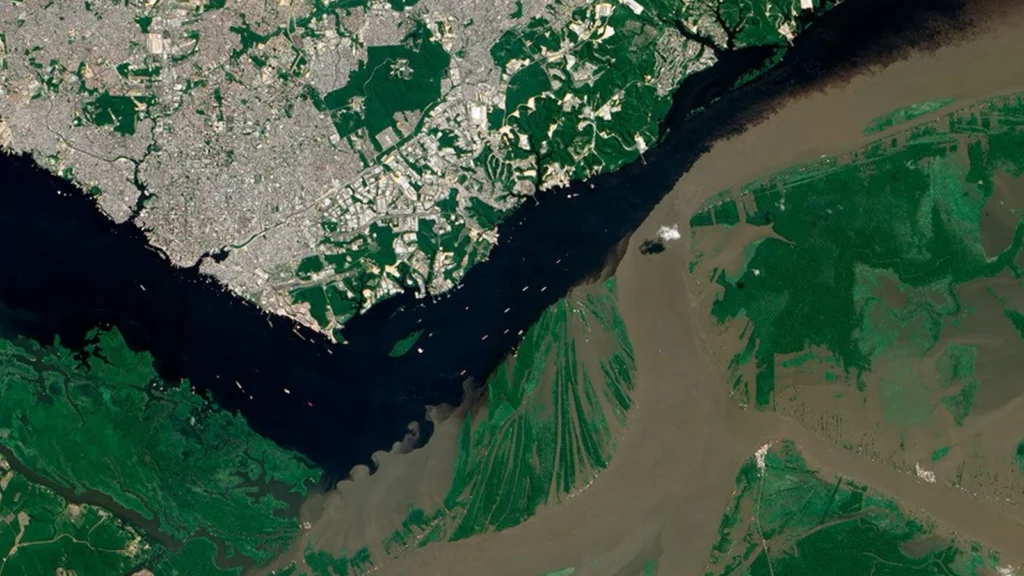
The Rio Negro can look almost black even though it carries much less suspended sediment than the muddy Solimões. The difference becomes visible near Manaus, where the two rivers run side by side before they mix.
A blackwater river gets much of its dark color from dissolved organic matter released by soils and decaying plants. Whitewater in the Amazon, such as the Solimões, often looks tan or brown because it carries fine suspended sediment. Clearwater rivers such as the Tapajós tend to have fewer suspended particles and less dissolved color. Darker water doesn’t necessarily carry more sediment.
How to use this article: See what a filter can tell you, compare the measured river samples, or learn when the water’s color can mislead you.
What makes a river dark or cloudy?
The filter keeps particles but can leave a dissolved stain
Dissolved compounds can absorb light without making water look milky. Suspended mineral particles scatter light, so the water can look cloudy even when it appears lighter than blackwater. The diagram separates those two effects. If a sample still looks tea-colored after fine particles are removed, dissolved color is a better explanation than sediment alone.
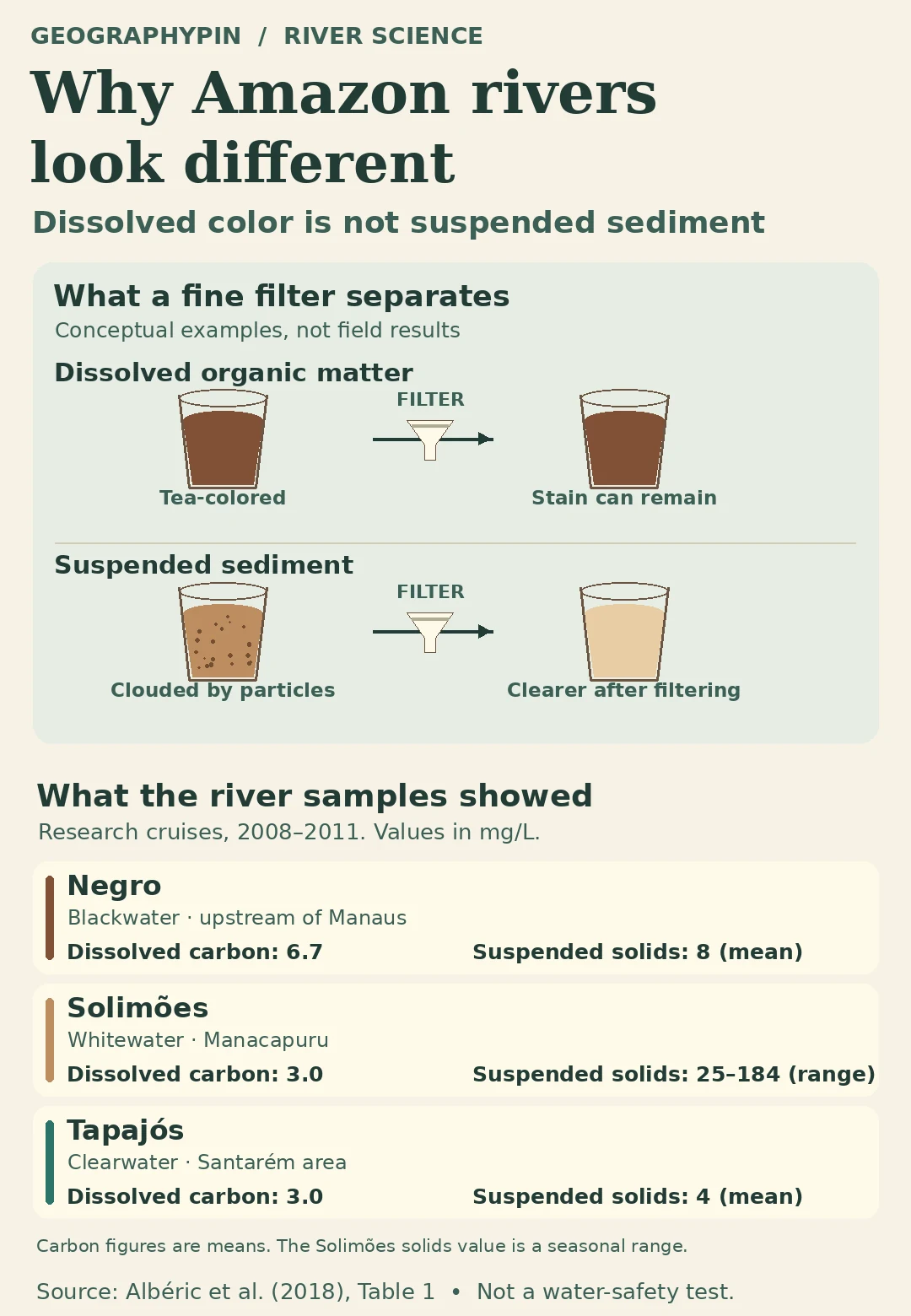
Scientists can test the distinction by measuring the light absorbed by a filtered sample and the mass of the particles removed from a known volume of water. The process is the reason to look beyond the color in a photograph.
Dissolved organic matter stains blackwater
Water passing through soils and over decaying plants carries a mixture of dissolved organic compounds into streams. Some of those compounds absorb more blue light than red light, giving a shallow sample a brown, tea-like tint. In a deep reach, the same water can look much darker.
Tests of the lower Negro have linked its low reflectance to strong absorption by colored dissolved organic matter and generally low suspended sediment. Dissolved organic carbon, or DOC, measures the carbon in that dissolved pool. It is useful alongside an optical measure, because some dissolved compounds add little visible color.
Suspended particles make whitewater cloudy
Three rivers sampled across water seasons
Albéric and colleagues sampled the Solimões near Manacapuru, the Negro upstream of Manaus and the Tapajós in the Santarém area on research cruises in 2008–2011. The darkest of those rivers had the highest average dissolved organic carbon, but its reported suspended solids were below even the low end of the Solimões’ seasonal range.
| River and sample area | DOC, mg/L | Total suspended solids, mg/L |
|---|---|---|
| Negro, upstream of Manaus | 6.7 ± 0.9 (5 samples) | 8, mean |
| Solimões, Manacapuru | 3.0 ± 0.6 (5 samples) | 25–184, seasonal range |
| Tapajós, Santarém area | 3.0 ± 1.0 (4 samples) | 4, mean |
The study reports mean DOC with its accompanying spread. The Solimões suspended-solids figures are a range, not a mean or a range for every stretch of the river. The pale-looking “whitewater” here means a sediment-rich water type, not froth or rapids.
How tributary geology shapes all three
The Solimões conveys sediment from the western Amazon river network, including eroding Andean catchments. The Tapajós drains a different source region: old crystalline and sedimentary rocks in the Brazilian Shield, where the river typically carries much less suspended material. In the Negro’s forested catchment, soil and plant-derived dissolved material accounts for much of the color even where mineral sediment is sparse.
Geology influences what the rivers carry, but it does not decide the color by itself. Runoff, a local sediment input or a tributary mixing in can change an individual reach. A field and satellite study found that sediment from the Branco affected the reflectance of the lower Negro more than about 56 miles (90 km) from their confluence. That is a documented exception to reading the entire river from its name.
When color is not enough
Compare filtered color under the same light
If a dark sample loses much of its color when fine particles are removed, look beyond a dissolved stain. Reflections, shade, depth, algae and suspended particles can all change what you see from the bank. Comparing filtered samples under the same light and checking their particle concentrations helps separate those explanations.
Near Manaus the Negro and Solimões stay visibly distinct for part of the shared channel because the two flows differ in speed, temperature and density. They do mix farther downstream. The cover image records conditions on June 17, 2012, not the three sampling averages or a permanent line in the river. None of these colors shows whether untreated water is safe to drink.
Frequently Asked Questions
Does darker water carry more suspended sediment?
Not necessarily. The sampled Negro had more dissolved organic carbon but much less suspended sediment than the Solimões. Dissolved color and suspended particles are different measurements.
Can Amazon whitewater look brown?
Yes. ‘Whitewater’ names a sediment-rich water type, not a literal color. The Solimões can look muddy brown because it carries suspended mineral particles; it does not have to look white or foamy.
How can you distinguish blackwater from water that just looks dark in shade?
Compare shallow samples in matching light and measure how much light passes through after filtering. Shade changes the view, but a stain in the water remains when you move the same sample into controlled light.
What Did We Learn Today?
The Negro’s dissolved stain and the Solimões’ suspended sediment look different because they interact with light differently. The Tapajós provides a third comparison, and the Branco shows why those labels don’t apply equally to every reach. Sample the water rather than trying to read its chemistry from one color.
Sources & Data Notes
Open sources & map notes
- Patrick Albéric and colleagues, runoff cycles in the Amazon, 2018, Table 1 and Figures 1 and 3. Five 2008–2011 research cruises cover different water stages. Values describe named station samples, not basin-wide annual means. The three-station comparison uses published measurements. The filter drawing shows the mechanism, not the results of a trial.
- Marinho and colleagues, lower Rio Negro sediments, 2021, field and Sentinel-2 evidence for low suspended sediment, high dissolved color and the Branco’s downstream influence. Martinez and colleagues, Amazon water optics, 2015, for particle scattering and water color controls.
- Acta Amazonica sediment provenance study on the Tapajós, 2020, for the Brazilian Shield and sediment context. Amazon organic-matter mixing experiments, 2023, for independent blackwater, whitewater and clearwater terminology and composition.
- Cover: Jesse Allen and Robert Simmon, NASA Earth Observatory, using Advanced Land Imager data from the NASA EO-1 team, captured June 17, 2012. Cropped and resized NASA imagery; no color was changed. See the NASA Earth science reuse policy.