Six republics made up socialist Yugoslavia, and six United Nations members emerged from its former territory. Some present-day maps show a seventh label, Kosovo, because they distinguish it from Serbia without necessarily counting it on the same terms.
The six former Yugoslav republics correspond to today’s Bosnia and Herzegovina, Croatia, North Macedonia, Montenegro, Serbia and Slovenia. All are UN members. Kosovo and Vojvodina were autonomous provinces within Serbia, not republics. Kosovo declared independence in 2008, but recognition is not universal and it is not a UN member.
How to use this article: Compare the six republics, locate the two provinces, then check which state used the name Yugoslavia and what Kosovo’s separate label means.
Which present-day countries came from the former Yugoslavia?
Compare the six republics with the UN member list
The former Yugoslavia in this comparison is the Socialist Federal Republic of Yugoslavia (SFRY) just before its breakup began in 1991. It consisted of six republics: Bosnia and Herzegovina, Croatia, Macedonia, Montenegro, Serbia and Slovenia. All six have present-day counterparts on the UN member list. The former republic of Macedonia is now called North Macedonia.
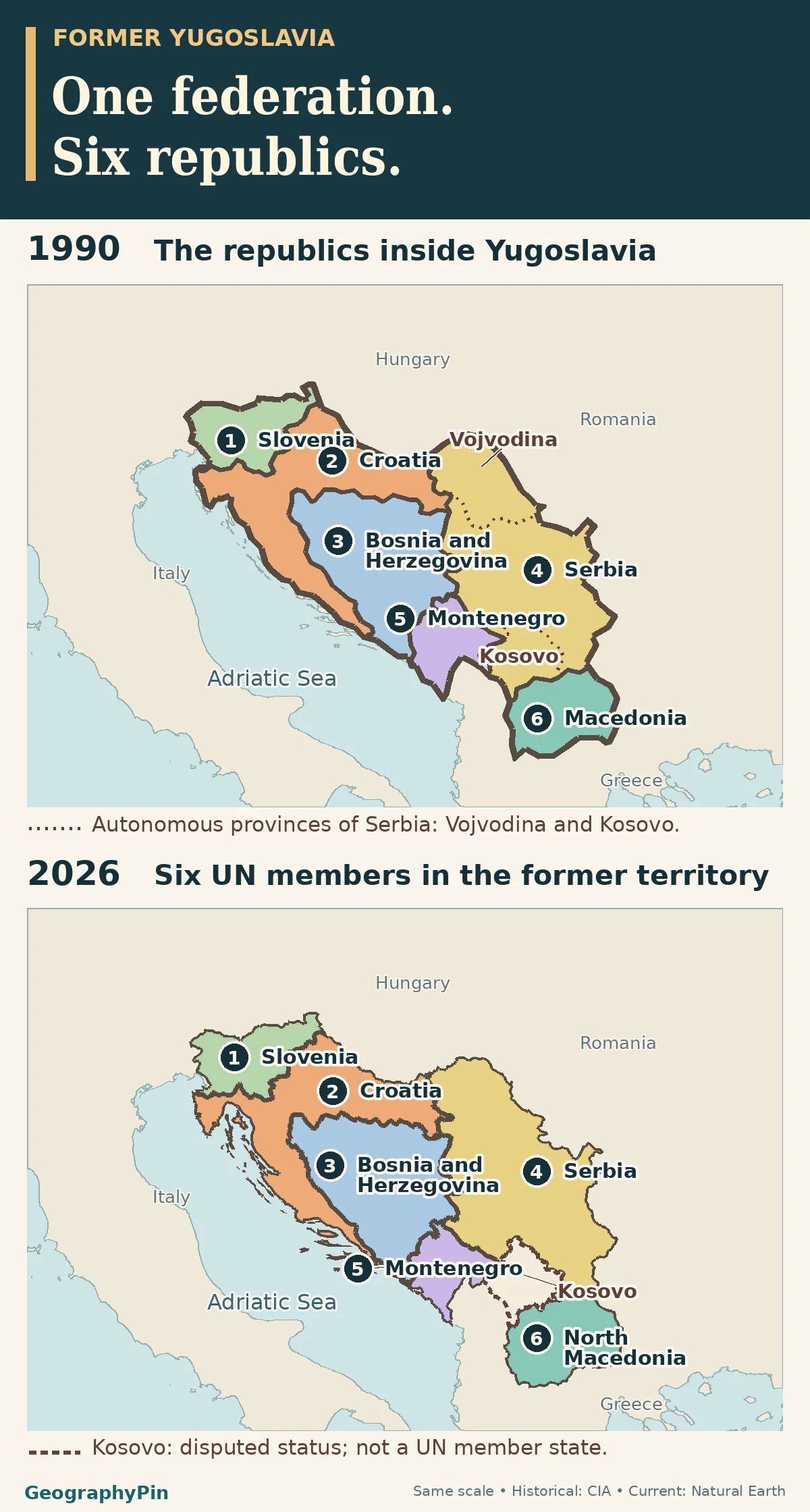
On the 1990 historical map, the republic lines are divisions within one federation. On the present-day map they help orient you among separate countries. The table links historical and current units by their political role; it is not a legal claim that every line remained identical.
| Historical unit | Status within the SFRY | Present-day comparison |
|---|---|---|
| Bosnia and Herzegovina | Republic | Bosnia and Herzegovina, UN member |
| Croatia | Republic | Croatia, UN member |
| Macedonia | Republic | North Macedonia, UN member |
| Montenegro | Republic | Montenegro, UN member |
| Serbia | Republic; included both autonomous provinces below | Serbia, UN member; it does not recognize Kosovo’s declared independence |
| Slovenia | Republic | Slovenia, UN member |
| Vojvodina | Autonomous province within Serbia | Autonomous province of Serbia |
| Kosovo | Autonomous province within Serbia | Declared independence in 2008; recognition is not universal; not a UN member |
Vojvodina and Kosovo were not seventh and eighth republics
Read the two provincial outlines inside Serbia
Vojvodina lay in the north of the Republic of Serbia, while Kosovo lay to the south. The International Criminal Tribunal for the former Yugoslavia describes both as autonomous provinces of Serbia within the federation. They had distinct status, but that did not make them separate republics. A historical map may label both by name without using the same line for a provincial boundary and a republic boundary.
Vojvodina remains an autonomous province of Serbia. Kosovo took a different path after the breakup and the war. The fact that they had the same kind of historical boundary does not mean they have the same political status today.
The name Yugoslavia outlasted the original federation
Distinguish the six-republic federation from Serbia and Montenegro
The six-republic federation broke apart in the early 1990s. The UN admitted Bosnia and Herzegovina, Croatia and Slovenia on May 22, 1992, and the state now called North Macedonia on April 8, 1993. UN admission dates identify membership, not necessarily the dates these republics declared independence.
Serbia and Montenegro formed the later Federal Republic of Yugoslavia (FRY), which the UN admitted on November 1, 2000. The same state changed its name to Serbia and Montenegro in 2003. Montenegro declared independence in June 2006 and joined the UN that month; Serbia continued the former union’s membership. A 1990s map labeled “Yugoslavia” may therefore show just Serbia and Montenegro, not the six-republic SFRY.
Why Kosovo appears separately on some modern maps
Separate declaration, recognition and UN membership
In June 1999, UN Security Council Resolution 1244 authorized an interim international administration for Kosovo. Kosovo declared independence on February 17, 2008. The United States recognized it the next day. Serbia does not recognize Kosovo’s independence, and Kosovo is not on the UN member roster.
The International Court of Justice concluded in its July 22, 2010 advisory opinion that the declaration itself did not violate international law. The Court did not decide whether Kosovo had attained statehood or rule on the legal effects of recognition. The EU’s statement at the October 2026 Security Council meeting uses Kosovo’s name without taking a position on its status. Separate marking on the modern panel shows the territory and the dispute, rather than declaring the question settled.
When the answer is six and when a map shows seven places
There are six historical republics and six present-day UN members in the territory of the former federation. If a map shows those six plus Kosovo separately, it has seven present-day political labels. That is a different counting rule, not an additional historical republic or a seventh UN member.
The same distinction prevents the opposite mistake. Albania, Bulgaria and Greece can appear on a wider Balkan map, but they were not republics of the SFRY. A regional map can shade them alongside former Yugoslav countries; a map of the federation’s historical extent should not.
Frequently Asked Questions
Is Republika Srpska the same as Serbia?
No. Republika Srpska is an entity within Bosnia and Herzegovina under the Dayton constitution. Serbia is a separate country. Their names do not override the international boundary.
Why do some older documents use “the former Yugoslav Republic of Macedonia”?
That was the provisional name used at the UN when the state joined in 1993. The UN records its change to North Macedonia effective February 14, 2019. The historical Yugoslav republic and today’s country are not two separate entries in the count.
Can a place belong to an international institution without being a UN member?
Yes. For example, Kosovo has been a member of the International Monetary Fund since 2009. Each organization has its own membership rules, so that does not add Kosovo to the UN list.
What Did We Learn Today?
The six Yugoslav republics correspond to six UN member states today. Vojvodina and Kosovo had a different historical status. Maps that draw Kosovo separately can show seven political labels, but the difference comes from what is counted, not from an extra Yugoslav republic.
Sources & Data Notes
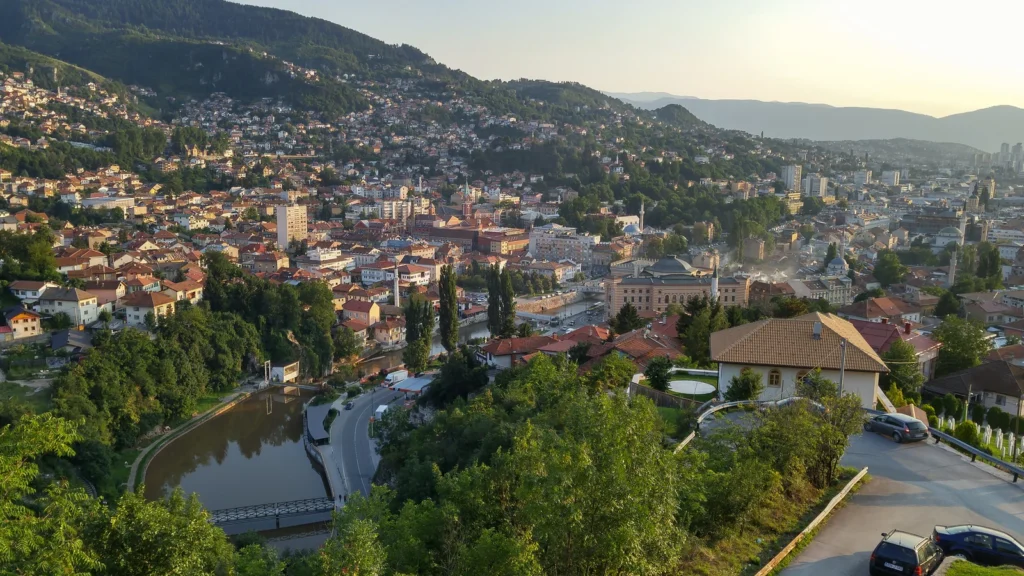
Featured image: A view of Sarajevo from the Yellow Fortress, Skelanard, July 18, 2018, CC BY-SA 4.0. Cropped, resized and converted to WebP; adapted image remains CC BY-SA 4.0. Sarajevo photograph postdates Yugoslavia. The historical classification comes from the International Criminal Tribunal for the former Yugoslavia and its account of the six republics and two provinces. UN succession and admission records and the member-state roster distinguish independence, admission and continuation of membership. The Vojvodina government and Annex 4 of the Dayton Agreement establish the present substate examples. Kosovo references are Security Council Resolution 1244, the 2010 ICJ advisory opinion, U.S. recognition records, Serbia’s October 2026 statement, the October 2026 EU statement and the IMF membership record. No recognition total or judgment on disputed sovereignty is implied. Original GeographyPin cartography used generalized original linework from the CIA Cartography Center’s 1990 snapshot (PDF page 12) and present Natural Earth 1:10m public-domain borders, not modern borders on the historical panel. Prepared for final factual and editorial review by Zurab Koniashvili (Z.K. Atlas).
