Knowing Armenia’s currency is only the first step in planning how to pay. A card that works at your Yerevan hotel may not solve a village lunch, a prearranged driver’s payment or an exchange counter’s confusing buy-and-sell board. Plan those transactions separately rather than carrying either no cash or your entire travel budget.
Use drams, with cash where your plans require it
Armenia’s currency is the Armenian dram, coded AMD. Carry some dram cash alongside a usable card, especially for travel outside Yerevan. Compare exchange offers by the final amount received after fees, check ATM conversion choices, and distinguish current banknotes from the older issues withdrawn in April 2026.
How to use this article: Identify older banknotes, work through an exchange comparison, or understand the card-terminal currency choice.
Practical information checked November 18, 2026. Exchange rates, bank charges and payment arrangements can change. The numerical example below is hypothetical, not a live quote.
1. Recognize the dram and check older banknotes
The Central Bank of Armenia identifies the national currency as the dram, with the ISO code AMD. One dram is divided into 100 luma. For trip calculations, keep the currency code beside the amount so an AMD price is not mistaken for dollars or another currency.
| Type | Denominations in drams |
|---|---|
| Modern circulating coins | 10, 20, 50, 100, 200, 500 |
| Third-series banknotes | 1,000, 2,000, 5,000, 10,000, 20,000, 50,000 |
| Older banknotes still listed in circulation | 50,000 (2001 issue); 100,000 (2009 issue) |
The coin row describes the modern circulating series, not every historic or collector issue. For everyday purchases, ask for a useful mix of smaller notes and coins when obtaining cash. A valid high-value note is not automatically convenient for a small transaction.
Old and current notes can have the same face value
The CBA withdrew specified second-series notes on April 15, 2026: the old 500, 1,000, 5,000, 10,000 and 20,000 dram issues identified in its withdrawal notice. This did not withdraw the current third-series notes with matching denominations, nor the older 50,000 and 100,000 dram notes still listed in the circulation catalogue.
If you kept cash from an earlier trip, check the issue and design against the CBA images before trying to spend it. The notice provides for free exchange of the withdrawn issues at commercial banks in Armenia and the CBA. Bring uncertain notes to a bank rather than relying on their color or denomination alone.
2. Carry cash for the parts of the trip that need it
Armenia’s official tourism site describes cards as widely accepted in Yerevan, while recommending cash for businesses and services that do not take them, particularly outside the capital. That is a planning distinction, not a promise that every Yerevan terminal accepts your particular card.
Before departure, check with your issuer that the card can be used in Armenia, how withdrawals are charged and what limits apply. Confirm the payment method directly with accommodation, drivers and activity providers when booking. A reservation confirmation and a completed payment are not the same thing.
For a rural day, list the expenses you have actually agreed to pay in cash: transport, meals, admissions and any outstanding accommodation balance. Add a modest contingency based on your itinerary, then obtain that amount before leaving a place where you can replenish it. This is more useful than a universal daily cash allowance that ignores prepaid services and group size.
For transport, ask whether the specific service requires cash, a ticket or an app payment. Do not assume one city’s fare system applies to intercity journeys or village connections. Keep the agreed amount and pickup details together so the payment question is settled before departure.
Use the Armenia travel guide to plan your bases and travel days first; then match the cash plan to those stops. Keep a backup payment method separate from the one you use routinely.
3. Compare the amount you receive, not the biggest rate
The CBA publishes average market exchange rates. These are a reference for understanding the market, not a guaranteed price at a particular bank or exchange counter. Consumer quotes can differ, and a separate charge can change which offer is better.
When handing over foreign cash to receive drams, ask for the rate at which the provider buys your foreign currency. When converting leftover drams back, the opposite side of the board applies. Confirm the final payout for your exact amount before agreeing, including any fee or minimum-transaction condition.
A higher advertised rate can still pay less
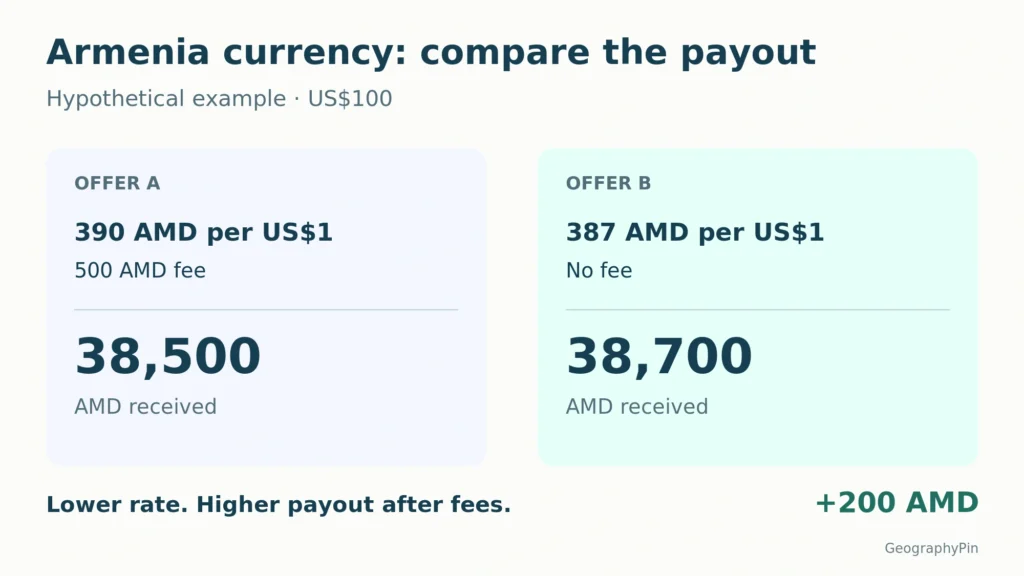
Illustration prepared November 18, 2026: suppose you exchange US$100. The following invented offers demonstrate the arithmetic only; neither is a current Armenian exchange rate or an offer from a named provider.
| Offer | Calculation | Drams received |
|---|---|---|
| A: 390 AMD per US$1, with a 500 AMD fee | 100 × 390 − 500 | 38,500 AMD |
| B: 387 AMD per US$1, with no fee | 100 × 387 | 38,700 AMD |
Offer B pays 200 AMD more even though its displayed rate is lower. Use the same method with real quotes: multiply the foreign-currency amount by the offered rate, then subtract charges expressed in drams. If a fee is charged separately in another currency, include that cost too rather than treating it as free.
Use an established bank or exchange office, check the posted terms and count the cash before leaving. Keep the receipt. Avoid converting substantially more than the trip requires simply because the headline rate looks attractive.
4. Read the ATM and card-terminal choices
An ATM can involve more than one charge: the machine’s own fee, your issuer’s withdrawal or foreign-transaction fee, and the currency conversion. Check both the screen and your card terms. A withdrawal limit shown by the machine does not tell you what your bank will charge or authorize.
AMD or your home currency?
A terminal or ATM may offer to bill you in your home currency using dynamic currency conversion, or DCC. Visa explains that this is a separate conversion offer, with its own rate and possible markup. The screen should show the relevant amounts, exchange rate and extra charges, and the decision belongs to you.
If you want your card’s normal conversion process, choose the local-currency transaction in AMD and decline the offered DCC conversion. That does not remove your own bank’s fees. Do not confuse declining currency conversion with canceling the purchase or withdrawal.
Compare the disclosed cost rather than accepting a home-currency amount just because it is familiar. If the choice is unclear or someone pressures you to accept conversion, Visa recommends declining the conversion offer and reporting the problem to your card issuer. Keep the receipt and check the posted transaction afterward.
5. Check cash declarations before crossing the border
The Armenian State Revenue Committee’s passenger guidance requires a declaration when the combined cash and traveler’s checks carried at one entry or exit exceed the equivalent of US$10,000, using the exchange rate applicable on the declaration date. Count currencies together, not as separate allowances.
For movement across the Eurasian Economic Union customs boundary, amounts exceeding US$100,000 also require documents establishing the funds’ origin. Other monetary instruments, apart from traveler’s checks, have separate declaration requirements regardless of amount; balances held on bank cards are not physical cash to declare under this guidance.
If your money or documents may require declaration, use the red channel and ask customs rather than guessing. Read the SRC passenger declaration guide before travel, and check the rules of your departure and transit countries as well. Armenia’s declaration threshold does not override another country’s cash-export restrictions.
What Did We Learn Today?
A useful Armenia payment plan follows the journey: check older cash, confirm which bookings need drams, and obtain a manageable reserve before rural stops. At an exchange counter or ATM, compare the complete transaction rather than a headline rate. Border declarations are a separate responsibility from finding a convenient way to pay.
Sources & Data Notes
View currency and payment sources
Checked November 18, 2026. The denomination table follows the CBA’s current circulation catalogue, not older banknote PDFs. The exchange example is original hypothetical arithmetic, not a live converter or a record of an actual transaction. Cash-planning suggestions depend on confirmed bookings; card acceptance and individual bank charges remain provider-specific. Customs guidance is summarized for travelers, not for commercial transfers.
- CBA: current banknote catalogue and currency code
- CBA: evolution of the dram and modern coin series
- CBA: specified second-series banknote withdrawals from April 15, 2026
- Armenia Travel: ATMs, cards and cash
- CBA: average market exchange rates
- Visa: dynamic currency conversion choices and disclosure
- Visa: foreign transactions and ATM charges
- Armenian SRC: passenger declarations, 2024 guide, questions 1 and 7
- Armenian SRC: border-crossing guide, 2024, question 13