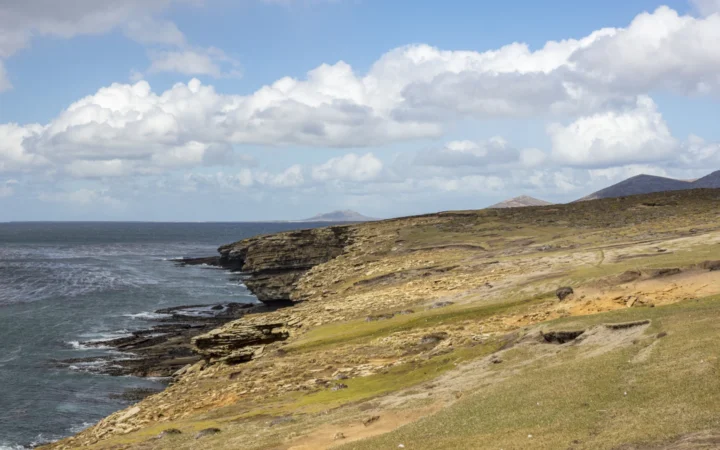
The Falklands War was fought over islands in the South Atlantic, but its supply lines extended across an ocean. Understanding where the campaign happened also helps separate the outcome of the fighting from the continuing disagreement over sovereignty.
The 1982 conflict in brief
The Falklands War was fought between Argentina and the United Kingdom in 1982 after Argentine forces invaded the South Atlantic islands on April 2. British forces retook them, with the Argentine surrender at Stanley on June 14. The military outcome restored British administration but did not resolve the sovereignty dispute.
Present-day status sources checked: November 18, 2026. Historical events are identified by their 1982 dates.
Read the conflict in context: Start with the decision to invade, compare the ocean and island scales, or distinguish administration and sovereignty claims.
1. Why the dispute became a war
A territorial dispute and the decision to invade
The islands are called the Falklands in English and Malvinas in Spanish. Argentina and Britain had competing sovereignty claims long before 1982. Negotiations from the 1960s had not produced agreement. The immediate cause of the war was the Argentine military government’s decision to seize the islands, replacing the British administration by force.
Argentina was ruled by a military junta led by General Leopoldo Galtieri. In Britain, Prime Minister Margaret Thatcher ordered a task force south to reverse the invasion. The U.S. State Department’s historical account describes unsuccessful American mediation: Argentina would not compromise its sovereignty claim, while Britain required Argentine withdrawal before negotiations over sovereignty.
The UN Security Council’s Resolution 502, adopted on April 3, demanded an immediate end to hostilities and the withdrawal of Argentine forces. It also called for a diplomatic solution. The resolution addressed the breach of peace; it was not a final determination of sovereignty.
2. The South Atlantic geography behind the campaign
Ocean distance and island terrain
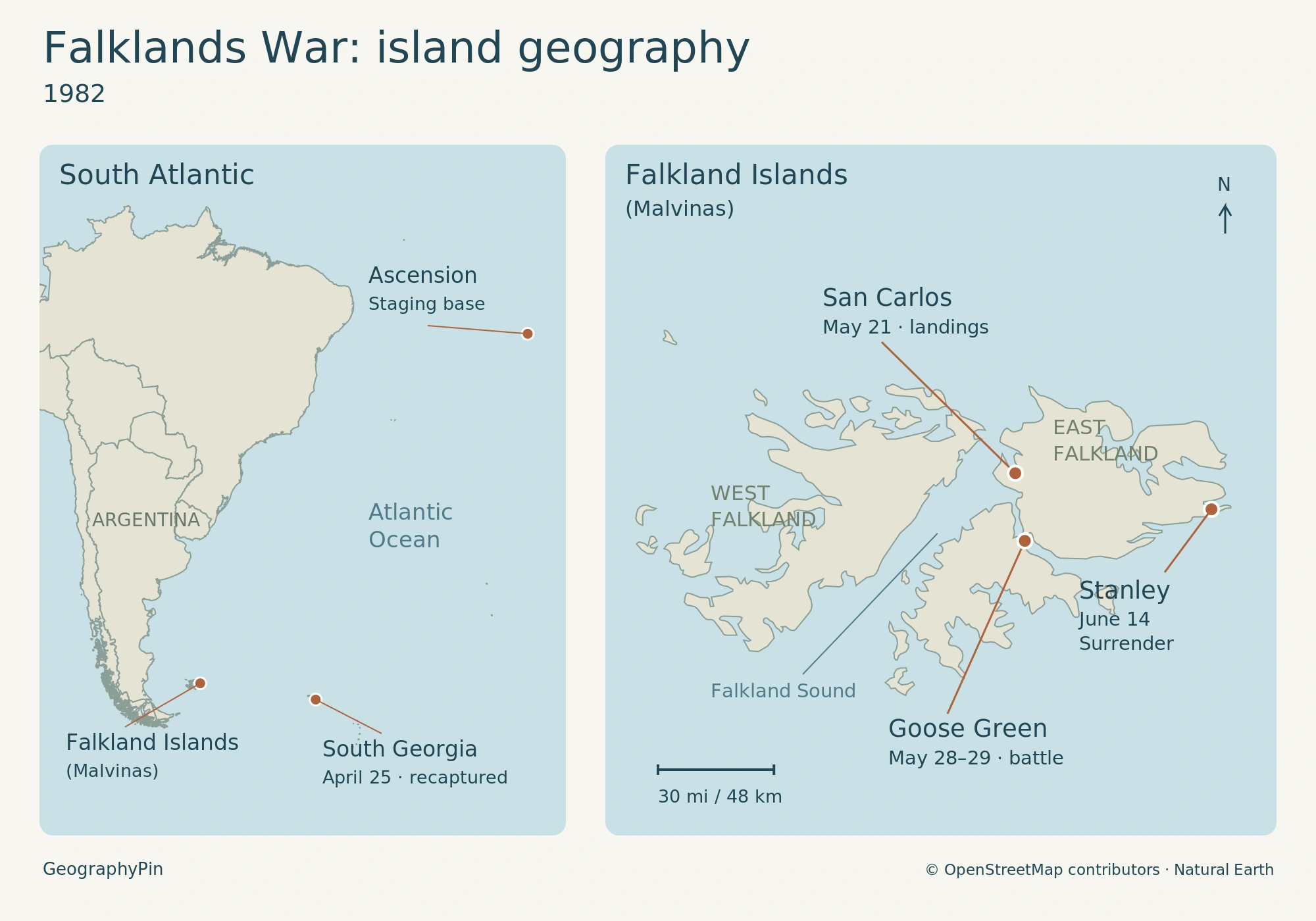
The Falkland Islands are an archipelago, with East Falkland and West Falkland as its two main islands. They lie roughly 300 miles (480 kilometers) from southern Argentina and about 8,000 miles (13,000 kilometers) from Britain. These are broad geographical distances, not the measured length of a particular fleet voyage.
Britain had to move people, fuel and equipment across the Atlantic. Ascension Island became a major staging and supply point. Sebastian Ritchie’s RAF history explains how its airfield supported both air and naval operations, and how long distances made aerial refueling especially important. A small island far from the battlefield thus belonged to the campaign’s wider geography.
On East Falkland, the landings at San Carlos and the eventual surrender at Stanley were separated by difficult ground. The National Army Museum describes advances across rough terrain and the battles for the heights around Stanley. Weather, transport and the movement of supplies mattered alongside the fighting itself.
3. A concise timeline of the 1982 war
The June 14 surrender at Stanley did not immediately complete prisoner repatriation or the surrender of outlying garrisons. South Georgia was a separate location in the wider conflict.
| Date | Event |
|---|---|
| April 2 | Argentine forces invade the Falklands and take control of Stanley. |
| April 3 | UN Security Council Resolution 502 demands Argentine withdrawal and an end to hostilities. |
| April 5–6 | Major elements of the British task force sail from Portsmouth. |
| April 25 | British forces regain South Georgia, a separate island in the wider conflict. |
| May 2 | HMS Conqueror sinks the Argentine cruiser General Belgrano. |
| May 21 | British troops land around San Carlos Water on East Falkland. |
| May 28–29 | Fighting at Darwin and Goose Green ends with the Argentine garrison’s surrender. |
| June 11–14 | Battles around Stanley precede the Argentine surrender there on June 14. |
4. How the fighting unfolded
The war combined fighting at sea, attacks from the air and a ground campaign. British forces could not treat the surrounding ocean as a secure supply corridor: Argentine aircraft struck warships and support vessels. The loss of helicopters aboard Atlantic Conveyor sharply reduced transport capacity and complicated movement ashore.
The sinking of General Belgrano became one of the war’s most disputed episodes. The cruiser was outside Britain’s declared total exclusion zone. The Royal Navy Museums account acknowledges the continuing controversy. An exclusion-zone boundary and the wider arguments about the use of force are not the same question; a locator map should not turn that boundary into a verdict.
After the San Carlos landings, the British ground campaign moved toward Stanley. Fighting at Goose Green was followed by battles for the surrounding high ground. Argentine forces at Stanley surrendered on June 14, and Britain restored its administration of the islands. This was a military defeat for Argentina, not a negotiated sovereignty settlement.
5. The human cost and political aftermath
Royal Navy Museums records 649 Argentine military personnel, 255 British personnel and three Falkland Islanders killed during the conflict. Those figures describe wartime deaths, not everyone later affected by injury, bereavement or the experience of combat. A short campaign was not a small loss for the people involved.
The defeat undermined Argentina’s military government. Galtieri was forced from power after the surrender, and civilian democratic rule returned in 1983. In Britain, victory strengthened Thatcher politically and helped the Conservatives in the following year’s election. These were major consequences, but neither election results nor military success determined the legal positions of the two governments.
6. What the war did not settle
Administration, sovereignty claims and islanders
The United Kingdom administers the islands, while Argentina continues to claim sovereignty. The UN lists the Falkland Islands (Malvinas) as a Non-Self-Governing Territory and explicitly identifies a sovereignty dispute between the two governments. Administration describes who governs; it does not erase the existence of the competing claim.
In a September 10, 2026 parliamentary answer, the British government reaffirmed its position that the islands should remain British for as long as the islanders wish, emphasizing their right to self-determination. Argentina’s foreign ministry frames the issue instead as an unresolved territorial and decolonization dispute, maintains its sovereignty claim and calls for negotiation.
Those positions should not be collapsed into the statement that the islands were “awarded” to Britain in 1982. The war restored British control after the invasion. The diplomatic disagreement continued afterward, and the islanders’ political wishes remain central to the British position. Historical campaign maps and present-day political maps therefore answer different questions.
What Did We Learn Today?
The Falklands War began with Argentina’s invasion and ended in British military victory. Its geography involved an Atlantic supply network, separate island groups and a demanding land campaign on East Falkland. The surrender at Stanley changed control of the islands, while the longer sovereignty dispute continued. Understanding both facts avoids confusing a war’s outcome with a final diplomatic settlement.
Sources & Data Notes
Historical chronology and status sources
The timeline selects major events rather than every engagement. The June 14 surrender at Stanley is distinguished from later outlying operations and prisoner repatriation. British and Argentine positions are attributed separately; the UN’s terminology is retained when describing its classification. Broad distance figures are rounded. The older parliamentary briefing is used for historical events and geography, not its outdated population or European Union references.
- UK Ministry of Defence: invasion, San Carlos landings and Stanley surrender
- U.S. Office of the Historian: Crisis in the South Atlantic
- UN Security Council Resolution 502 (1982), via Refworld
- House of Lords Library: Falklands War, 35 Years Anniversary
- National Army Museum: The British Army and the Falklands War
- Sebastian Ritchie: RAF Command and Control, 1982–2014, page 18
- Royal Navy Museums: Falklands 40, Conflict Overview
- UN Secretariat: Falkland Islands (Malvinas), A/AC.109/2026/6, paragraphs 1–5
- UK parliamentary answer on sovereignty, September 10, 2026
- Argentina’s foreign ministry: La Cuestión de las Islas Malvinas
Original geography illustration: GeographyPin, using Natural Earth (public domain) and © OpenStreetMap contributors (ODbL). Historical dates checked against National Army Museum, UK Ministry of Defence and RAF Air Historical Branch. Generalized geographic reference, not a tactical map.
Representative landscape photograph: amanderson2, December 24, 2019, via Wikimedia Commons, CC BY 2.0. This is modern scenery, not a photograph of the 1982 fighting. The hosted derivative is unchanged; thumbnails may be cropped.