The hardest first-trip decision in Uzbekistan is often what to leave out. Start with a route that allows time in the cities, then decide whether Khiva and the longer western journey fit your available days.
Leave time between the cities
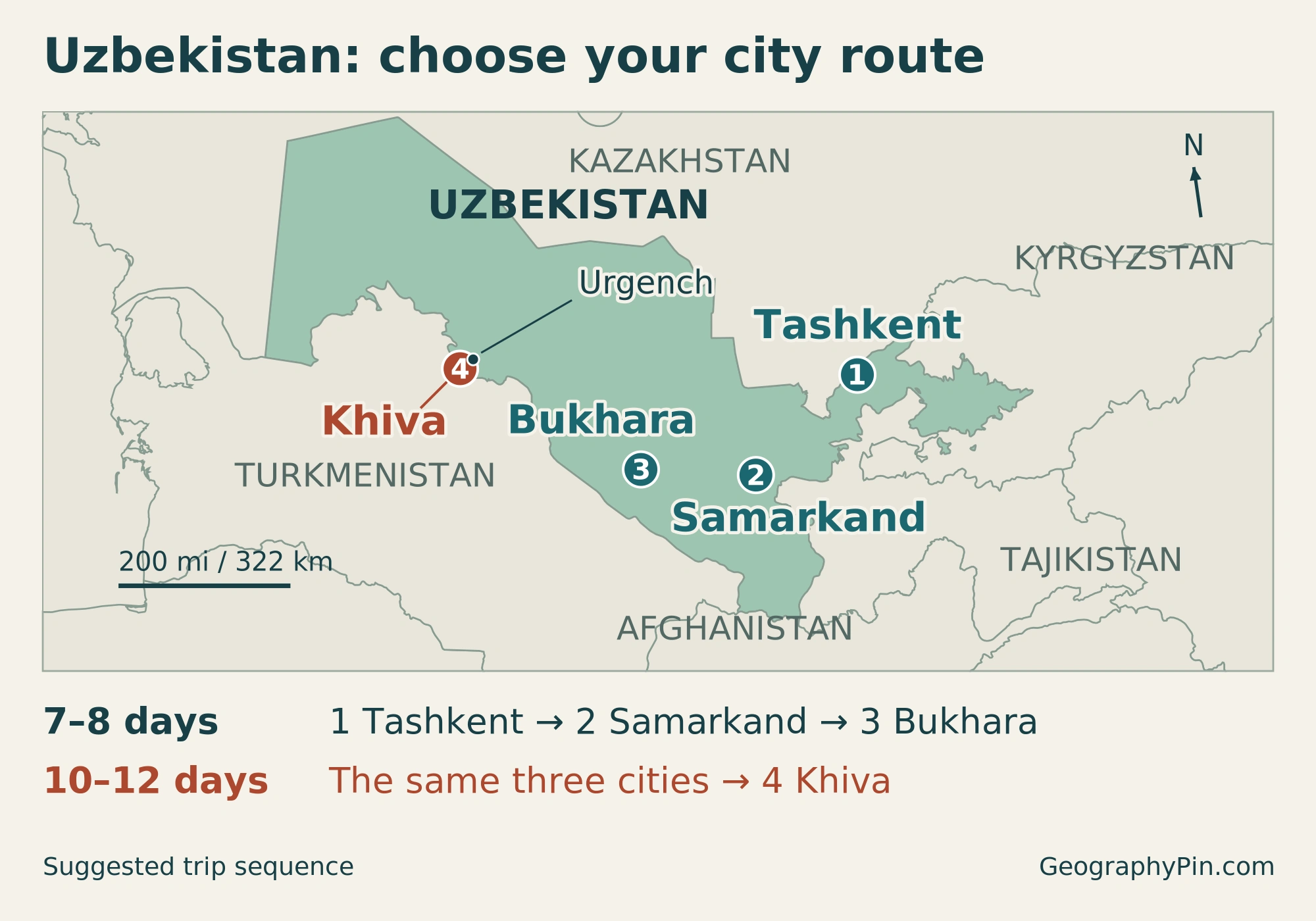
For a first Uzbekistan trip, allow seven or eight days for Tashkent, Samarkand and Bukhara, or ten to twelve days to add Khiva without rushing the transfers. Spring and autumn suit a city-focused route. Confirm transport for your dates, then check nationality-specific entry rules and accommodation registration before departure.
Practical information checked: November 18, 2026. Entry rules, transport and access can change.
How to use this article: Compare trip lengths, decide between rail and flying, or go straight to the entry checks.
1. Choose three cities or make room for Khiva
For a first trip, I would start with Tashkent, Samarkand and Bukhara over seven or eight days. That leaves room to arrive, settle in, spend time in the cities and move between them without treating every evening as a departure deadline. With ten to twelve days, Khiva becomes a more comfortable addition.
Count nights before counting landmarks
| Time available | Route | How to divide it |
|---|---|---|
| 7–8 days | Tashkent → Samarkand → Bukhara | About 2 nights in each; reserve departure positioning separately. |
| 10–12 days | The same route, then Khiva | Add 2 nights in Khiva and protect time for the westward transfer and departure. |
| 5 days or less | Tashkent and Samarkand, or another two-city combination | Drop a stop rather than compressing four cities into travel days. |
These are planning recommendations, not minimum stays. Two nights usually provide only one uninterrupted day when arrivals and departures fall in the middle of the day. If you land late, count that as an arrival night, not a sightseeing day. Add time for a slower walking pace, children, photography or an afternoon indoors.
Check your international flights before committing to the direction. Returning to Tashkent may be necessary for your chosen departure; a suitable flight from another city may avoid backtracking. If a domestic journey and an international flight are separate bookings, I would spend the previous night in the departure city rather than build the trip around a tight same-day connection.
2. What each city adds to the trip
Choose cities for the experience you want, not because each has appeared on a must-see list. The main route works best when you leave time for something other than moving from one ticket desk to the next.
- Tashkent: make room for the capital’s metro, museums and Chorsu Bazaar. It gives the trip a different urban setting from the historic centers farther west.
- Samarkand: allow time for major ensembles such as the Registan and Shah-i-Zinda, rather than reducing the city to one photo stop.
- Bukhara: favor slower time in the old city, including the Lyabi-Hauz area and its surrounding streets.
- Khiva: add an overnight stay for the walled inner town of Itchan Kala, not simply a hurried arrival-and-departure visit.
The individual city guides handle walking plans, accommodation areas and attraction checks. Use them to plan each stay once you have settled the overall route. For landscapes and broader geographic context, use the Uzbekistan country profile.
3. Book the long transfers before the small details
Rail for the sequence, a flight when it saves a day
Uzbekistan Railways connects the main city corridor. Its July 2026 report describes the Jaloliddin Manguberdi service from Tashkent to Khiva, stopping at Samarkand, Navoi, Bukhara and Urgench, with a journey of about seven and a half hours end to end. Use that corridor to shape the trip, then check the actual departures and seats for your dates.
Search the official railway booking service for each stage before fixing nonrefundable hotels. Check the station, travel date, arrival time and passenger details, not just the destination name. A short train journey can still consume much of a day once checkout, station transfers and the next hotel are included.
For train types, station names and booking checks, see the Uzbekistan train guide.
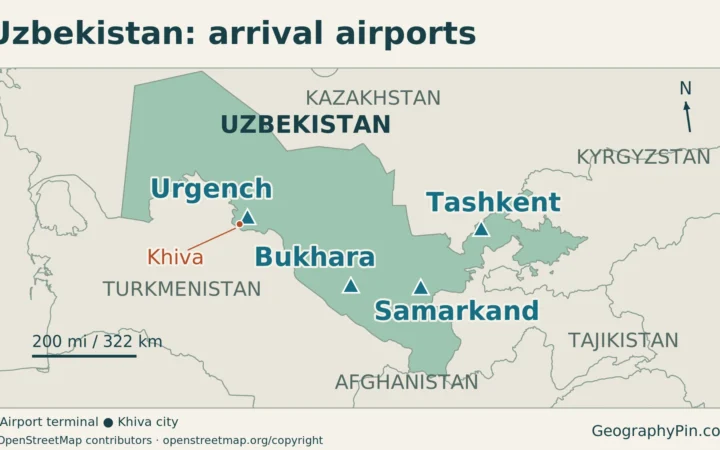
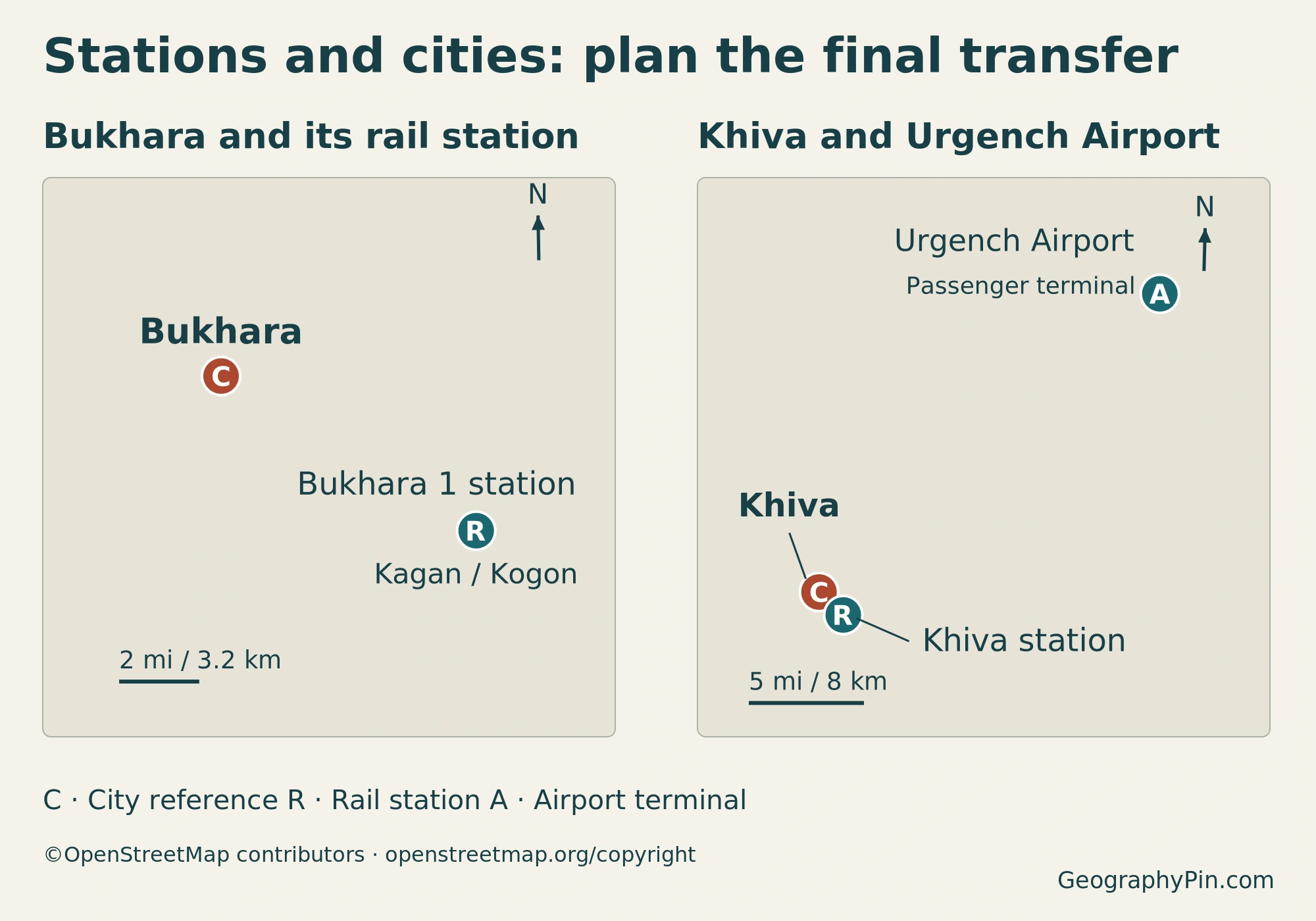
For the western end, compare rail with a flight between Tashkent and Urgench. Uzbekistan Airways’ November 2026 departure board lists that air connection. Urgench is a separate destination from Khiva, so include the onward ground transfer in your comparison. Check the airline’s current flight information and the conditions of the fare you actually book.
The airports and arrival-planning guide compares gateways, terminal changes and transfers to the correct railway station.
Compare the whole journey: airport travel, check-in and baggage collection all count, alongside the time in the air or on the train. With several cities in the middle, rail can keep the trip moving in one direction; a flight can be useful for the long return after Khiva.
4. Match the season to the trip you want
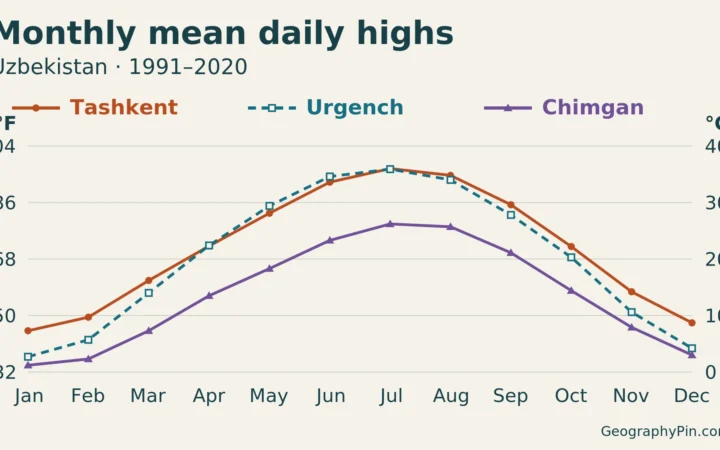
Spring and autumn are the easiest starting points for a city-focused itinerary. Uzbekistan’s national tourism guidance favors these periods for sightseeing. They are a preference, not a weather guarantee: carry layers, check the forecast and leave flexibility for wet or unusually hot days.
For named-station monthly temperatures and city-versus-mountain comparisons, see the best time to visit Uzbekistan.
Summer requires a different rhythm, particularly in the western cities. The national tourism page for Khiva describes hot, dry summers and winter temperatures that often fall below freezing. In hot weather, I would put outdoor sightseeing early, reserve an indoor or hotel break, and keep the evening schedule flexible. Do not fill the midday gap with another exposed excursion simply because the calendar has space.
Winter can suit a trip with shorter outdoor visits and more indoor time, provided you are comfortable with cold weather. A mountain or desert extension needs its own seasonal and access check; conditions on a city circuit do not establish whether a remote road, trail or activity is suitable.
5. Settle entry and arrival arrangements early
Your passport determines the entry rules
As checked on November 18, 2026, U.S. citizens can visit Uzbekistan visa-free for tourism or business for up to 30 days. This regime began on January 1, 2026. Do not apply that rule to another nationality, a different passport type, employment or a longer stay: consult Uzbekistan’s Ministry of Foreign Affairs visa guidance.
For the document checklist, Indian-passport exception and registration rules, use the Uzbekistan visa and entry guide before booking.
Check the passport-validity rule for your nationality and document with the Uzbek consulate and your carrier before booking. Include any transit-country requirements, not just the rules for your final destination.
Arrange accommodation registration promptly. Ask your hotel or host how they will register your stay, and keep the confirmation. Visa-free entry does not mean registration-free travel. If you change accommodation, check that the next stay is covered rather than assuming the first hotel registered your entire route.
Before arrival, save the accommodation address offline, agree how to reach it and tell the host if your flight lands late. For medication, drones or unusual equipment, check the relevant import rules before packing; ordinary tourist entry permission does not settle those separate requirements.
6. Plan everyday spending and meals
Use Uzbek soum for local spending and keep a cash backup. The UK’s travel guidance warns that international cards and compatible ATMs are much less dependable outside the main cities. Exchange money through official channels, and check payment arrangements before a remote excursion or a stay with a small accommodation provider.
For denominations, exchange quotes and border cash rules, see the guide to Uzbek soum, cash and cards.
A useful budget separates four things: accommodation, intercity travel, local transfers and admission or guiding. Compare the full total, including luggage and cancellation conditions, rather than treating an advertised starting fare as the cost of a complete journey. Leave a reserve for replacing a missed connection or changing plans.
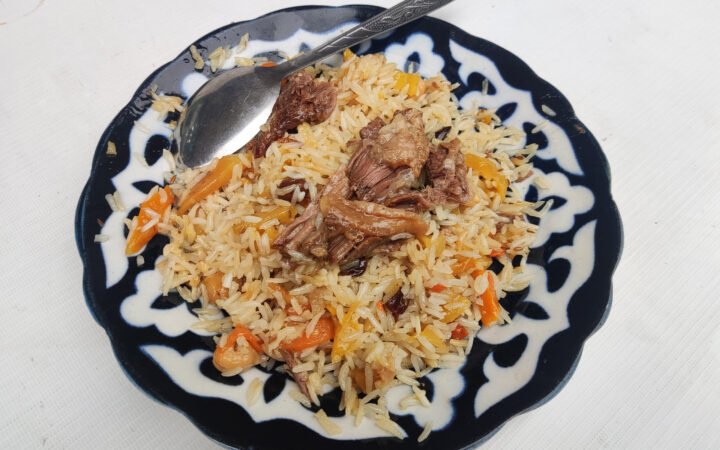
For a first look at plov, non, samsa and other dishes, the Uzbek food guide explains what to expect and what to ask when ordering.
For dietary requirements, explain what you cannot eat rather than relying on a dish’s name. Ask about broth, cooking fat and fillings as well as visible ingredients. Carry that explanation in writing if communication may be difficult, and check with accommodation in advance when food restrictions are significant.
The U.S. State Department advises travelers not to drink tap water and to favor freshly prepared, thoroughly cooked food. Request safe drinking water explicitly and be cautious about ice. These are practical precautions, not a reason to avoid local food altogether.
7. Treat the city circuit and remote travel differently
The U.S. State Department’s advisory issued January 26, 2026 rates Uzbekistan Level 1: Exercise Normal Precautions. That does not guarantee an incident-free trip or mean the same planning suits every area. Review the advice for your nationality, insurance coverage and personal circumstances before departure.
On the city route, protect belongings in crowds and use licensed transport. For excursions, ask about the vehicle, seatbelts, communication and the return plan. A cheap transfer is not good value if the arrangement leaves you unable to change course safely.
The Afghanistan frontier requires separate attention. UK guidance describes the Friendship Bridge crossing as closed to foreigners and warns of military restrictions near the river border; some nearby sites need permission or an organized visit. Do not treat that area as an interchangeable extension of the Tashkent–Samarkand–Bukhara route.
Travelers whose circumstances involve particular legal or health risks should read the relevant sections of their government’s advice, including medication and LGBT+ guidance. For any remote addition, check permission, transport and emergency arrangements specifically.
What Did We Learn Today?
A first Uzbekistan trip works better when its length follows the route, not the number of famous places on a list. The three-city circuit leaves more room for a shorter visit; Khiva deserves extra time for both the stay and the journey. Book the crucial transfers, protect arrival and departure time, and match practical checks to your passport and the places you will actually visit.
Sources & Data Notes
View planning sources
Route lengths and night allocations are editorial recommendations, not operator itineraries. Rail information establishes the corridor, not daily frequency or seat availability. The flight board was checked in November 2026. Confirm the journeys and entry conditions for your own dates and passport.
- Uzbekistan Railways: July 29, 2026 service report
- Uzbekistan Railways: booking search
- Uzbekistan Airways: current flight board
- Uzbekistan Ministry of Foreign Affairs: visa regimes
- Uzbekistan public-services portal: registration and visitors
- U.S. State Department: Uzbekistan travel advisory
- U.S. State Department: entry and practical country guidance
- UK travel advice: money, personal safety and local laws
- UK travel advice: Afghanistan border region
- Uzbekistan Tourism: seasonal trip planning
- Uzbekistan Tourism: Khiva and its climate
Maps: original GeographyPin route and arrival diagrams. City reference points and generalized boundaries use Natural Earth countries 5.1.1 and populated places 5.1.2 (public domain). Facility positions use © OpenStreetMap contributors, ODbL, cross-checked against official station descriptions and the July 10, 2025 Urgench airport chart. They locate facilities, not exact entrances, rail alignments or transfer routes. Route lengths are editorial recommendations.
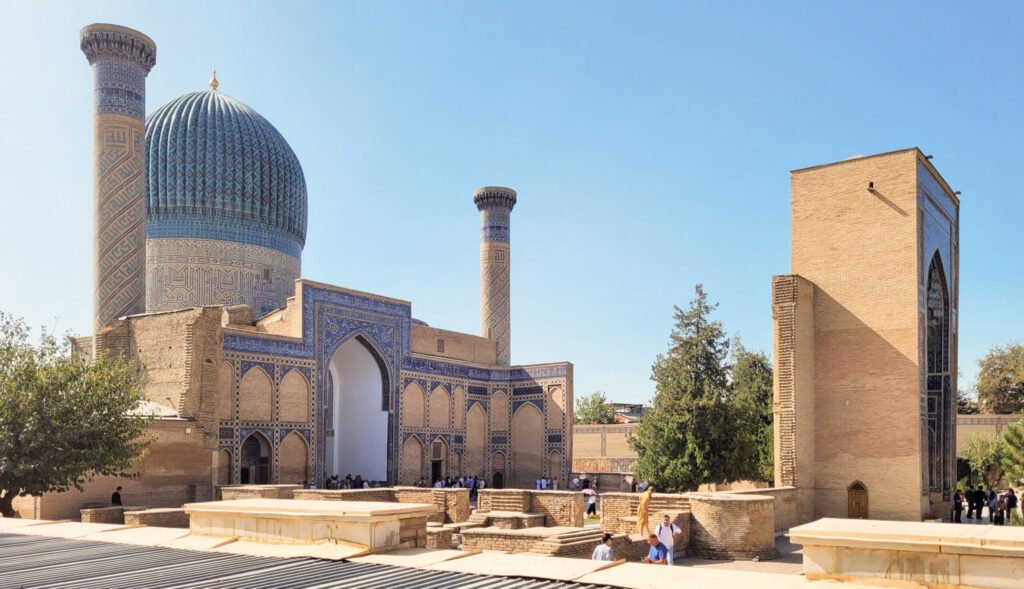
Cover: Gur-e Amir in Samarkand, September 29, 2023, by Bgag, Wikimedia Commons, CC0 1.0.