A trip built around Uzbekistan’s city streets asks something different of the weather than a western road journey or a mountain extension. Choose the places and the amount of outdoor time first, then use the season to make that route more comfortable.
The case for an April or October trip
April and October are strong starting points for sightseeing in Uzbekistan’s main cities, based on 1991–2020 station climate normals. May and September are warmer alternatives; summer calls for heat-conscious scheduling, while winter brings cold nights. Mountain and western extensions need their own checks: a pleasant city average does not establish conditions along your route.
Sources checked: November 18, 2026. Climate figures describe 1991–2020, not a forecast for your travel dates.
How to use this article: Compare the monthly station figures, check a mountain extension, or find the latest Tashkent city forecast.
1. April or October for a city-focused trip
For a trip with long stretches of city walking, April and October offer a useful starting point. Samarkand’s mean daily highs were 71°F (21.5°C) in April and 72°F (22.0°C) in October. This is a planning judgment from the station data, not a promise that every day will be mild.
May and September can work if you prefer warmer afternoons. Do not read “spring” as uniformly cool, however: Bukhara’s May mean high was 87°F (30.7°C), rising to 99°F (37.3°C) in July. For a summer city visit, favor shorter outdoor sessions and leave time for indoor breaks.
If your dates are fixed, change the pace rather than trying to fit the same walking schedule into every season. Decide which visits require prolonged time outside, which can move to another part of the day, and which can be shortened. The Uzbekistan travel guide helps connect that choice to the wider route.
2. How the monthly averages differ by location
Three stations, one comparison period
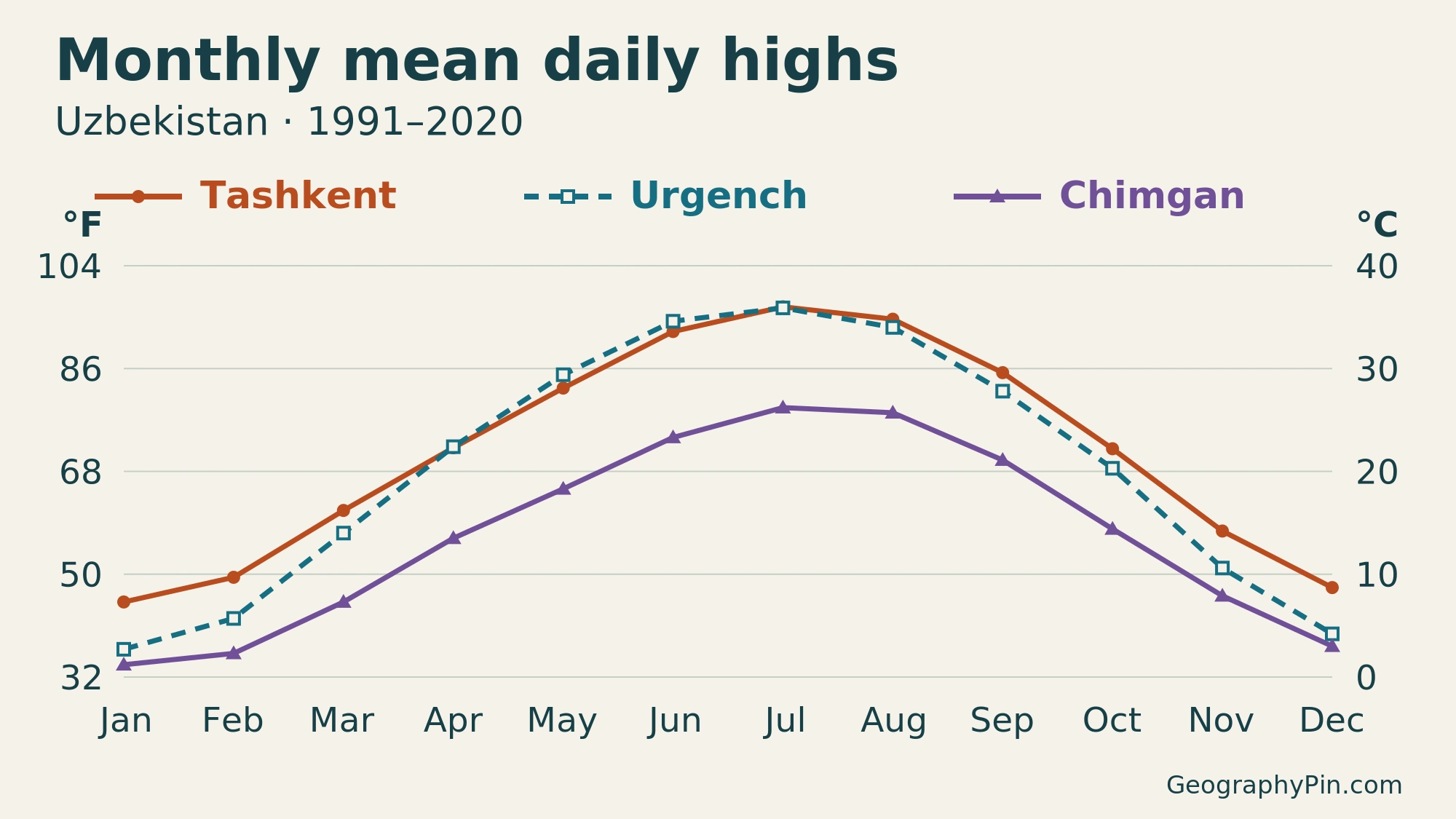
The table uses Uzbekistan’s station submissions in the WMO 1991–2020 climate-normal archive held by NOAA NCEI. Values are mean daily highs for each month, not record temperatures, daily mean temperatures or a countrywide average.
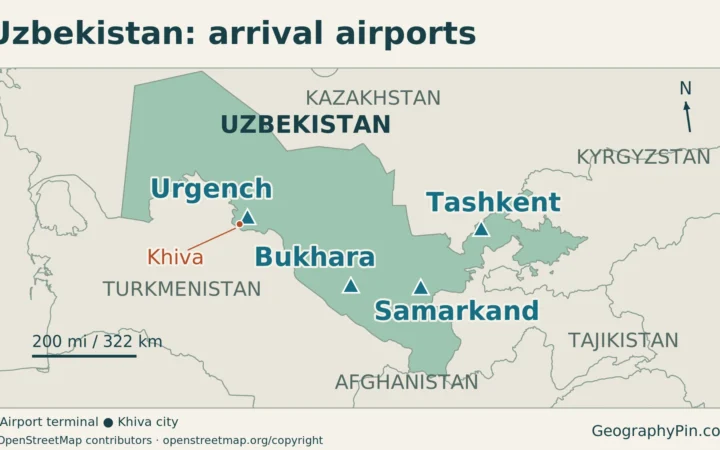
Tashkent represents its named city station; Urgench provides a western reference, not a measurement taken in Khiva. Chimgan is a mountain station at about 5,479 feet (1,670 meters), not a summit or a description of every trail.
| Month | Tashkent | Urgench | Chimgan |
|---|---|---|---|
| Jan | 45°F (7.3°C) | 37°F (2.7°C) | 34°F (1.2°C) |
| Feb | 49°F (9.7°C) | 42°F (5.7°C) | 36°F (2.3°C) |
| Mar | 61°F (16.2°C) | 57°F (14.0°C) | 45°F (7.3°C) |
| Apr | 72°F (22.3°C) | 72°F (22.4°C) | 56°F (13.5°C) |
| May | 83°F (28.1°C) | 85°F (29.4°C) | 65°F (18.3°C) |
| Jun | 92°F (33.6°C) | 94°F (34.6°C) | 74°F (23.3°C) |
| Jul | 97°F (36.0°C) | 97°F (35.9°C) | 79°F (26.2°C) |
| Aug | 95°F (34.8°C) | 93°F (34.0°C) | 78°F (25.7°C) |
| Sep | 85°F (29.6°C) | 82°F (27.8°C) | 70°F (21.1°C) |
| Oct | 72°F (22.2°C) | 69°F (20.3°C) | 58°F (14.4°C) |
| Nov | 58°F (14.2°C) | 51°F (10.6°C) | 46°F (7.9°C) |
| Dec | 48°F (8.7°C) | 40°F (4.2°C) | 37°F (3.0°C) |
A monthly average is useful for choosing a season, but it smooths over individual hot, cold, wet and windy days. It also does not show what the weather will be at the hour of a visit. Use it to compare options, then replace the assumption with a forecast near departure.
3. Western plains and mountains need different plans
The western stations show why a desert-side itinerary is not automatically a warm winter escape. Urgench’s January mean daily low was 22°F (-5.7°C); Nukus’s was 19°F (-7.5°C). Plan winter clothing for early starts and evenings, not only the average afternoon.
For western road trips, ask about the actual day’s stops, time outdoors and opportunities for breaks. A city station cannot stand in for every exposed road, archaeological site or overnight location. Do not turn a monthly temperature into a claim that a remote excursion will be comfortable.
A cooler station is not an access report
Chimgan’s July mean high was 79°F (26.2°C), substantially below the lowland summer values. But spring is not simply an earlier version of summer: its April mean precipitation was 5.63 inches (142.9 mm). That total includes precipitation, not just rain, and does not measure snow depth.
For any mountain extension, verify the particular road, trail or lift with its operator or local authority and check conditions close to the outing. The season alone cannot establish that a route is open or suitable. Keep the mountain day movable rather than attaching it to a city forecast.
4. Spring and autumn are not interchangeable
Tashkent’s April and October mean highs were almost identical: 72°F (22.3°C) and 72°F (22.2°C). Their mean monthly precipitation differed: 2.49 inches (63.3 mm) in April versus 0.93 inches (23.7 mm) in October. Similar afternoon temperatures do not mean the same wet-weather plan.
- March through May: allow for a transition from cooler conditions to warmer afternoons rather than treating the whole season as one temperature. Pack layers and an option for wet weather.
- June through August: build the day around shorter outdoor sessions and breaks, particularly in the lowland cities. Longer daylight does not make midday the best time to walk.
- September through November: check the month, not just the word “autumn.” Leave room for cooler evenings and a different balance of indoor and outdoor visits later in the season.
- December through February: choose this for a cold-tolerant itinerary, with warm clothing and shorter outdoor plans. Shorter daylight also reduces the room for a late-starting excursion.
Weather data cannot tell you which month has the cheapest rooms or fewest visitors. If cost or a festival is deciding the trip, check the actual dates and prices separately. Do not infer discounts, crowds or opening schedules from the temperature table.
5. Check the forecast before fixing the day’s plans
Find the Tashkent city section in the newest bulletin
For weather on your dates, open Uzhydromet’s latest forecasts, choose the newest daily bulletin and read Toshkent shahri, the Tashkent city section. Check its validity dates. A later section for Tashkent region is not the same geographic forecast.
For another stop, look for the forecast covering that location and check whether it describes a city, a whole region or a mountain area. Do not copy Tashkent’s weather across the itinerary. A bulletin published today may cover tomorrow, so the period of validity matters as much as the posting date.
- Before booking: match the month to the places and outdoor time that matter most to you.
- Before packing: check forecast daytime and overnight temperatures, precipitation and wind for the actual stops.
- Before a day trip: confirm transport and site access independently of the weather.
- Before leaving each morning: decide which parts of the day can move if conditions change.
What Did We Learn Today?
The best season depends on what you will do outdoors and where. Use named-station averages to choose the broad window, distinguish the western plains from mountain conditions, and keep wet-weather and cold-evening plans in reserve. Near departure, a location-specific forecast and an access check should replace assumptions based on the month.
Sources & Data Notes
View station data and methods
Checked November 18, 2026. Climate values come from Uzbekistan’s WMO 1991–2020 station files in NOAA’s archive version 2.2. Highs and lows are monthly means of daily maxima and minima; precipitation is the mean monthly total. Fahrenheit is converted from the original Celsius values and rounded half-up to whole degrees; Celsius retains one decimal. Inches are converted from millimeters and rounded to two decimals.
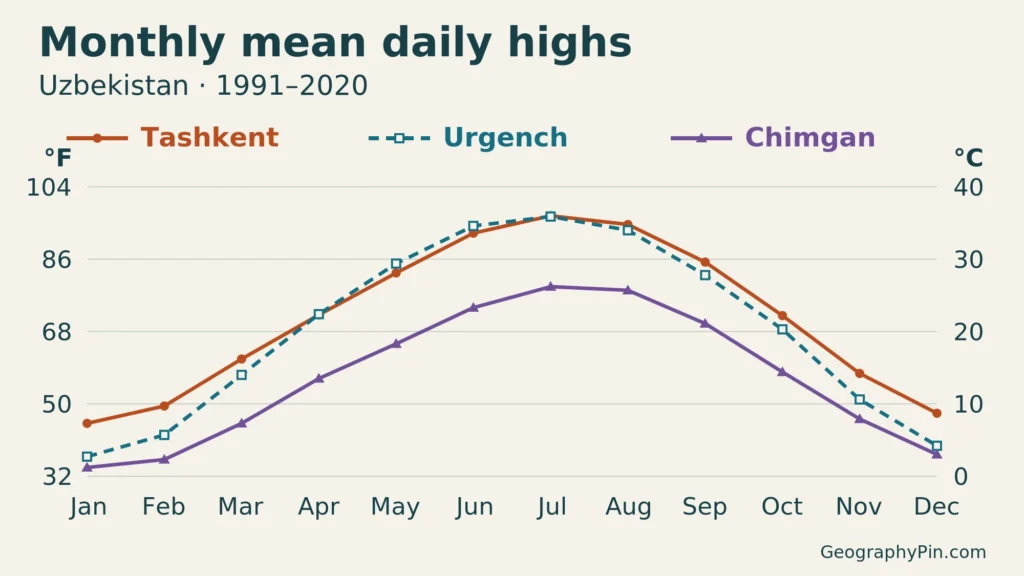
The featured chart is an original GeographyPin visualization of the same monthly mean highs shown in the table.
Selected temperature and precipitation records report 30 contributing years, except Chimgan’s July and August, which report 29. Station identifiers are Tashkent 38457, Samarkand 38696, Bukhara 38683 (file name “Buhara”), Urgench 38396, Nukus 38264 and Chimgan 38706. Recommendations are editorial interpretations of those station patterns, not forecasts, comfort guarantees or verified opening seasons.