A train to Samarkand may be labeled with Bukhara as its final destination, and a ticket for Bukhara takes you to a station in Kagan. Getting the journey right means checking the service, station and seat separately.
The right train starts with the right station
Book Uzbekistan trains through the official ticket site, then compare the actual stations, departure times and available classes. Afrosiyob is a fast seated option, but other trains may fit your journey better. Check the passenger details before payment and carry the identity document that matches the issued ticket.
Booking information checked: November 18, 2026. Availability, timetables and fare conditions can change.
How to use this article: Learn to read a train result, check station differences, or find out when tickets go on sale.
1. Start with the official ticket search
Use the official Uzbekistan rail booking website. Select your departure station, destination and date, then search. You can inspect results before signing in.
Read your journey, not just the train’s final destination
A Tashkent–Samarkand result may show Bukhara or Khiva as the train’s final destination. Read the times for your selected stations, not the full service route.
Read the train number, station names, date and local times together. If the arrival is after midnight, check the arrival date before arranging a pickup or hotel. A midnight departure belongs to the new calendar day, even if you leave your accommodation the previous evening.
A train marked “There are no seats” is not currently bookable in that result. Try another departure or date.
2. Afrosiyob is one option, not the whole railway
Afrosiyob is the high-speed seated train associated with the Tashkent–Samarkand–Bukhara corridor. Other services can suit a different departure time, budget or overnight plan. Choose by the actual journey and accommodation offered, not the best-known name alone.
| Option | What to compare |
|---|---|
| Afrosiyob | Fast seated service; compare available class and departure time. |
| Jaloliddin Manguberdi | Another fast seated option, including services toward Khiva. |
| Sharq or Nasaf | Other daytime trains; compare the listed sitting accommodation and total journey time. |
| Passenger or express trains with sleeping accommodation | Check the specific carriage: the results may offer Sleeper, Coupe or SV, not one uniform product. |
The operator distinguishes open-plan sleeping carriages, compartments and SV accommodation. Open-plan carriages have berths beside a shared aisle without compartment doors; SV compartments typically have two lower berths. Check the carriage description behind the search label before choosing.
For a dated comparison, the official search for Tashkent to Samarkand on November 25, 2026 showed an Afrosiyob journey of 2 hours 13 minutes and a Sharq journey of 3 hours 9 minutes. Those are examples from one search, not a permanent timetable.
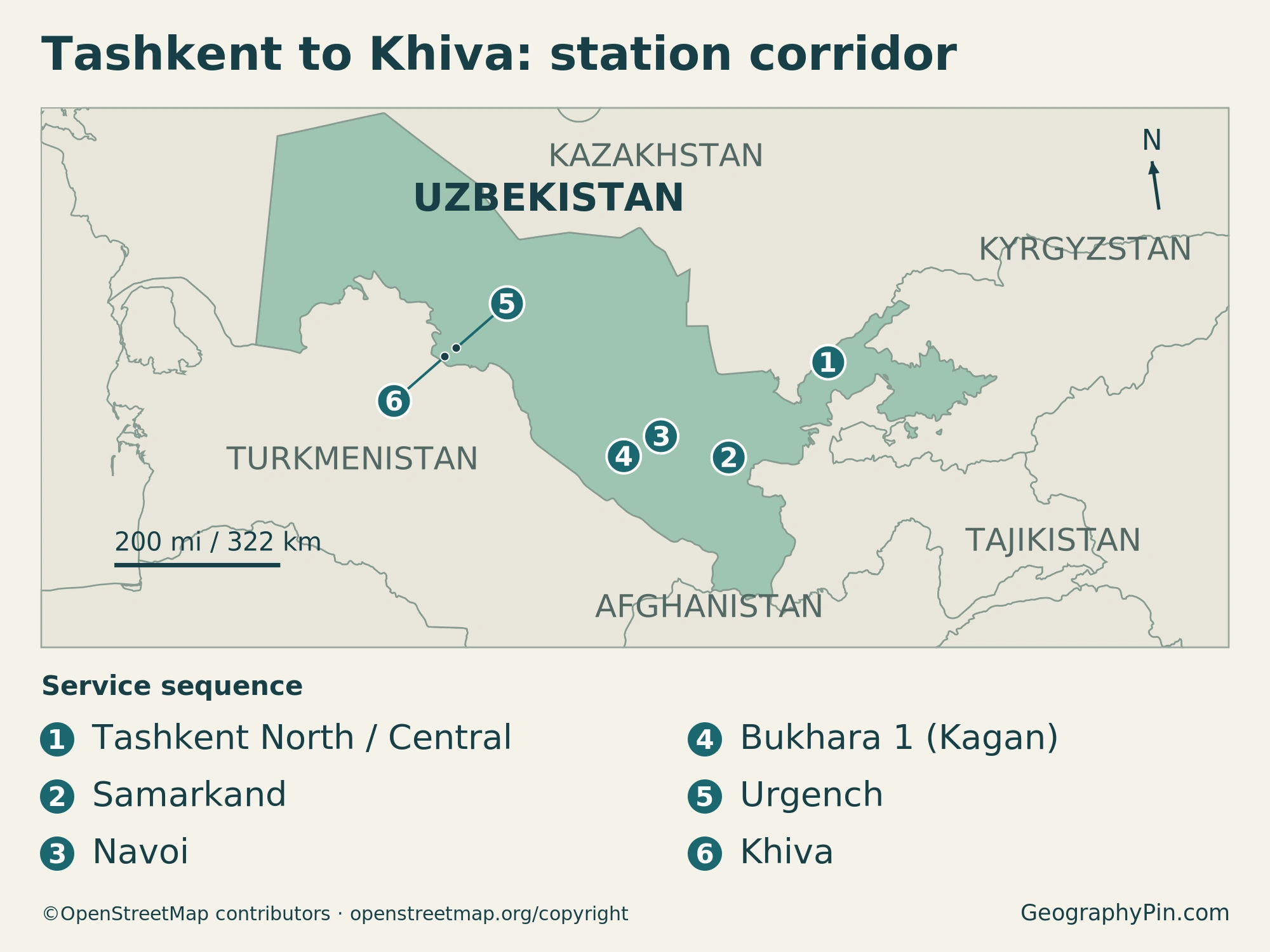
For the western corridor, the railway’s July 2026 report describes Jaloliddin Manguberdi trains running from Tashkent to Khiva via Samarkand, Navoi, Bukhara and Urgench. Search your own city pair and date: a service running through a station does not guarantee seats for every intermediate journey.
For a daytime leg, I would usually prioritize a convenient arrival over a small saving that leaves hours of waiting before check-in. Overnight, the carriage layout and where your berth sits matter more. Open the seat plan and read the class description before choosing; do not assume that “express” describes a particular level of comfort.
3. Check which station your ticket actually uses
Bukhara, Khiva and Urgench are not interchangeable
| Destination | Check before booking |
|---|---|
| Tashkent | Results can use Tashkent North or Tashkent South. Give your driver the station on your ticket. |
| Samarkand | Plan the onward city transfer separately from the rail journey. |
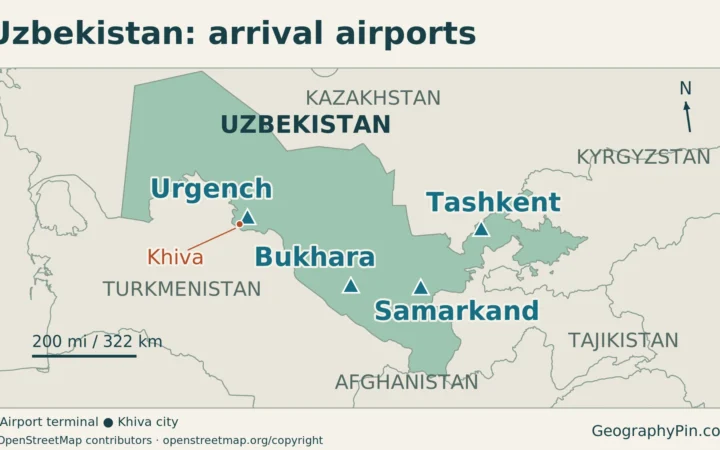
| Bukhara | The main Bukhara railway station is in Kagan, also spelled Kogon, outside the historic city. |
| Khiva | Khiva and Urgench have separate stations. A ticket to Urgench is not a ticket to Khiva. |
A city-name search is only the beginning of the transfer plan. Save the final ticket’s station details and the accommodation address, then check how they connect. Allow time for luggage, station checks and the trip across town rather than treating the scheduled train duration as a door-to-door journey.
For connecting trains, check whether they use the same station. A short gap on a timetable can conceal a cross-city transfer. If the connection is essential to a flight or another nonrefundable booking, allow time for the transfer and station checks rather than relying on the fastest possible taxi journey.
4. From search result to a usable ticket
The search interface shows stages from train choice through payment. You must authenticate before ticket issuance. Treat these as the decisions to complete, not a promise that every payment method follows identical screens:
- Select the train and class. Compare the date, stations, local times and price.
- Choose a carriage and seat. Inspect the layout and listed inclusions. If you are traveling together, check every assigned place rather than assuming one order means adjacent seats.
- Enter each passenger’s details. Use the identity document that will be carried on the journey. For foreign visitors, the operator specifies the travel passport; correct mistakes before paying.
- Review the conditions and total. Check passenger names, document numbers, dates, route and class again.
- Pay and retrieve the issued ticket. Save the PDF and confirmation, not just a screenshot of a pending payment.
A payment problem is a reason to check the order status before trying again. Keep the booking reference and payment record so the seller can trace the transaction. Do not send card details or passport scans to an unofficial social-media account offering to fix a booking.
When should you look for tickets?
The current public offer allows sales to start no earlier than 60 days before departure from the train’s initial station, but lets the carrier change the opening date. Treat 60 days as a possible advance-sales limit, not a guaranteed release day. Check again when your intended journey becomes available.
5. Read the refund terms before you need them
Refunds are not necessarily the full amount paid. The operator’s refund guidance distinguishes the fare components and deductions according to how close to departure the ticket is returned. Online orders may be returned through the account or a station ticket office, subject to the applicable conditions.
Before paying, check which seller will handle the payment and refund, which fees are retained, and whether the deadline refers to your boarding station or the train’s original starting station. The current public offer names Trainhub.io as the seller for international-card and digital-wallet purchases; its terms describe a transfer to that seller’s website. Follow the instructions attached to your own order.
If plans change, begin the refund process promptly and save its confirmation. If the account does not show a completed return, contact the relevant support service rather than assuming that a failed screen refunded the money.
6. Arrive ready to board
The current public offer recommends reaching the station control checkpoint at least 30 minutes before departure. Allow more time if you need ticket-office help or assistance. Bring the identity document named on the ticket and keep the ticket available offline.
Phone presentation depends on electronic check-in and QR-reading facilities. An A4 printout is a useful backup. Some international journeys without electronic check-in require exchange at a ticket office for the prescribed paper ticket; check the instructions for your particular train.
- Check the final details: station, date, local departure time, train number, carriage and seat.
- Prepare documents: your issued ticket and the matching identity document, plus any documents required for an international journey.
- Plan luggage: check the carrier’s rules for bulky items and keep essential belongings accessible.
- Arrange assistance early: confirm station and carriage access rather than assuming every platform and train is step-free.
- Board the booked service: a ticket for one departure is not a general pass for any train on the route.
What Did We Learn Today?
Train names, full service routes, boarding stations and carriage classes describe different parts of a journey. A good booking brings those details together with the correct passenger documents and enough time to reach the station. Compare what is actually available for your dates, then keep the issued ticket and its conditions accessible until the trip is complete.
Sources & Data Notes
View booking sources and checks
The search interface was checked without making a reservation. Journey-duration examples refer to a November 25, 2026 Tashkent–Samarkand search made on November 18; fares and available-seat counts are not reproduced. Later booking steps follow the operator’s published instructions, not a completed payment test. Consult the current offer for the conditions attached to your purchase.
- Official railway booking website
- Passenger operator: how to purchase electronic tickets
- Official ticket system: public offer and conditions
- Passenger operator: refund guidance
- Passenger operator: Bukhara station in Kagan
- Passenger operator: Khiva station
- Passenger operator: Urgench station
- Uzbekistan Railways: July 2026 Jaloliddin Manguberdi service report
- Uzbekistan Railways: Afrosiyob background
Map: original GeographyPin station locator using Natural Earth countries 5.1.1 (public domain) and © OpenStreetMap contributors station positions (ODbL), checked against operator station descriptions. It shows facility reference points, not entrances, platforms or railway alignments. The numbered sequence follows the July 2026 service report, not every train shown in the booking system.
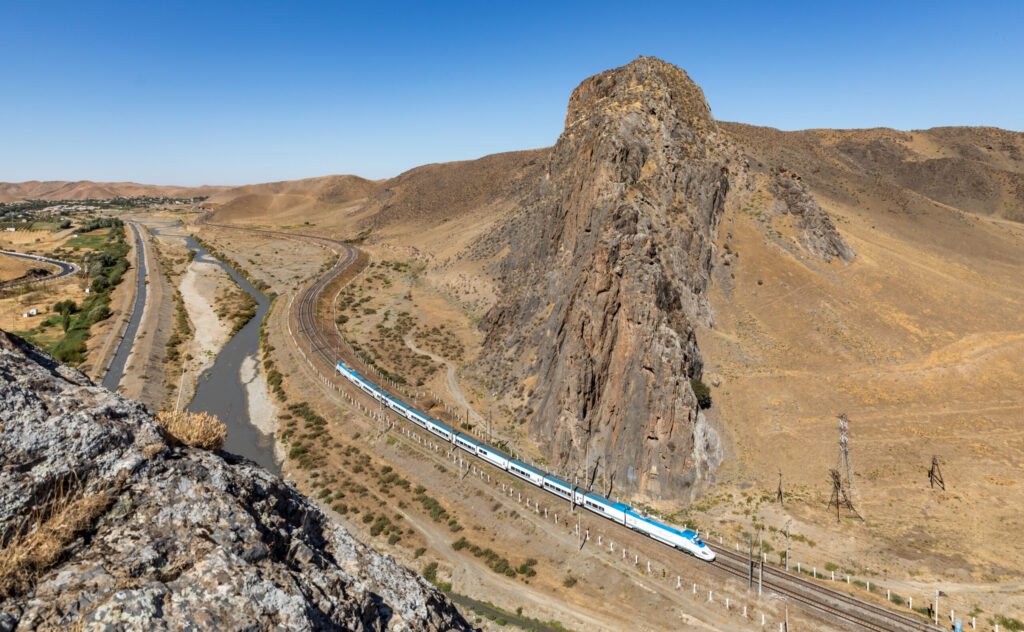
Cover photograph: Afrosiyob between Jizzax and Gallaorol, September 7, 2024, by David Gubler / Kabelleger, Wikimedia Commons, CC BY-SA 4.0. Responsive resized/cropped reproductions remain under the same license. The photograph does not establish a current timetable.