Tashkent works best when you choose a few contrasting experiences rather than treating the city as one long walk. The practical decision is how to combine the old-city sights, the modern center and your arrival or departure without spending the day in transit.
Chorsu, Khast Imam and the modern center
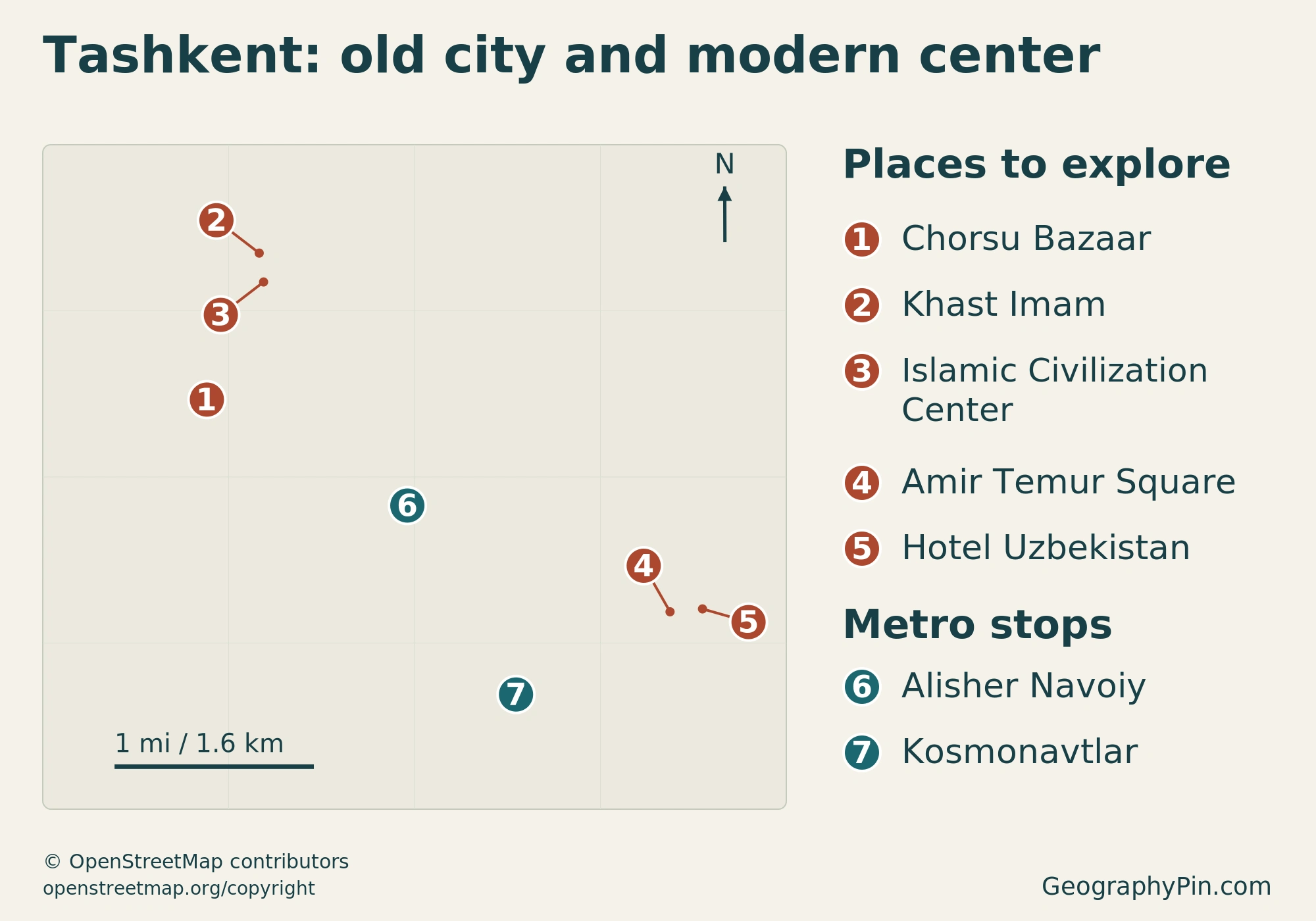
For a first Tashkent visit, allow two days if possible: combine Chorsu and Khast Imam with a deliberate museum choice, then explore the modern center and selected metro stations. Choose a base near your main sightseeing cluster, and check the exact airport terminal or railway station before arranging transfers.
Practical information checked November 18, 2026.
How to use this article: Compare base areas, choose your old-city priorities, plan a museum slot, or check the arrival-point names.
1. How long to stay in Tashkent
A full museum visit is the main reason to add a second day. With less time, choose between an afternoon in the Islamic Civilization Center and the modern-center circuit rather than rushing both.
| Time available | Prioritize | Leave out |
|---|---|---|
| Half a day | Chorsu and the old-city cluster, or Amir Temur Square and a metro ride | A cross-city checklist |
| One full day | Chorsu, Khast Imam, lunch, then a selective center/metro visit | A lengthy museum visit unless you cut another stop |
| Two days | Separate old-city sights and the Islamic Civilization Center from the modern-center day | Unnecessary hotel changes |
Allow two full days on the ground, rather than counting an overnight arrival or an early departure as sightseeing time. Keep the first afternoon light if you are arriving tired.
2. Where to stay
Central squares or the old city?
Choose the Amir Temur Square area for a first visit centered on the modern city. It gives you an easily recognizable meeting point and a practical place to begin the center-and-metro part of the visit. Check the actual hotel entrance on a map, not merely a booking site’s broad “city center” label.
Choose the Chorsu/old-city side if the bazaar and Khast Imam are your main interests. You will still need to plan transport for the modern center. A room closer to one cluster can be more useful than an apparently central room that requires awkward walks to every stop.
For a short final night before departure, work backward from the airport terminal or railway station on your ticket. Do not choose a hotel beside “Tashkent station” until you know which station your train uses.
Hotel Uzbekistan’s official website lets you compare rooms if you want to stay in the landmark building near Amir Temur Square. Its distinctive building can also be a sightseeing reference without becoming your accommodation choice. Compare the room category, current photographs and cancellation terms for your dates.
3. What to see
Chorsu and Khast Imam
Chorsu is the market stop. Give yourself time to browse rather than treating it as a quick photograph of a dome. Food trading and craft stalls are part of its appeal. Allow roughly an hour for a first look, longer if you enjoy browsing or stop to eat.
Khast Imam is the religious and architectural stop. Also written Hazrati Imam, the ensemble includes the Barak Khan madrasah, Tillya Sheikh mosque and Kaffal Shashi mausoleum. Choose a slower visit if religious architecture matters more to you than a broad city overview. Respect worship and any instructions at individual entrances.
If seeing the celebrated Uthman manuscript is a priority, plan for the Islamic Civilization Center: the Tourism Committee’s 2026 account identifies it with the Center’s Qur’an Hall. Older descriptions of the former library display can send you to the wrong entrance.
Make the new museum a deliberate choice
The Center opened in March 2026 and is a separate museum commitment, not simply another quick courtyard stop. Its official visitor page, checked November 18, 2026, lists daily hours of 9 a.m.–10 p.m., timed tickets and different prices for Uzbek and foreign visitors. Choose the applicable category and visit format before paying.
For a two-day stay, I would give the museum its own block on the old-city day rather than compressing it between airport arrival and a train. Follow the operator’s rules on religious-area clothing and flash photography.
Amir Temur Square and the metro provide the contrasting experience. The equestrian monument and nearby Hotel Uzbekistan offer recognizable orientation points in the modern center. Add a few station interiors rather than trying to inspect the entire network. Alisher Navoiy and Kosmonavtlar are sensible names to include when planning your metro exploration.
4. Two days in Tashkent
Day 1: the old city and Islamic Civilization Center. Begin at Chorsu, then continue to Khast Imam. Use a car between the two if you prefer to save your walking for the sights. After lunch, give the Center a dedicated afternoon slot if its collections interest you. Keep the evening free rather than adding a distant attraction.
Day 2: the modern center and metro. Start around Amir Temur Square, with the monument and Hotel Uzbekistan as orientation points. Then explore a few station interiors, including Alisher Navoiy or Kosmonavtlar. Break for lunch before deciding whether you want another short metro outing or a relaxed afternoon near your base.
With one full day: visit Chorsu and Khast Imam in the morning, take a proper lunch break, then change districts for selected metro stations and Amir Temur Square. If the museum matters more to you, substitute it for the modern-center afternoon rather than squeezing everything in.
With half a day: choose Chorsu plus Khast Imam, or the center plus metro, and stop there. Follow station diagrams for transfers and keep clear of passenger flows when looking at interiors. The aim is a satisfying visit, not the largest possible number of stops.
The Tashkent city profile explains the geographical setting and the historical layers behind these choices. It is useful background for understanding why the old city and reconstructed center feel so different.
5. Airport and railway transfers
Airport and railway names to check
| Arrival point | What to verify |
|---|---|
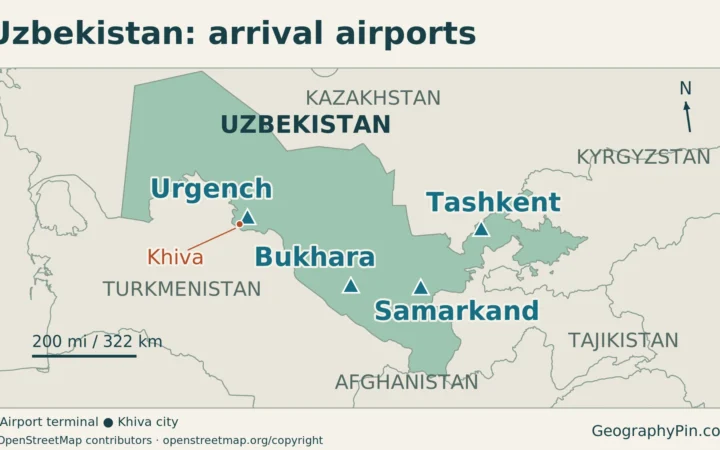
| Tashkent Airport (TAS), Terminal 2 | International terminal; confirm the arrival or departure meeting point |
| TAS, Terminal 3 | Domestic terminal; do not assume an indoor connection to Terminal 2 |
| Tashkent Central / Toshkent Markaziy | The exact station on your rail reservation |
| Tashkent South / Toshkent Janubiy | A different station, not another name for Central |
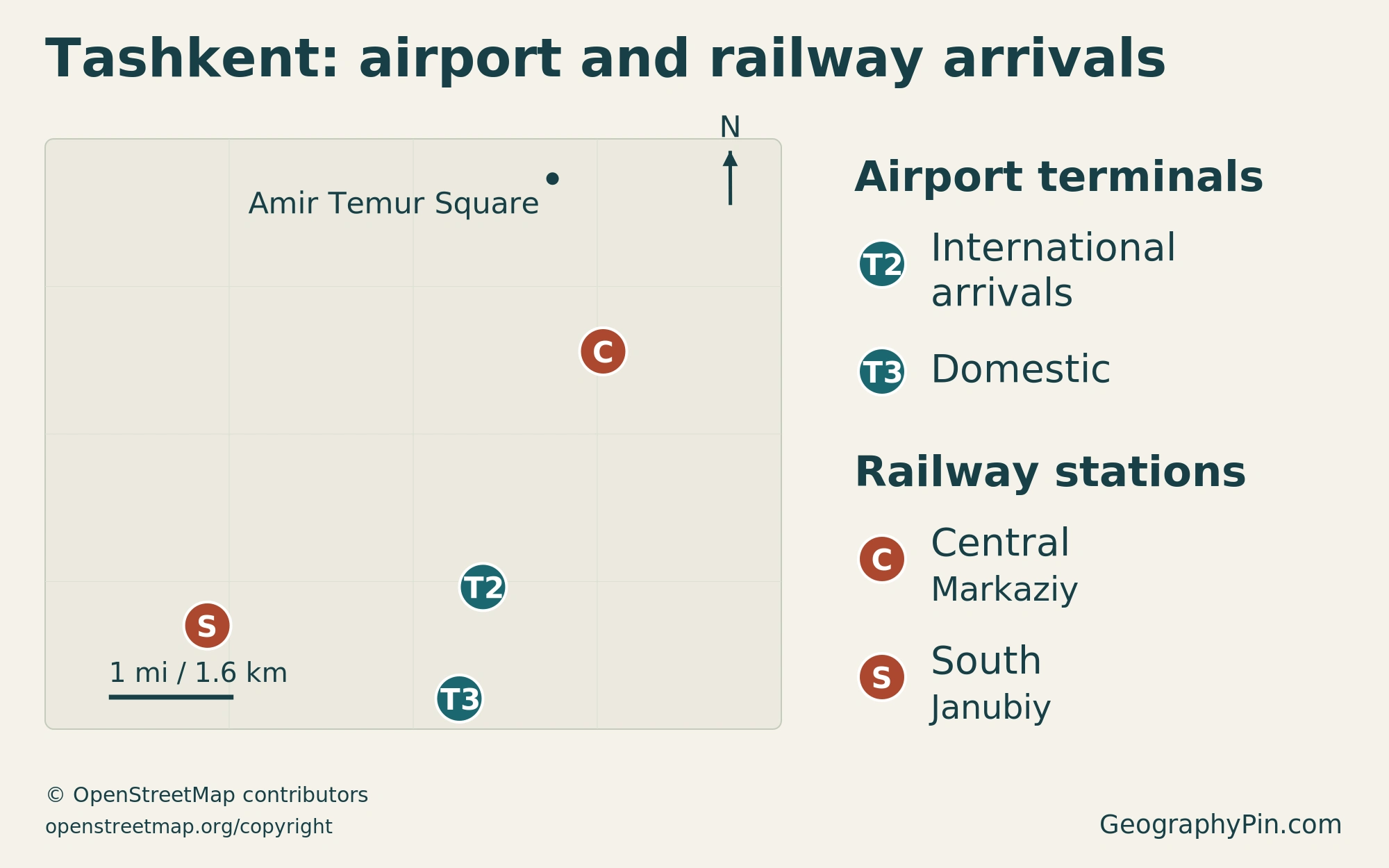
Asiana’s published airport guidance distinguishes international Terminal 2 and domestic Terminal 3 and describes baggage collection for domestic/international transfers. If you change terminals, allow for a landside journey and confirm baggage handling with your airline. Do not assume that a published connecting-flight time includes everything needed for two separately purchased tickets.
For a straightforward hotel transfer, arrange a pickup or use a recognized taxi booking channel. Uzbekistan Airports has published arrangements for official taxi dispatch in arrivals and app-booked Yandex Go pickups. Confirm the vehicle, meeting point and fare before departing. For a terminal change, confirm the transfer arrangement with your airline and leave room for a taxi instead of making a tight connection depend on a shuttle.
For trains, use the railway’s official ticket service and copy the station name from the actual reservation into your transfer plan. Central and South are separate stations. A route name such as “Tashkent–Samarkand” alone does not identify the correct building. Leave time for finding the entrance and the station’s boarding procedures rather than arriving at departure time.
For train types, station names and booking checks, see the Uzbekistan train guide.
6. Getting around by metro
The metro is useful both for changing districts and for seeing station design. It is not a reason to turn every journey into an architectural stop, particularly with luggage or when you are tired.
Published fares checked November 18, 2026: ATTO’s announcement sets a single electronic payment at 2,500 UZS from October 1, 2026. It lists 3,000 UZS for a single-use QR ticket bought with cash at an information kiosk. Electronic options include transport cards, bank cards and supported apps; keep a backup payment method rather than assuming every foreign card will work.
The Ministry of Transport says the one-hour transfer arrangement permits one metro use within that period; re-entering the metro starts a new period. For a simple sightseeing outing, staying inside the system between chosen stations avoids unnecessary exits and purchases. Consult ATTO’s current fare information rather than an older guide’s price.
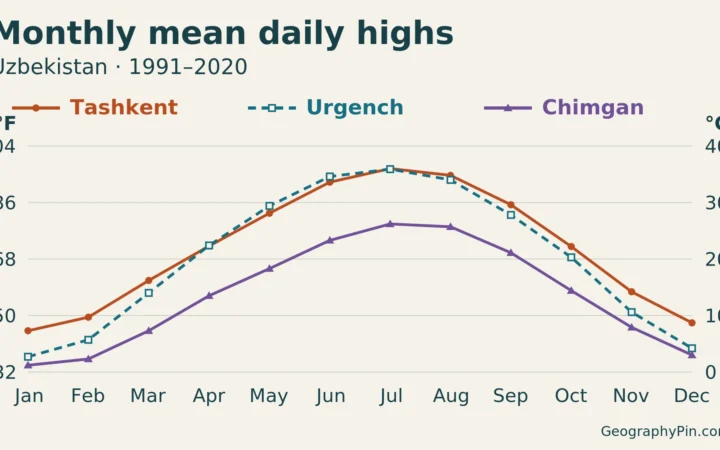
On a hot day, do the outdoor market and squares earlier, then use an indoor visit or a substantial rest break. In cold or wet weather, shorten the outdoor circuit and prioritize the museum or metro. Leave the longest outdoor stretches for the part of the day when you will enjoy them.
If steps, long transfers or standing are difficult, choose fewer stops and ask about the exact entrances and assistance you need. A booked car between clusters can save walking, but check individual museum and station access before relying on a step-free visit.
For broader country context, see the Uzbekistan country profile. Keep flight and rail commitments separate from optional sightseeing: the best final stop is one you can skip without threatening your onward journey.
What Did We Learn Today?
A good Tashkent visit depends more on choosing complementary clusters than on collecting every landmark. Keep the market and religious sights together, give a substantial museum visit its own time, and use the modern center and metro as a contrasting experience. Match transfers to the terminal or station on your ticket, and leave enough flexibility to shorten the day.
Sources & Data Notes
Operator checks, planning assumptions and image credits
Operational pages were checked November 18, 2026. Fares and admission arrangements can change. Suggested visit lengths are editorial planning allowances, not guaranteed journey times. The map is orientation, not a certified pedestrian-access route.
- ATTO: fares effective October 1, 2026
- Ministry of Transport: fares and transfer rules
- Asiana Airlines: Tashkent airport and terminal transfers
- Uzbekistan Airports: arrivals taxi arrangements
- Uzbekistan Railways: Central station and official booking link
- Suburban passenger operator: distinct South station name
- Islamic Civilization Center: visitor information
- Tourism Committee: the Center and Qur’an Hall in 2026
- National tourism portal: Khast Imam ensemble
- National tourism portal: Amir Temur Square
- National tourism portal: Tashkent market and cultural sights
- Government construction directorate: metro design and station names
- Hotel Uzbekistan: location and direct accommodation information
Maps: Original orientation diagrams by GeographyPin using © OpenStreetMap contributors, ODbL, checked November 18, 2026. Named locations were corroborated with official tourism, hotel, airport/airline and railway sources. The Islamic Civilization Center museum point follows the Ministry of Justice-linked Bola Huquqlari directory and its linked museum location. Facility pins do not certify entrances or pickup points.
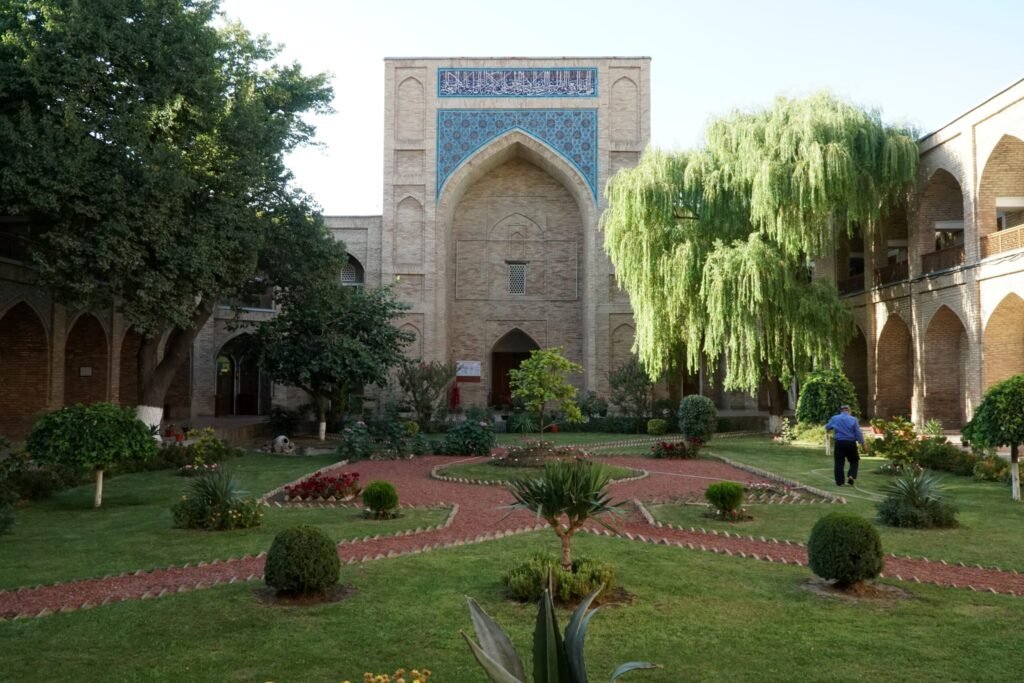
Featured image: Kukeldash Madrasah courtyard, July 28, 2018, Adam Harangozó / Wikimedia Commons, CC BY-SA 4.0. Original photograph uploaded unchanged; the site’s responsive cover display may crop it.