Vietnam’s private businesses and global trade links can seem difficult to reconcile with its communist-party government. The apparent contradiction disappears when political leadership is separated from ownership, markets, and economic policy.
Yes. Vietnam remains a one-party state led by the Communist Party of Vietnam. Economic reform did not end that political system. Its official model is a socialist-oriented market economy, combining multiple ownership forms with a leading state sector. Private enterprise and international trade are compatible with that stated framework.
How to use this article: Compare institutions and markets, follow the reform timeline, or distinguish party policy from legal implementation.
1. Party leadership and market activity are different questions
The word “still” often reflects a mistaken expectation: that opening an economy automatically replaces its political system. Vietnam’s experience shows why those changes must be examined separately. Buying goods from a private business tells you something about commerce, not how national governing authority is organized.
Institutions versus markets
| Political institutions | Economic arrangements |
|---|---|
| Article 4 establishes the Communist Party’s leadership of the state and society. | Article 51 recognizes multiple ownership forms and economic sectors, with a leading role for the state economy. |
| The January 2026 Party Congress resolution reaffirms party leadership. | Resolution 68 gives private-sector development a major policy priority. |
| Freedom House’s 2026 assessment describes a one-party state and restricted opposition. | The IMF’s 2025 assessment discusses exports, investment, and reforms rather than an economy without markets. |
These columns are not competing verdicts. They describe different dimensions. Neither the existence of private firms nor a political label provides a complete account of how a particular business is owned, financed, or regulated.
2. What the constitution and party documents say
The official consolidated constitutional text issued in July 2025 incorporates the National Assembly’s amendments of June 16, 2025. Its Article 4 retains the Communist Party’s leading role. That is the legal basis for describing Vietnam as communist-party-led, rather than treating the label as a Cold War memory.
A legal provision is not the whole political picture
Freedom House’s 2026 country assessment describes the practical system as one-party rule. It notes that some independent candidates can technically run in legislative elections while most opposition is barred in practice. The presence of elections or non-party individuals should therefore not be confused with open competition between parties to govern.
The Communist Party’s 14th National Congress resolution, adopted in January 2026, continues to place economic development under party leadership. It also discusses considering further constitutional amendments. A proposal to consider amendments is not an enacted replacement constitution; the distinction prevents a future policy intention from being reported as existing law.
Vietnam belongs in the political category discussed in GeographyPin’s communist countries list. That category does not mean it has achieved an ideal classless society or eliminated every form of private economic activity.
3. What changed with Đổi Mới
Đổi Mới, usually translated as “renewal,” names the reform process launched in 1986. The World Bank’s Vietnam overview connects the country’s subsequent transformation with economic reforms and integration into international trade and investment. This was a change in economic arrangements under continuing party leadership, not the introduction of a rival-party electoral system.
A timeline of change and continuity
| Date | What changed or continued |
|---|---|
| 1986 | Đổi Mới economic reforms began. Reform is a process, not a claim that all controls disappeared that year. |
| January 11, 2007 | Vietnam joined the WTO. Trade commitments expanded its international economic integration without redefining its ruling-party system. |
| May 2025 | Politburo Resolution 68 prioritized private economic development. This is a party policy document, not itself a parliamentary statute. |
| June–July 2025 | Constitutional amendments and their consolidated text retained party leadership alongside a multi-sector economic framework. |
| January 2026 | The 14th Party Congress reaffirmed the political direction; government Decree 20/2026/ND-CP addressed implementation of private-sector measures. |
WTO membership matters for trade rules, not as a certification that a country has become capitalist or democratic. The sequence illustrates how international integration and domestic political continuity can occur together.
4. Private enterprise is part of official economic policy
The claim that communist-party rule means private business is banned is plainly inadequate for modern Vietnam. In its Resolution 68 on private economic development, the Politburo called for stronger protection of property and business rights and better access to resources. The document itself acknowledged obstacles affecting private firms, including financing, land, and the effectiveness of support policies.
Keep party policy, legislation, and implementation separate
Resolution 68 sets party direction. A subsequent National Assembly resolution, 198/2025/QH15, provides special mechanisms and policies, while the government’s Decree 20/2026/ND-CP details implementation of specified provisions. The government portal describes targeted tax incentives, including measures for eligible newly registered small and medium-sized enterprises.
Those are different institutional acts. It would be wrong to call every party resolution a law, or to assume that announcing an incentive proves that all eligible firms receive it effectively. This example explains the policy direction; it is not tax advice for a particular business.
The IMF’s September 2025 consultation assessment offers a separate economic perspective. It emphasizes the challenges facing an export-led growth model, the importance of economic governance, and risks associated with investment and finance. A government’s objectives and an outside assessment of economic conditions answer different questions.
5. How the official model compares with China’s
Vietnam calls its model a socialist-oriented market economy. Article 51 combines that label with multiple ownership forms and sectors. The state economy’s leading role and official support for private enterprise are therefore presented as parts of the same framework, rather than mutually exclusive choices.
A shared distinction, not identical systems
China’s constitution uses “socialist market economy” and also recognizes non-public businesses. In both cases, communist-party leadership can coexist with markets. That similarity is useful, but it does not establish identical business rules, ownership patterns, institutions, or reform histories.
A meaningful comparison specifies what is being compared. Asking whether private firms exist is different from asking which assets the state owns, how credit is allocated, or whether political opposition can compete. There is no defensible single percentage showing how communist either country is.
For the broader distinction between constitutional identity and economic organization, see GeographyPin’s explanation of socialist-country classifications. Vietnam’s specific answer rests on its own institutions and documents, not on copying China’s label.
Frequently Asked Questions
Is private business ownership the same as private ownership of land?
No. Under Articles 53 and 54 of the constitution, land is publicly owned with the state representing the owner, while organizations and individuals can hold legally protected land-use rights. A business, its buildings, and its land-use rights are therefore not interchangeable categories.
What Did We Learn Today?
Vietnam’s case is best understood through continuity and change together: party leadership continued while economic arrangements evolved. Recent private-sector initiatives fit within the official market framework, but policy promises, legal measures, and actual business conditions remain distinct kinds of evidence. A precise explanation keeps those distinctions visible instead of forcing the country into an all-state or all-private stereotype.
Sources & Data Notes
Evidence reviewed in November 2026. Constitutional claims use the official Vietnamese consolidated text incorporating the June 2025 amendments; English explanations here are paraphrases. Party resolutions, parliamentary measures, government decrees, and outside assessments are identified separately. Official development objectives are not treated as achieved outcomes, and the timeline is selective.
- Vietnam: consolidated Constitution, July 2025; official Vietnamese text, Articles 4, 51, 53, and 54
- Government News: translation of the 14th National Party Congress resolution, February 2026
- Government News: translation of Politburo Resolution 68 on private economic development, May 2025
- Government News: Decree 20/2026/ND-CP and private-sector measures, January 2026
- World Bank: Vietnam country overview; reform background
- IMF: 2025 Article IV consultation conclusion, September 2025
- Freedom House: Vietnam, Freedom in the World 2026
- WTO: Viet Nam member information
- China: Constitution, incorporating amendments through 2018; Articles 11 and 15
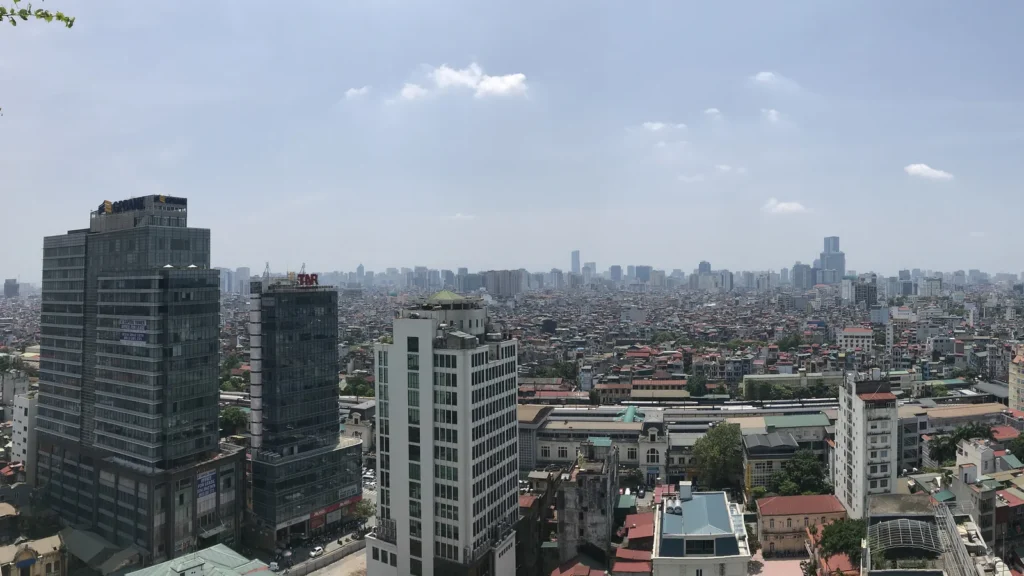
Photo: Ilovemcribs / Wikimedia Commons, CC BY 4.0; cropped, resized and converted to WebP. Photographed in August 2019; urban context, not evidence of present-day ownership or political arrangements.