A country-name puzzle can give different answers depending on whether “and” means a separate word or three letters hidden inside a longer word. There is another catch: a familiar country name and its full state title need not produce the same result.
Under the common-English naming convention used here, six sovereign states contain the separate word “and”: Antigua and Barbuda, Bosnia and Herzegovina, Saint Kitts and Nevis, Saint Vincent and the Grenadines, Sao Tome and Principe, and Trinidad and Tobago. The United Kingdom joins the list when its full name, United Kingdom of Great Britain and Northern Ireland, is used.
Start with your question: Check the counting rule, compare short and full names, or separate words from letter sequences.
1. What counts as a country with “and”?
The main table uses common English names, including the complete name Saint Vincent and the Grenadines and the shortened name United Kingdom. It counts the word “and,” regardless of capitalization, among sovereign states. It does not count a matching sequence inside another word or include dependent territories.
This convention is explicit because official lists differ. The UN Statistics Division uses United Kingdom of Great Britain and Northern Ireland even in its operational short-name list. Meanwhile, the British government's geographical names index abbreviates Saint Vincent and the Grenadines to St Vincent in its “Name” column. A search of either list therefore needs its naming rules explained.
Choose the rule before counting
For this article, the comparison is between the six names in the table and the UK's familiar shortened name. It is not a claim that every authority publishes a six-country list.
2. The six countries and their locations
| Country | Geographic setting |
|---|---|
| Antigua and Barbuda | Caribbean |
| Bosnia and Herzegovina | Southeastern Europe |
| Saint Kitts and Nevis | Caribbean |
| Saint Vincent and the Grenadines | Caribbean |
| Sao Tome and Principe | Gulf of Guinea, off Africa |
| Trinidad and Tobago | Southern Caribbean |
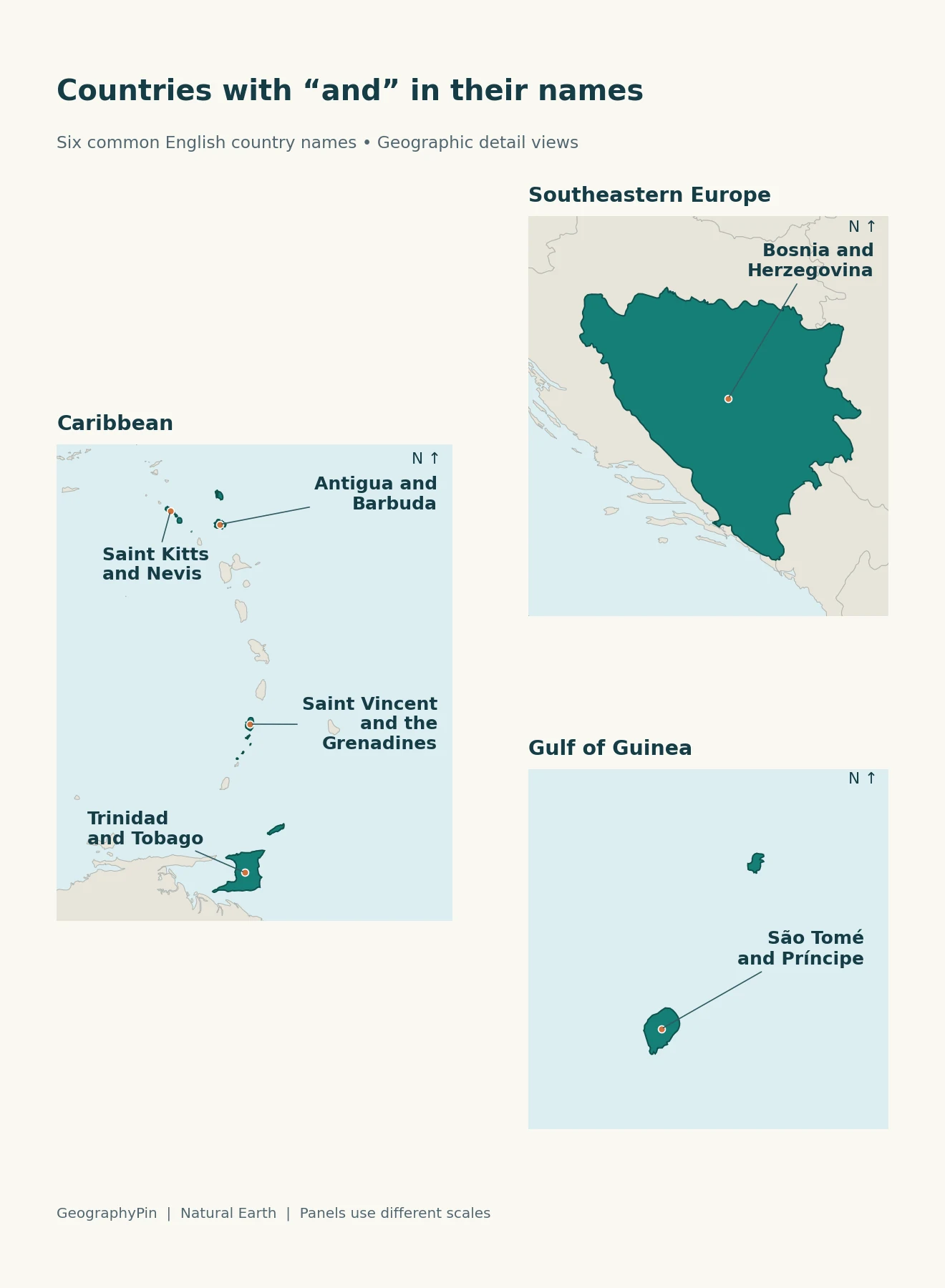
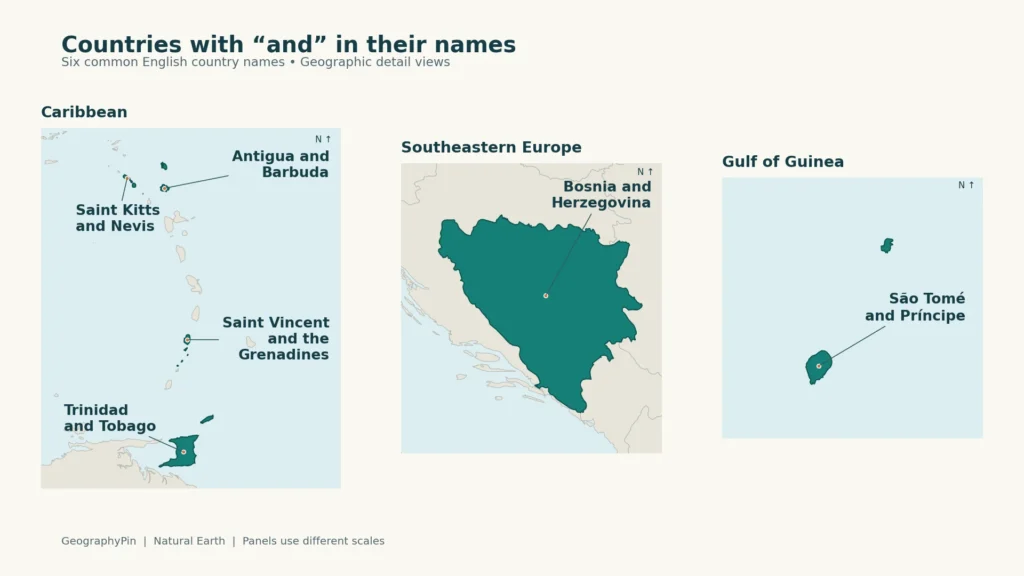
The locator shows four Caribbean countries, one European country and one African island country. Its three panels use different scales; they are not an area comparison. Colored shapes represent countries. Orange dots anchor country labels, not capitals. The Caribbean detail separates islands that would almost overlap on a world map.
A name is not an island count
Five entries are island countries, but the conjunction does not mean each state consists of exactly two islands. Saint Vincent and the Grenadines already illustrates the difference: its name links an island with a group of islands. Bosnia and Herzegovina is the mainland exception, not a pair of islands.
Each row identifies one state, not two countries. For a different kind of reference, use the world capital cities list to connect country names with their capitals. The present table is about names and location, not population, size or political structure.
3. Why the United Kingdom can be a seventh answer
Familiar names and full state titles
“United Kingdom” contains no “and.” “United Kingdom of Great Britain and Northern Ireland” does. If a quiz permits full state titles, excluding the UK merely because its everyday name is shorter would be inconsistent.
UNGEGN's country-name reference makes the distinction particularly clear. Its UK entry gives United Kingdom as the national English short name, but uses the longer title in both the UN short-name and formal-name fields. In other words, the word “short” in a database does not necessarily mean the shortest everyday expression.
Other entries also have longer formal titles. The British list records Federation of Saint Christopher and Nevis for the country commonly called Saint Kitts and Nevis. That is a naming variant of the same state, not an additional country to add to the count.
The practical answer is to state your convention alongside your number: six using the familiar names shown here; seven when the UK's full title is included. Use the same named source or stated naming convention throughout your count.
4. Names with the letters a-n-d are a different list
Whole words versus letter sequences
Andorra, Finland, Iceland, Ireland, Poland, Rwanda, Switzerland, Thailand and Uganda all contain the consecutive letters a-n-d. None uses “and” as a separate word. New Zealand and Netherlands also match a substring search, as do Marshall Islands and Solomon Islands through the word “Islands.”
Compare these simple tests:
- “Trinidad and Tobago”: passes both tests, because the word also contains the letters.
- “Finland”: passes the letter test but fails the separate-word test.
- “Canada”: fails both. Having the letters in a different order is not a match.
These are examples of substring matches, not a second authoritative country classification. For a spreadsheet, decide whether to search the name field for a complete word or any occurrence of “and.” Keep the original names alongside the result so that an abbreviation does not silently change the answer.
5. Why territories stay outside the main table
Turks and Caicos Islands and South Georgia and the South Sandwich Islands contain the word “and,” but they are UK Overseas Territories, not additional sovereign states. A country-and-area database can legitimately include them for statistical purposes without classifying them as independent countries.
A word search has no way to make that political distinction on its own. Start with the intended set of places, then apply the naming test. Otherwise, the result answers “which database entries contain this word?” rather than “which countries contain this word?”
Frequently Asked Questions
Does an ampersand count as “and”?
An ampersand means “and,” but it is a different character. For this list, country names are written with the word spelled out. A literal computer search needs a separate rule to treat “&” as equivalent.
Is “Sao Tome e Principe” another matching country?
No. The Portuguese name is São Tomé e Príncipe, where “e” is the conjunction. Sao Tome and Principe is its English form. The country is the same; this article's word test is specifically in English.
What Did We Learn Today?
Country-name counts depend on the naming convention and the matching rule. The six familiar English names in the table contain the separate word “and”; the UK's full title adds another. Substrings such as the ending of Finland, translated names and dependent territories answer different questions and should not be mixed into that count.
Sources & Data Notes
The table uses the common English names printed above, not an unmodified database export. UN and British naming fields are compared to explain why other counts differ. Substring examples are illustrative, not an exhaustive second list.
- UN Statistics Division: M49 country and area names and regional groupings.
- UNGEGN country-name reference, 2021 session document: national and UN naming fields; used for stable naming distinctions, not current political statistics.
- FCDO geographical names index: country and official-name fields, and separate Overseas Territory list.
- Natural Earth: public-domain basemap geometry. Country polygons are generalized. Label anchors are derived from the largest country polygon and checked to lie within it; they are not capital markers. The maps are locators, not navigation charts.