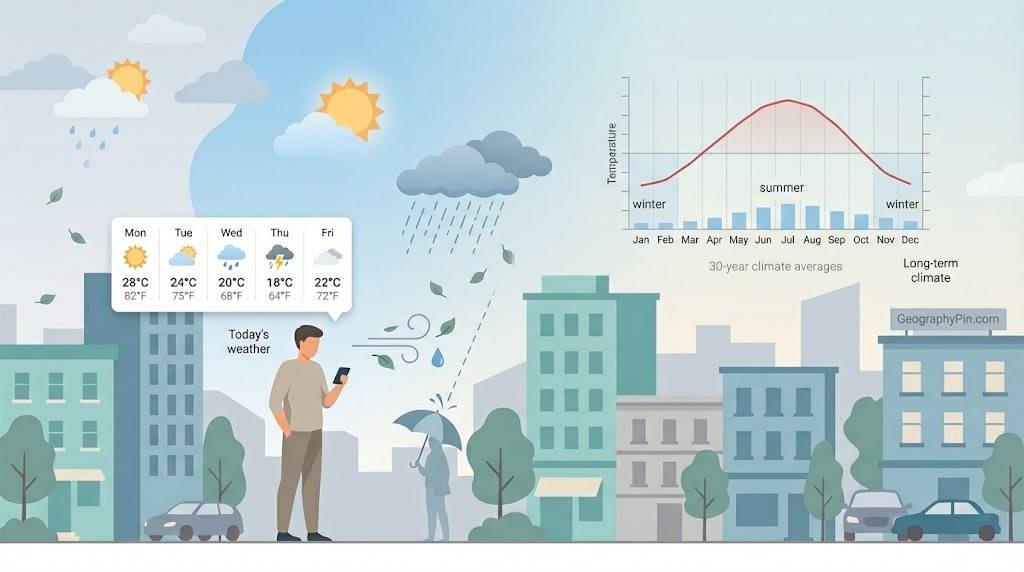
On any given day, you might check a weather app before leaving home, then hear about climate change in the news. The terms are closely related, but they answer different questions about the same atmosphere.
Weather describes short-term atmospheric conditions at a particular place, while climate describes the longer-term pattern of those conditions. Weather can change within minutes or days; climate is assessed through statistics across years and decades, with 30-year periods serving as the standard basis for climatological normals.
How to use this article: Start with the time-scale split for the fastest definition, use the comparison table for a side-by-side check, see where microclimate fits, and finish with shifting averages and odds.
Weather vs Climate: The Basic Difference
Weather describes what the atmosphere is doing now or in the near future at a specific place. Climate describes the longer-term pattern of those same conditions in a place or region. A short phrase that works well is this: weather is what you get; climate is what you expect.
Time scale is the real dividing line
The same atmospheric ingredients appear in both ideas: temperature, precipitation, humidity, wind, air pressure, and cloud cover. Weather follows these conditions from minute to minute and day to day, while climate examines their averages, variability, seasonal patterns, and extremes over much longer periods. WMO climatological standard normals use 30-year periods updated each decade; the current standard period is 1991–2020.
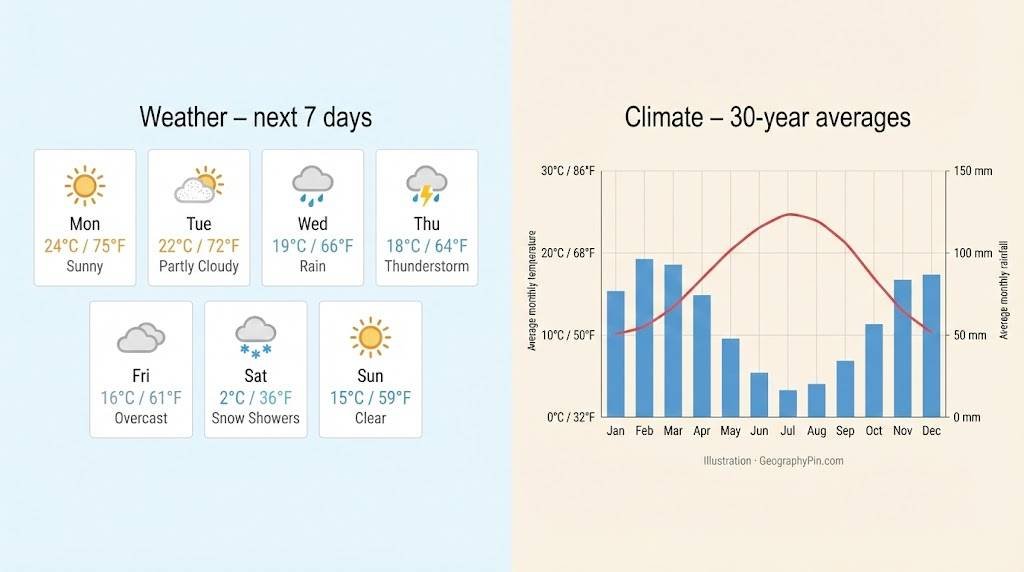
Weather vs climate at a glance
Both weather and climate are built from the same atmospheric data, but they are used for different kinds of questions. Weather helps answer what may happen this afternoon or this weekend. Climate helps answer what a place is usually like across seasons and over decades.
| Aspect | Weather | Climate |
|---|---|---|
| Time scale | Minutes to days or weeks; forecast confidence generally declines with lead time | Long-term patterns and variability, often summarized with 30-year normals |
| Space scale | A street, city, valley, coast, or region | A small local area, a region, a country, or the planet |
| Typical question | Will it rain this afternoon? | What are winters here usually like? |
| Commonly associated field | Meteorology | Climatology |
| Main use | Daily decisions, warnings, and short-term planning | Infrastructure, farming, water management, and long-term risk planning |
Where microclimate fits
Microclimate means a small local area inside a larger region that has its own long-term atmospheric pattern. A dense city core can stay warmer than nearby rural land because of the urban heat-island effect, while a shaded valley can remain cooler and damper than surrounding slopes. That is still climate, just measured at a smaller scale.
What Counts as Weather?
Weather is the mix of conditions you feel when you step outside today: temperature, humidity, cloud cover, wind, air pressure, and precipitation. It can change quickly, sometimes within minutes, because the atmosphere is a moving, interacting system rather than a fixed backdrop.
Meteorologists track weather using ground stations, weather balloons, radar, satellites, aircraft observations, and computer models. As a broad educational benchmark, NOAA says a seven-day forecast is accurate about 80% of the time, while forecasts 10 days or longer are right about half the time. These figures are general rules of thumb rather than guarantees for every place, variable, or event; they illustrate how confidence declines as lead time grows.
Real-life weather examples
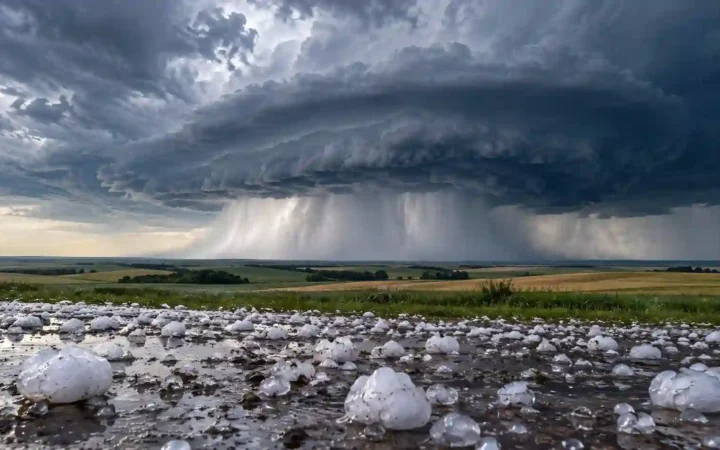
A cold front moving through town this evening, a foggy morning commute, a thunderstorm that erupts for half an hour, or a windy day ahead of a storm system are all weather events. They are immediate, local, and short-lived, even when they are intense. Their importance comes from timing and local impact, not from long-term averages.
Meteorology focuses on weather and atmospheric processes
Meteorology studies the atmosphere, atmospheric processes, weather, and forecasting; it is broader than short-range prediction alone. Its forecasting work is especially practical for storms, floods, cold snaps, heat, aviation, agriculture, and emergency warnings.
What Counts as Climate?
Climate describes the usual pattern of weather in a place over a long period. That includes averages, seasonal rhythms, variability, and the range of conditions considered normal or unusual there. It is why a desert, a rainforest, a Mediterranean coast, and a polar region can have different climate descriptions even though their day-to-day weather still changes.
A 30-year standard normal helps smooth noisy short-term swings while remaining useful for comparison and planning. One strange winter or one especially wet summer does not define a climate by itself. Long records make it easier to see what is typical, what is rare, and whether the baseline itself is shifting.

Climate normals and records
Climate is described with both normals and records. Normals summarize typical conditions across a standard period, while records show the extremes a place has reached during its observed history. Both matter. Normals help with planning; records show what the atmosphere has already proved it can do.
Meteorology vs climatology
Meteorology and climatology use many of the same observations and models, but they emphasize different questions. Meteorology asks how the atmosphere behaves and whether rain, frost, or storms are likely soon. Climatology asks how patterns vary over years and decades and whether the odds of heat, drought, heavy rain, or seasonal shifts are changing over time.
Outfit vs wardrobe is still the easiest analogy
One analogy survives because it works: weather is your outfit, climate is your wardrobe. Today’s weather decides whether you grab a jacket, but the climate where you live influences whether your closet contains heavy coats, rain gear, or mostly light shirts. Another useful version is weather is your mood, climate is your personality. The first changes fast. The second shows the longer pattern.
How Climate Change Affects Weather
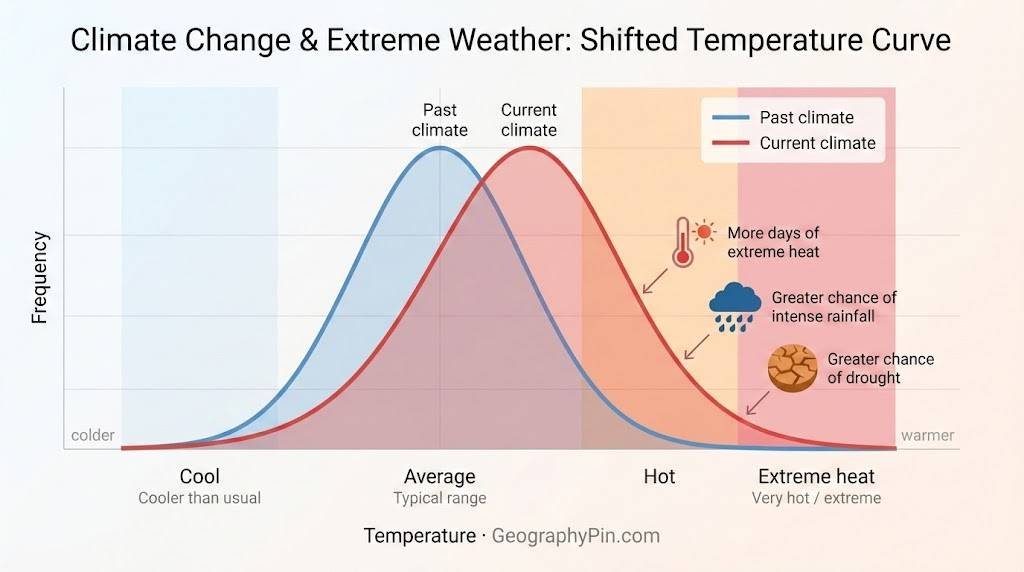
Climate change is about shifts in the long-term background state of the climate system, not a single storm by itself. But that background matters because weather unfolds inside it. When the baseline becomes warmer, wetter, or drier in a region, the odds of some kinds of weather events can change too.
Shifting averages and shifting odds
The IPCC concludes that human-induced climate change is already affecting many weather and climate extremes in every region. Hot extremes have become more frequent and intense across most land regions since the 1950s, while heavy precipitation has increased in frequency and intensity over most land area with sufficient observations. Evidence and confidence differ by event type and region.
WMO’s State of the Global Climate 2025 assessment reports that 2024 remains the warmest year in the 176-year observational record, at about 2.8°F (1.55°C) above the 1850–1900 average. The year 2025 ranked second or third depending on the dataset, at about 2.6°F (1.43°C) above that baseline; 2015–2025 were the 11 warmest years on record. A single year is not the same as the full climate trend, but these results show how elevated the recent global temperature baseline has become.
That is why attribution studies matter. They do not usually ask whether climate change created a weather event out of nothing. They ask whether human-caused warming changed the probability or intensity of an event, such as a heatwave or heavy-rain episode. That is a more accurate way to connect individual weather events to climate change.
Frequently Asked Questions
Why are 30-year periods used for climate normals?
Thirty years is long enough to reduce the influence of a few unusual seasons while still producing a practical reference period. It is the WMO standard for climatological normals, not a rule that climate has no meaning until exactly 30 years have passed.
Can strange weather happen without the climate changing?
Yes. A snowy spring day, an unusually cool month, or one very wet summer can occur within an otherwise stable climate pattern. Climate is judged from the longer distribution and trend, not from one surprising event or season.
Is global warming the same thing as climate change?
Not exactly. Global warming refers to the long-term rise in Earth’s average surface temperature. Climate change is broader: it includes warming as well as related changes in rainfall, ice, sea level, seasons, and other parts of the climate system.
Can climate projections predict the exact weather on a future day?
No. Climate projections estimate how averages, ranges, and probabilities may change under different conditions; they do not tell us the exact weather in a particular city on a particular day decades from now.
What Did We Learn Today?
Weather is the atmosphere’s short-term state; climate is the longer pattern of its averages, variability, seasons, and extremes. Thirty-year normals provide a standard comparison period but do not create a hard boundary between the concepts. A changing climate shifts the background conditions and, with them, the probability or intensity of some weather extremes.
Sources & Data Notes
Definitions, climate-normal conventions, forecast-reliability context, annual temperature records, and extreme-weather attribution were checked against NOAA, WMO, NASA, and IPCC material. Annual global-temperature anomalies are rounded WMO estimates and may shift slightly with later dataset revisions. This article was prepared and editorially reviewed by Zurab Koniashvili (Z.K. Atlas), who completed the final factual checks and publication approval and accepts responsibility for publication. AI tools may have assisted during the editorial process, including with language refinement and the creation or editing of visual materials.