A tidal bore is a steep-fronted wave, or a train of waves, that travels upstream through a river or estuary as the incoming tide advances. It forms only where tidal conditions and channel shape allow the rising water to concentrate into a distinct moving front. It is not a tsunami.
How to use this article: Follow the wave-front diagram, explore why channel shape matters, or compare real examples.
1. The incoming tide becomes a moving front
Most people recognize a tide by watching water gradually cover a beach or rise against a harbor wall. A tidal bore is a more concentrated expression of an incoming tide: a recognizable wave front moves along the channel, and the water level rises abruptly as it passes.
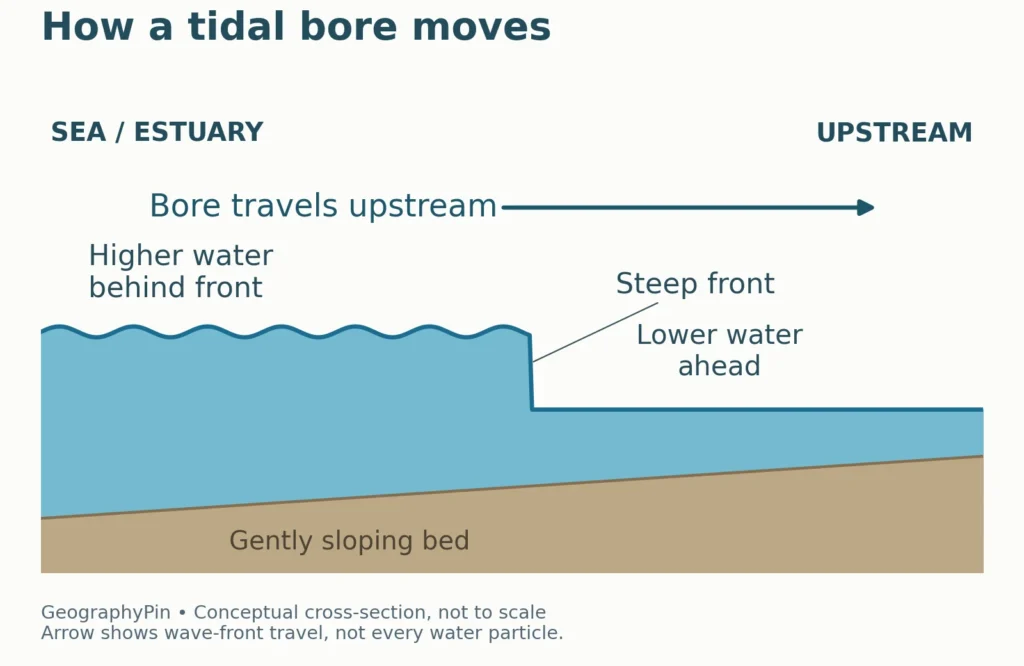
The NOAA tide glossary describes a bore as a tidal wave advancing through a shallow, sloping river or estuary with a steep leading edge. A breaking front may be followed by additional waves. The key feature is not simply fast water; it is a moving transition in water level associated with the advancing tide.
Read the direction correctly
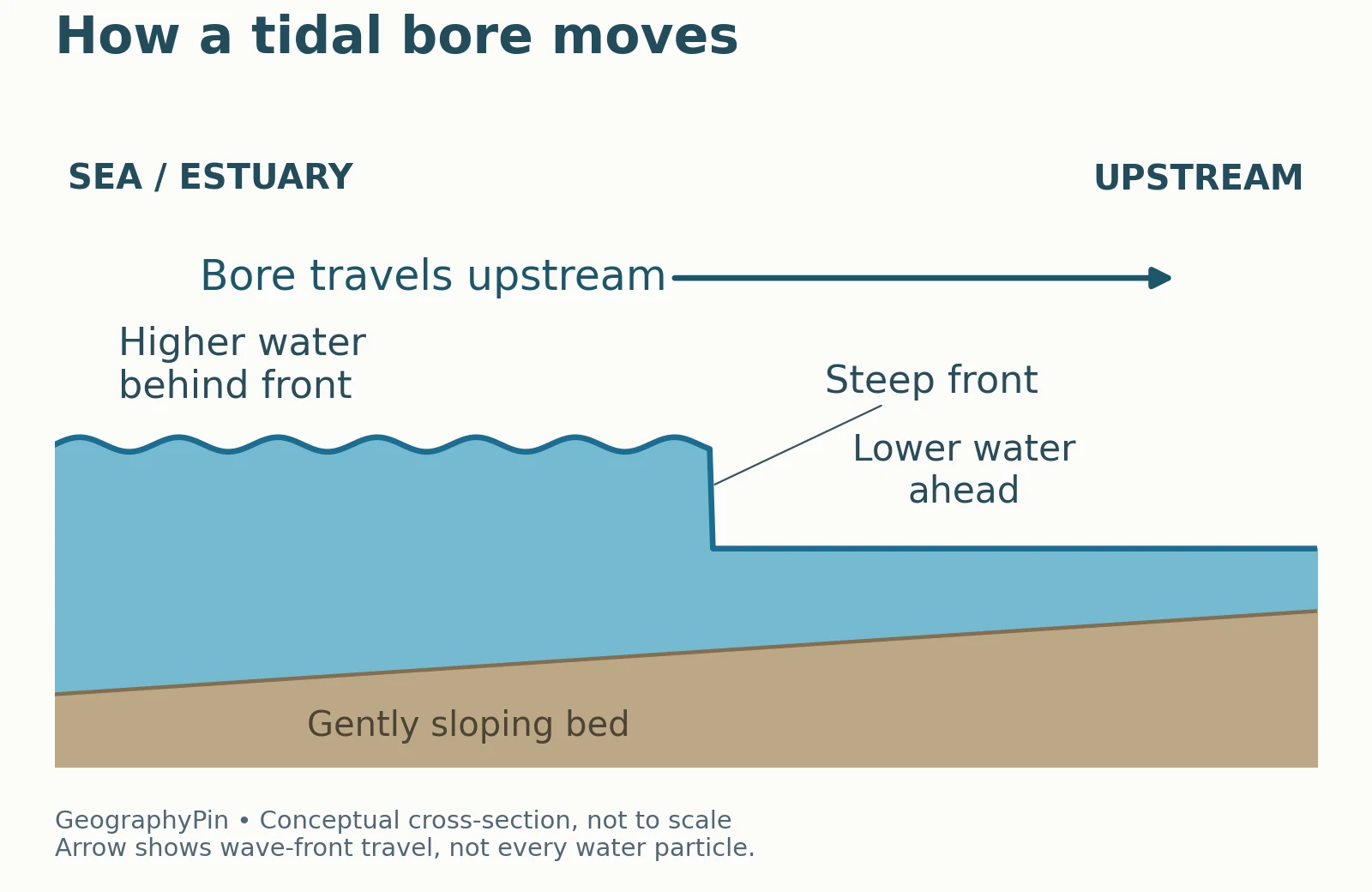
In the diagram, the sea is toward the left and the upstream direction is toward the right. The raised water behind the front advances into the shallower water ahead. The arrow tracks the progress of the front, not the path of every parcel of water.
That distinction matters in a river. A wave can move upstream while the water motion around it is more complicated than one uniform arrow. The passing bore changes the local flow, and strong upstream currents can accompany the incoming tide. But watching a crest travel inland does not mean that the river has permanently reversed its drainage direction.
Breaking and undular bores
Not every bore is a foaming wall. The USGS catalog of tidal bores distinguishes breaking bores from undular ones. An undular bore has an organized succession of waves rather than an entirely breaking front.
Pictures of the most dramatic examples can therefore give a misleading impression of the whole phenomenon. A low wave train may belong to the same family of tidal behavior as a conspicuous turbulent front. Shape and strength vary with the incoming tide, the depth of the channel and the river’s outflow.
2. Why only some estuaries produce a bore
A river meeting the sea is not enough. The arrival of tidal water has to interact with a suitable channel. Large tidal ranges, shallow water and an entrance that narrows inland are commonly associated with bores, but they should be understood together rather than as a single universal checklist.
Tidal range means the difference in water level between high and low tide. It is not the height of the bore itself. A large range supplies a strong tidal setting; the height of the moving front is a separate measurement at a particular place and time.
Channel shape concentrates the incoming water
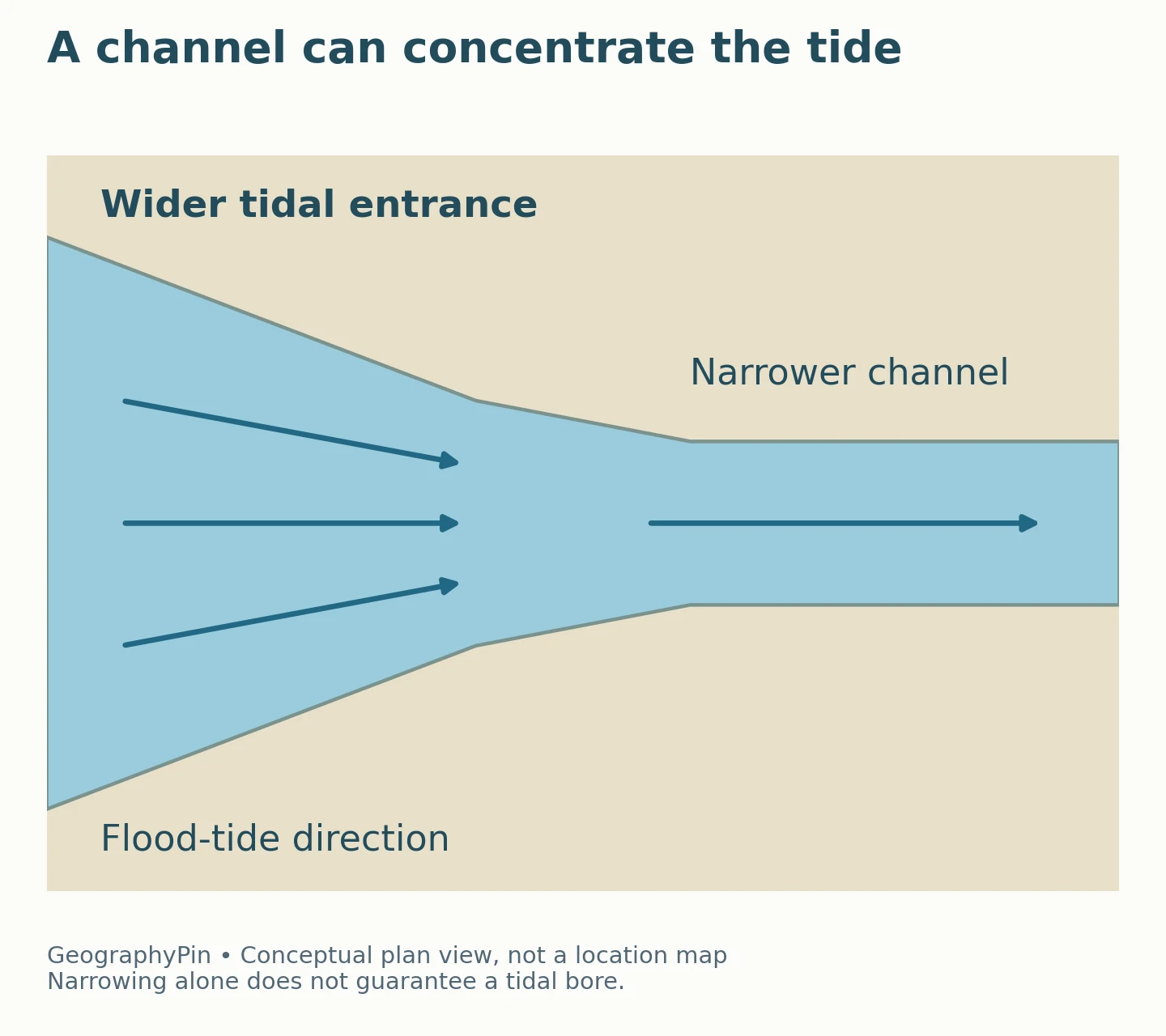
A broad entrance feeding a narrower channel can concentrate the advancing tide. Shallower water also changes the way the tidal wave travels. Under suitable conditions, the gradual rise becomes steep enough to form a distinct front.
The Canadian Hydrographic Service’s explanation emphasizes the interaction of a large rise at the entrance, shallow and gently sloping bed, restrictions, friction and the remaining outgoing flow. The water cannot spread through the interior as smoothly as the outside level rises.
The diagram isolates the narrowing effect. It does not show a measured river, and a funnel shape alone is not a guarantee that a bore will appear. An actual estuary has changing depths, sandbars, bends and freshwater inflow. Those details help determine whether the tide develops a recognizable bore and how far that front persists.
For the broader setting, GeographyPin’s delta and estuary comparison separates the water system from the sediment-built landform. Neither label, by itself, tells you whether a tidal bore occurs.
Avoid a universal height threshold
Different explanatory sources describe characteristic tidal ranges or spectacular wave heights. Such figures are not interchangeable. A catalog may summarize the sites it examined, while a local guide describes one river under favorable conditions.
For identifying the process, ask what the measurement represents: high-to-low tidal range, the height of the bore front, water level above a chart datum, or a wave’s travel speed. A number without that label can turn a sound observation into a misleading comparison.
3. Why the same bore is not equally impressive every day
The astronomical tide varies through the lunar cycle. Around new and full moons, the Sun’s and Moon’s tide-generating effects combine to produce larger tidal ranges. These are spring tides, a name unrelated to the season of spring. Around the quarter moons, the range is generally smaller: these are neap tides.
NOAA’s explanation of spring and neap tides describes a cycle occurring throughout the year. The larger ranges can favor a stronger bore at suitable locations, but the phase of the Moon alone does not tell you the exact arrival time or the size of a particular wave.
The spring-versus-neap-tides guide explains that lunar-cycle distinction in more detail. Here, its importance is the changing tidal input to an estuary, not a guarantee of one wave on every full moon.
Local conditions still matter
The freshwater flow, wind and channel conditions influence what an observer sees. Gloucestershire Archives notes that wind direction and the amount of freshwater affect the Severn Bore. A prediction for one observation point is not automatically valid at another point farther upstream.
The National Oceanography Centre also distinguishes predictable astronomical tides from the actual water levels affected by weather and coastal conditions. A tide table is valuable, but it should not be treated as a guarantee that every local detail will match a photograph or video.
Bore arrival is not the same as high water
A bore belongs to the advance of the rising tide. It is not simply another name for the moment of maximum water level. The visible front and the subsequent filling of the estuary are related parts of the same tidal episode, not identical events.
This is one reason an educational diagram cannot serve as a viewing timetable. For a visit, use current local bore information for the exact location, check the relevant time zone and follow official restrictions. Do not assume that a high-tide time at a distant port is the time a bore passes a riverbank.
4. Three places that show the geography of tidal bores
These examples illustrate different settings, not a ranking of the largest bores. Their wave heights are not compared because local conditions and measurement conventions differ.
| Example | Geographic setting | What it illustrates |
|---|---|---|
| Severn Bore, United Kingdom | The tidal Severn, connected to the Bristol Channel through the Severn Estuary | A large tidal range interacting with a narrowing river-estuary system |
| Turnagain Arm, Alaska | A branch of upper Cook Inlet near Anchorage | A bore can occur in an estuarine arm, not only in a river with a familiar single-channel mouth |
| Petitcodiac River, Canada | The river near Moncton, New Brunswick, in the Bay of Fundy tidal system | The same site’s bore can vary markedly with the tidal cycle |
Severn: a rising tide in a narrowing channel
The Severn is a well-known British example. Its bore moves inland through the tidal river rather than remaining as surf on an exposed beach. Gloucestershire’s factsheet explains the combined importance of the rising tide and the estuary’s decreasing width and depth.
The source also distinguishes a visible bore from a continuing rise in water level after the distinct wave has weakened. This is a useful reminder that “the tide reaches here” and “a clearly defined bore reaches here” are different statements.
Turnagain Arm: the estuary is part of the story
NOAA identifies Turnagain and Knik Arms, near Anchorage, as regular U.S. tidal-bore locations. Turnagain Arm branches from Cook Inlet, so its name is a clue to the setting: this is a long estuarine waterway rather than a wave crossing the open ocean.
The example also warns against equating an exposed flat with safe ground. Alaska State Parks specifically warns that Turnagain Arm’s mudflats can trap people while the tide rises. Watching from a designated safe viewpoint is very different from walking toward the wave across the flats.
Petitcodiac: a bore changes with the tide
The Canadian Hydrographic Service describes the Petitcodiac near Moncton, along with the Shubenacadie and Salmon rivers in Nova Scotia, as examples driven by the Bay of Fundy’s large tides. It notes that a conspicuous bore during the highest monthly tides can be much less impressive during smaller tides.
A photograph therefore records one event, not a permanent height. The right question is not simply whether a river “has a bore,” but what conditions produce a visible one at the place and time being considered.
5. Tidal bore, tsunami and storm surge are different
Several water phenomena can produce a sudden or dramatic change at a coast. Similar appearance does not establish the same cause.
| Phenomenon | Main cause | Key distinction |
|---|---|---|
| Tidal bore | The incoming astronomical tide interacting with an estuary or river channel | A distinct tidal front travels inland |
| Tsunami | Rapid displacement of water, commonly associated with an undersea earthquake | It is not generated by the normal tide cycle |
| Storm surge | Storm-driven water-level rise, especially from winds pushing water toward the coast | It is a weather effect above the predicted astronomical tide |
Table downloads (2)
- Three tidal-bore settings, not a size ranking (4 × 3)View tableDownload CSV
- Different causes of dramatic coastal water movement (4 × 3)View tableDownload CSV
A tsunami can enter a river and develop a bore-like front, but that does not make it a tidal bore. The cause remains different. Conversely, calling a tidal bore a “small tsunami” obscures the mechanism and can confuse hazard information.
NOAA defines storm surge as an abnormal storm-related rise above the predicted tide. Storm tide is the combined water level from the surge and astronomical tide. The word surge may also be used descriptively for a moving rush of water, so context matters: a “tidal surge” in a bore explanation is not automatically a hurricane storm surge.
A predictable phenomenon is not a safe one
A bore’s connection to the tides does not make entering the water safe. Strong currents, turbulence, quickly rising water and unstable banks or mudflats can turn a close approach into a serious hazard. Alaska’s Chugach State Park brochure explicitly tells visitors to stay off Turnagain Arm’s mudflats.
For ordinary observation, use established viewpoints, remain behind local barriers and do not follow other visitors onto exposed tidal ground. This article explains the process; it is not a surfing, boating or access guide.
Frequently Asked Questions
Does a tidal bore make a river flow backward?
It sends a wave front upstream and can produce strong landward flow as the tide advances. That is a temporary tidal event in the lower river or estuary, not a permanent reversal of the whole river from source to mouth.
Can a bore happen without a breaking wall of water?
Yes. Undular bores form a train of waves rather than an entirely breaking front. A less dramatic surface does not mean the tide, current or surrounding mudflats are safe.
Do tidal bores occur only in spring?
No. Spring tides occur around new and full moons throughout the year; the name does not refer to the season. Local tide and river conditions determine when a bore is visible and how strong it is.
What Did We Learn Today?
A tidal bore is the incoming tide organized into a moving upstream front, sometimes breaking and sometimes undular. Its formation depends on the tidal setting and the shape, depth and flow of an estuary or river. Tidal range is not bore height, spring tides are not seasonal, and a bore’s arrival is not the same as high water. Severn, Turnagain Arm and Petitcodiac illustrate the process without making it a tsunami, a storm surge or a safe place to enter the water.
Sources & Data Notes
The original diagrams are conceptual, not maps or numerical simulations. Tidal range, bore-front height, wave travel and water-particle motion are kept distinct. Examples are not a global inventory or ranking. The 1988 USGS publication abstract supports the distinction between undular and breaking bores; its historical locality count is not presented as a current total. Consult current local authorities for viewing conditions and restrictions.
- NOAA: Tide and Current Glossary
- USGS: Bartsch-Winkler and Lynch (1988), Catalog of Worldwide Tidal Bore Occurrences and Characteristics (publication abstract)
- Canadian Hydrographic Service: Tidal phenomena
- Canadian Hydrographic Service: Definitions for tides and currents
- NOAA: Spring and neap tides
- National Oceanography Centre: Tides explained
- Gloucestershire Archives: Severn Bore Factsheet
- NOAA: Five ocean terms, tidal-bore section
- NOAA: Storm surge and storm tide
- Alaska State Parks: Chugach State Park brochure, mudflat warning