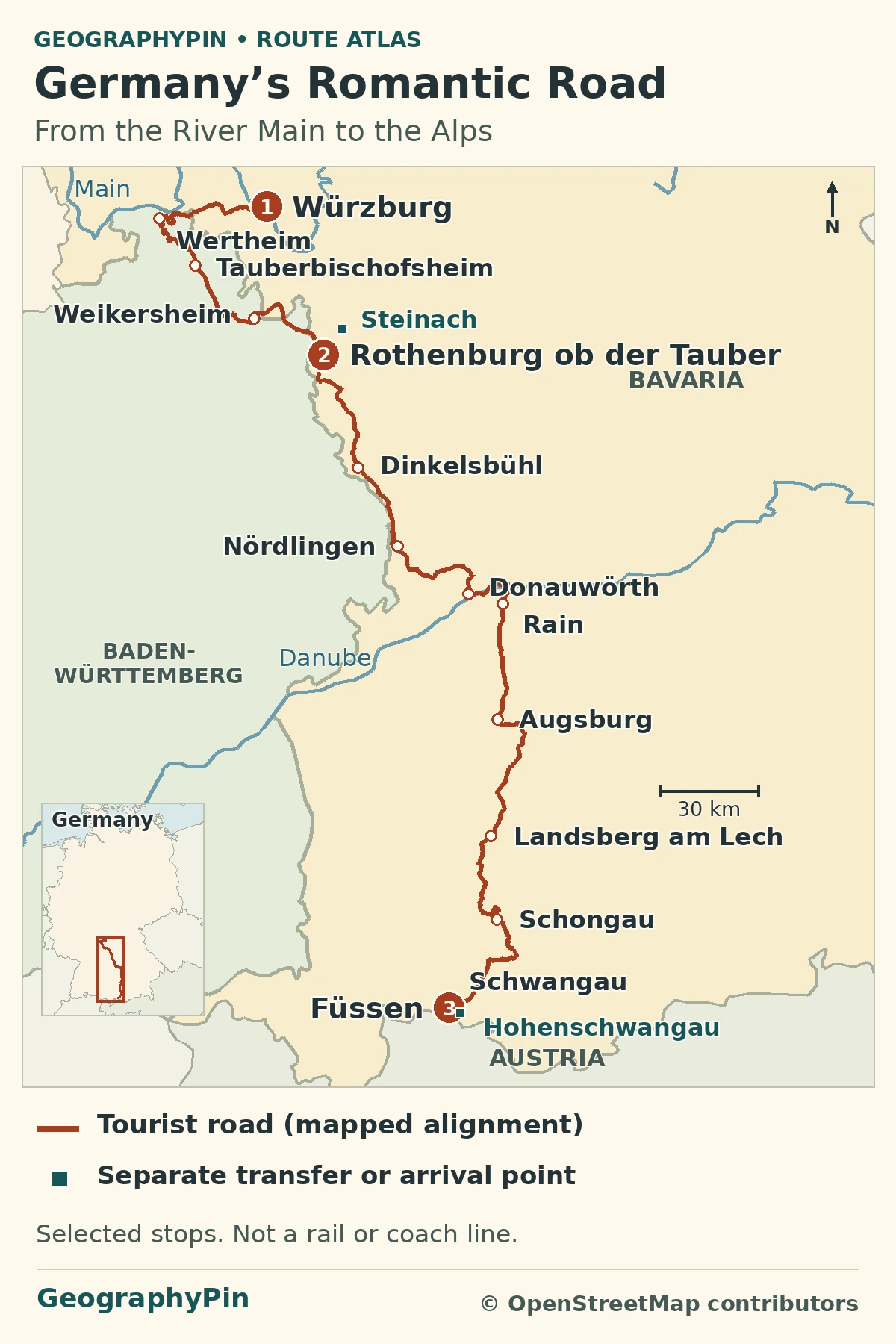
Germany’s Romantic Road runs from Würzburg on the River Main to Füssen at the foot of the Alps. The map shows where it bends west toward Wertheim, comes back through the Tauber Valley to Rothenburg ob der Tauber, and continues south through Augsburg. Drive if you want to stop in several small towns. Without a car, plan Rothenburg as a northern outing and use Augsburg as the starting point for a separate train trip to Füssen.
The Romantic Road is a signed tourist drive from Würzburg to Füssen through Bavaria and Baden-Württemberg. The main stops include Rothenburg ob der Tauber, Dinkelsbühl, Nördlingen, Donauwörth and Augsburg. There is no single train along the road: change at Steinach for Rothenburg, and use regional trains from Augsburg for Füssen.
How to use this article: Compare the driving, train and coach options, check a worked Sunday coach trip, or see how to reach Neuschwanstein from Füssen.
Romantic Road map and transport choices
On the map, the road dips into Baden-Württemberg before returning to Bavaria, then crosses the Danube at Donauwörth and heads toward the Alps. The tourism association advertises the route at about 460 km (286 mi) and lists 29 member towns. That is a useful sense of scale, not the distance for every itinerary. The signed drive links existing roads; it is not one numbered highway, the fastest motorway route between the endpoints, or the same alignment as the association’s cycling and walking routes.
Which towns are easiest to combine without a car?
Transport checked November 21, 2026. Pair Würzburg and Rothenburg for the northern part. In the south, Augsburg and Füssen make a workable pair, with a separate bus if you want the castle. Treat the towns in between as individual additions, not as stops on the same train.
| If you want to | Start and finish | Connection or constraint |
|---|---|---|
| Drive the signed route | Würzburg to Füssen via the selected towns on the map | Follow the brown tourist signs and the association’s motor-route map. Don’t let a motorway shortcut skip the stops you want. |
| Visit Rothenburg by regional public transport | Würzburg Hbf to Rothenburg ob der Tauber station | One change at Steinach on the usual RE 80 and RB 82 route. Check if RB 82 is a replacement bus. |
| Take a Sunday coach outing | Würzburg Hbf long-distance bus stand 12 to Rothenburg Schrannenplatz; return to Würzburg | No change on this outing. The published 2027 season runs on Sundays from May 2 through September 19. Some stops require advance arrangements. |
| Pair Augsburg and Füssen | Augsburg Hbf to Füssen station | Selected RB 77 runs are direct, about two hours in the published base timetable through December 12, 2026. Construction can change the trip. |
| Continue to Neuschwanstein | Füssen station to Hohenschwangau, then uphill to the castle | One more local bus leg (73 or 78), then a separate ascent. The village bus stop is not the castle entrance. |
Würzburg to Rothenburg across the Tauber Valley
Würzburg is the northern endpoint, but the tourist road does not immediately head south. It goes west to Wertheim, where the Tauber meets the Main, then turns upstream into the Tauber Valley. Tauberbischofsheim, Bad Mergentheim, Weikersheim and Creglingen are all on the association’s list. That bend is worth keeping if it’s the river towns you came to see. A train trip from Würzburg to Rothenburg leaves those stops out.
For the train, enter Rothenburg ob der Tauber as the destination. Steinach (bei Rothenburg ob der Tauber) is where you normally change, not where you get off for the old town. It is about 15 minutes from Steinach to Rothenburg on a regular RB 82 train. Rothenburg’s station is outside the walls and the old town is within walking distance. At the November 21 check, DB reported a replacement bus on the RB 82 segment, with the closure expected through November 30, 2026. Check the current departure point in the planner rather than heading automatically to the rail platform.
A Sunday coach outing with time in Rothenburg
The operator’s 2027 timetable shows a usable return pattern. For example, on the published opening Sunday, May 2, 2027, the schedule is 10:35 from Würzburg Hbf’s long-distance bus stand 12 to Rothenburg’s Schrannenplatz at 12:45. The northbound coach leaves the same square at 16:00 and reaches Würzburg Residenz at 17:40. That leaves 3 hours 15 minutes between the scheduled times at the square. The 18:00 return stop at Würzburg Hbf is marked as a request stop in the operator PDF. Confirm the exact departure and return drop-off when you book; these are scheduled times, not seats held or guarantees.
Rothenburg to Augsburg through the Ries
South of Rothenburg, Dinkelsbühl and Nördlingen both have old town walls, but their settings are different. Nördlingen sits inside the Ries impact crater: the view from the church tower is a way to see the town in the wider basin, not just its walls from above. Beyond Harburg the road reaches the Danube at Donauwörth, passes through Rain, and continues toward Augsburg.
If you skip the car, Dinkelsbühl ZOB/Schwedenwiese is an arrival point to search for, not a mainline rail station. VGN line 813 connects it with Dombühl Bahnhof, passing through Feuchtwangen. This gives you one place to change between train and local bus when approaching by rail. The VGN lists separate construction and annual timetables; find the return from the same bus stop before going. Donauwörth and Augsburg are better places to start another rail leg than assuming the small towns are all on the same line.
Füssen station and the last leg to Neuschwanstein
The tourist road continues through Landsberg am Lech, Schongau and Schwangau before ending at Füssen. The RB 77 from Augsburg Hbf goes by way of Buchloe, west of much of that alignment. Its base timetable through December 12 gives examples of direct journeys in 1 hour 54 minutes and 1 hour 57 minutes. The operator also reported works affecting selected departures on the Füssen corridor through that timetable change. Look up your date rather than treating these times as a promised running pattern.
Füssen is the rail stop; Hohenschwangau is the village for the castle
- Train: Get off at Füssen station, not at the castle.
- Local bus: From Füssen, check route 73 or 78 to Hohenschwangau Neuschwanstein Castles, Schwangau. This is the village stop on Alpseestraße, not the castle entrance. The ticket center gives about 15 minutes for this bus leg.
- Final climb: From the Hohenschwangau ticket center, the castle administration gives about 30–40 minutes on foot for 0.9 mile (1.5 km) up a steep road. Allow time for the climb before your timed castle visit.
At the November 21 check, the ticket center reported a closure of the B 17 through Schwangau expected until about December 18, 2026, with a signed detour through Hohenschwangau. The castles remained accessible, but the notice advised allowing extra time. Füssen was also rebuilding its bus station, with the first construction phase planned through May 2027; verify the boarding stand locally.
How to plan the return
A round trip is easy to arrange for one part of the road. A loop of the whole route is a different trip. If driving north again from Füssen, you can either retrace the signed route for stops you missed or use your navigator for a separate motorway return. Check any rental drop-off terms before planning to leave the car in another city.
Without a car, search the dated southbound and return journeys before setting the places you’ll sleep. A day trip that returns to Würzburg is not the same as a seat to the next town. The 2027 coach timetable marks Donauwörth Bahnhof as the change for passengers continuing to Augsburg or Füssen by rail, not as a through coach to either station. Donauwörth is a starred stop: the operator requires it to be reserved and paid for at least three days before departure. Check the actual onward rail trip and what the coach booking covers. If going on to the castle, look up the village-to-station bus back before taking the uphill leg.
Frequently Asked Questions
Is the coach stop at Wertheim-Village the same as Wertheim’s old town?
No. The operator lists the request stop at the shopping outlet’s Tourist Information at Almosenberg, not in the historic center where the Main and Tauber meet. If the point of your visit is the riverside old town, search for central Wertheim rather than choosing that coach stop by name alone.
Can I take a bicycle on the Romantic Road Coach?
No. The published 2027 coach timetable rules out carrying bicycles. If you’re only cycling one section, plan your onward trip separately and check the bicycle rules of the operator you’ll actually use.
Do I need separate booking confirmations for connecting legs?
Check whether your confirmation actually covers every leg. A sightseeing coach booking does not automatically cover a separately arranged regional train or a timed castle ticket. For rail connections, search your full rail journey first instead of buying each train on a separate ticket: Deutsche Bahn treats separately purchased rail tickets as independent contracts.
What Did We Learn Today?
The Romantic Road makes sense as one drive but as several trips by public transport. The Tauber Valley explains the westward bend on the map; Augsburg gives you a practical rail base for the southern end. If the castle is the priority, plan to get to Füssen station, then to Hohenschwangau, then uphill to the entrance.
Sources & Data Notes
Open the timetable, route data and photo credit
Transport information was checked November 21, 2026. Published timetables are not live seat or departure checks, and the tourist-road map does not show current detours.
- Romantic Road Tourism Association: the 29 towns, separate motor, cycle and walking alignments, route signs and general rail arrivals, Wertheim at the Main–Tauber confluence and Nördlingen and the Ries. The route-length figure is the association’s tourism overview figure.
- Romantic Road Coach 2027 timetable and operator PDF showing timetable columns and request stops. Use the published drop-off terms when confirming a date. The operator PDF is a schedule, not a seat-availability result. Wertheim Village’s visitor information locates the shopping outlet at Almosenberg.
- Deutsche Bahn: Steinach arrival board, Bavaria disruption notices and separate rail tickets. VGN: RB 82 annual timetable effective December 13, 2026 and bus 813 route and timetables. Rothenburg’s official arrival guidance confirms the old town is walkable from the station.
- Bayerische Regiobahn: RB 77 route and base timetable (Augsburg–Füssen example calculations from page 3 of the April 7–December 12 PDF) and current exceptions, including the Kaufbeuren works extension. Füssen’s bus station works, Ticket Center Hohenschwangau’s bus and road access page and Bavarian Palace Administration’s castle access details.
- Map: © OpenStreetMap contributors, motor route relation 56917 (downloaded November 21, 2026; ODbL). Borders and river context: Natural Earth, public domain. The mapped road alignment is for orientation, not street-level navigation or live detours. Use the association’s motor map and local signs to navigate.
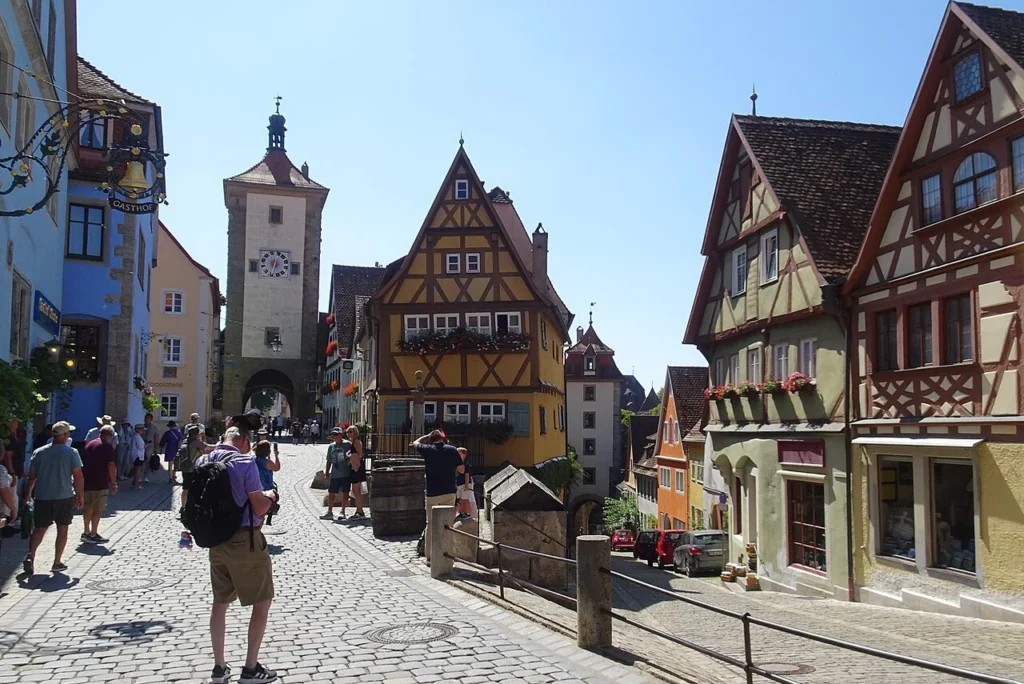
- Header photograph: Plönlein in Rothenburg ob der Tauber, Palickap, August 11, 2025, CC BY 4.0; cropped, resized and converted to WebP.