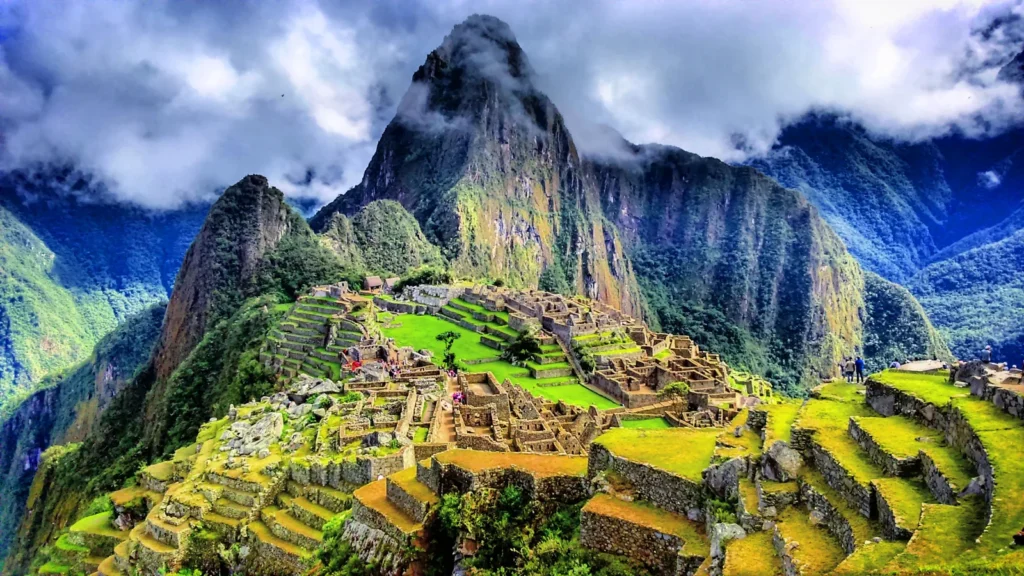
At Machu Picchu, a ticket that takes you to a terrace for the postcard view may never take you down among the stone buildings below. On the booking site, it’s also easy to mistake an upper terrace for a mountain summit. Start with what you want to see before picking a time.
Practical information checked: November 2026
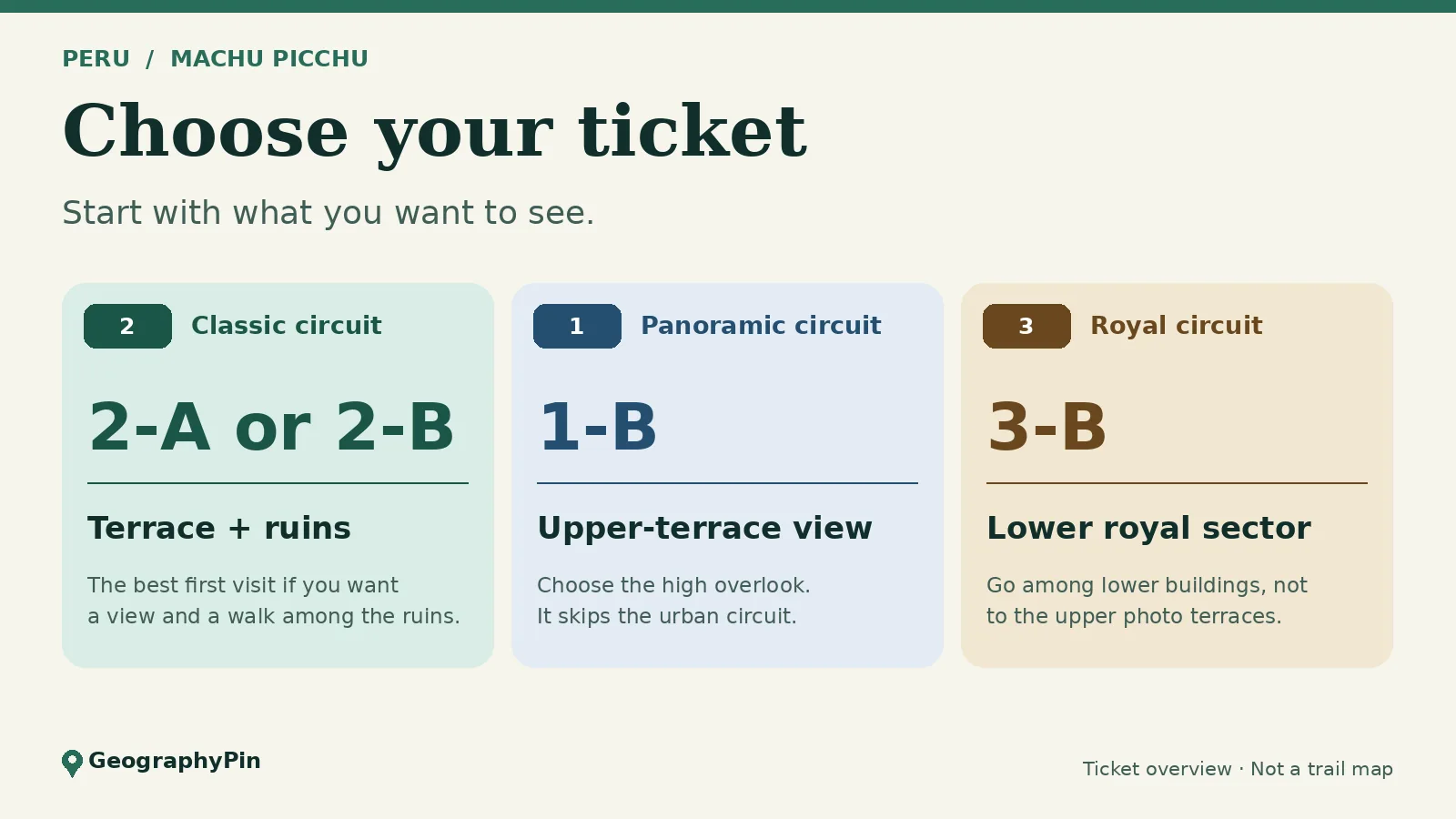
Choose Route 2-A or 2-B if you want both a terrace view and a walk through the ruins. Pick 1-B for the upper overlook without the urban circuit, or 3-B to explore the lower royal sector without climbing a mountain. For a summit or the Sun Gate, book the route that names that destination.
How to use this article: See how 2-A and 2-B differ, decide which mountain you want to climb, check the new checkpoint times or go straight to the ticket checklist.
Choose the experience before the time slot
2-A or 2-B: A wide view and a walk among the buildings
On TuBoleto, Circuit 2 is the classic circuit. Route 2-A is listed as Ruta clásico diseñada; 2-B is Ruta terraza inferior, the Lower Terrace Route. Their official plans show different approaches in the terrace sector before the lines continue into much of the same urban area. Route 2-B specifically takes you to the lower terrace. Both put you on a broad walk through the citadel rather than sending you back down immediately after the photograph.
If either is available at a workable time, don’t postpone the trip just because the other code looks more familiar. Pick 2-B if the lower terrace is the stop you want. Both are a better fit than 1-B if someone in your group would be disappointed to leave without walking among the stone buildings. Neither is a shortcut to the uppermost overlook or a ticket for a summit.
1-B or 3-B: The upper view is not the lower circuit
Route 1-B takes you uphill to the upper terraces and back out. You can look over the archaeological complex toward Waynapicchu, but you don’t follow the urban loop below. Route 3-B approaches the citadel from below and takes in part of the royal sector. Its plan marks a viewpoint for the Temple of the Sun; a viewpoint beside a building does not mean you may enter every room. With 3-B, don’t count on the high panorama from the upper terraces.

1-A or 3-A: The two peaks are not the same hike
Machu Picchu Mountain is the climb on Route 1-A. The closer peak behind the buildings in the familiar photograph is Waynapicchu, also written Huayna Picchu; its summit route is 3-A. The official map for each shows the branch away from the citadel. 1-A is on the panoramic side. 3-A connects to the lower royal circuit. Neither is Circuit 2 plus a climb, so don’t assume a mountain ticket also covers the classic urban loop.
All 10 routes compared
The rightmost column shows 2027 scheduled entry times at the main citadel gate in local time, not live ticket inventory. “Regular and high season” means the route appears in both published schedules, not that it’s guaranteed to be open every day. The route codes link to the official diagrams; follow the colored route line, not every landmark listed in the map legend.
| Route and official plan | What you see | What’s involved | 2027 gate times |
|---|---|---|---|
| 1-A Machu Picchu Mountain | Panoramic circuit plus the summit of Machu Picchu Mountain. | Long, sustained climb; not the urban circuit. | Regular and high season; 6 or 8 a.m. |
| 1-B Upper Terrace | The upper photo terraces, looking over the buildings. | Climb from the entrance to the terraces; no summit hike. | Regular and high season; hourly, 6 a.m.–3 p.m. |
| 1-C Intipunku (Sun Gate) | Terrace sector plus the out-and-back trail to the Sun Gate. | Uphill trail; roughly two hours round trip on the trail. | High season only; 7, 8, 9 or 10 a.m. |
| 1-D Inca Bridge | Terrace sector and the spur toward the Inca Bridge. | Cliffside trail; roughly one hour round trip on the spur. | High season only; hourly, 8–11 a.m. |
| 2-A Classic Route | Terrace views and the broad urban loop past the quarries and Temple Plaza area. | Stone stairs and uneven surfaces; no mountain summit. | Regular and high season; hourly, 6 a.m.–3 p.m. |
| 2-B Lower Terrace | Lower terrace photo stop and a broad route through the urban sector. | Stone stairs and uneven surfaces, despite “lower” in the name. | Regular and high season; hourly, 6 a.m.–3 p.m. |
| 3-A Waynapicchu Mountain | Lower royal sector plus the summit of Waynapicchu (Huayna Picchu). | Steep climb on the peak behind the ruins in the classic view. | Regular and high season; 6 or 8 a.m. |
| 3-B Royal Route | The lower royal sector, including the Temple of the Sun viewpoint on the plan. | No mountain hike; an adapted portion does not make the full route step-free. | Regular and high season; hourly, 6 a.m.–3 p.m. |
| 3-C Great Cavern | Lower royal sector and the trail to the Great Cavern (Temple of the Moon). | Long side route with a descent and a climb back; not a summit ticket. | High season only; 6 or 8 a.m. |
| 3-D Huchuypicchu | Lower royal sector and the smaller Huchuypicchu peak. | Shorter mountain ascent than the Waynapicchu summit, still on steps. | High season only; 6 or 8 a.m. |
If avoiding stairs is the reason for comparing routes, “lower” is a location, not an accessibility rating. Route 2-B still includes stone stairs. Peru’s disability council reported adapted sections and a wheelchair-accessible viewpoint on Circuit 3 in August 2026. The 3-B plan marks the adapted segment near the entrance. Neither source certifies the full 3-B route or the transport to the entrance as step-free. Confirm the exact segment and arrival arrangements with the site before buying.
When the seasonal routes are available
In 2027, the seasonal routes are 1-C, 1-D, 3-C and 3-D. Peru’s Ministry of Culture set four official high-season windows: January 1–3, March 25–28, June 19–November 2, and December 29–31. It set a daily cap of 5,600 visitors in those windows and 4,500 on other dates. Those limits include multiple routes and sales channels. They don’t tell you how many of your preferred tickets are still available.
For December 2026, the published high-season window is December 30–31. Don’t apply the 2027 date ranges or hike timetable to a 2026 ticket.
Separate the citadel gate from the hike checkpoint
From January 1, 2027, Routes 1-A, 3-A and 3-C have an extra deadline inside the site. A 6 a.m. ticket is for the main citadel entrance; check in for the hike from 7 to 8 a.m. An 8 a.m. ticket pairs with a 9 to 10 a.m. hike check-in. The noon cutoff is when you must start back from the summit or Great Cavern, not when you may start the hike. Route 1-A also has a 2 p.m. latest return from the mountain.
The newer regulation gives maximum combined visit times of 6½ hours for 1-A and 5½ hours for 3-A. Those limits replace the longer times shown on the older printed maps for those two routes. Build your travel around the first check: being at the bus stop in town at the time on your ticket is not the same as being at the citadel gate.
What to check before you pay
Match the code, the date and the traveler details
On Peru’s official TuBoleto page for the citadel, choose the circuit, then the route code, visit date and admission time. The menus are separate. For instance, selecting “Circuito 2” doesn’t yet select 2-A or 2-B. Before paying, check the code again and use the name and identification details you will present at the gate.
Check the total for your visitor category on the seller’s site. A separate 2027 protected-area tariff of S/11 for most international adults is not the price of the timed citadel ticket. The published November tariff temporarily sets that protected-area component to S/0 through December 31, 2026, and gives different amounts for some other categories. You may see that component incorporated in the booking flow; don’t add it again if it is already included in the total displayed. Train, bus and guided services are separate arrangements.
If your first choice is missing, switch only to a ticket that still gives you the experience you’re traveling for. If both classic routes are unavailable, pick 1-B for a view or 3-B for a visit among the lower buildings. If a particular mountain is the point of the trip, look for another date before buying a different route. The annual schedule is not a release date. Check actual availability in TuBoleto before you commit to nonrefundable travel.
Keep the issued ticket and the matching ID ready for inspection. If a seller supplies a ticket rather than just a reservation confirmation, the Ministry of Culture’s TuBoleto verification notice explains how to check its validity. For the wider geography around the site, see our Peru country profile.
Frequently Asked Questions
Which route gives the classic Machu Picchu photograph?
Choose 1-B for a high terrace view over the citadel toward Waynapicchu. If you want that kind of view and time among the buildings, look for 2-A or 2-B instead. With 2-B you photograph from a lower terrace, so don’t expect exactly the same angle as 1-B.
Does a panoramic ticket also include the buildings below?
No. Route 1-B takes you to the upper terrace zone and back; it does not include the classic urban loop. Choose a Circuit 2 route for a broader walk among the ruins, or 3-B if the lower royal sector is the priority.
Is the Sun Gate on Route 1-C the same as an Inca Trail permit?
No. The 1-C ticket lets you walk between the citadel and Intipunku during high season. It does not give you a permit for a multi-day Inca Trail trek, which is regulated separately.
What Did We Learn Today?
Decide first whether you want a terrace view, a walk through the stone city or a specific hike. The route code tells you which of those your ticket covers. Once you have the right code, check the calendar and match the citadel entrance time and any secondary checkpoint to your travel plans.
Sources & Data Notes
View route maps, 2027 rules and image credit
Route features were compared from the marked paths on the ten official maps. Gate slots are allocations in the 2027 annex, not a report of tickets on sale. For 2027 hike checkpoints and current time limits, the newer regulation is used in preference to the older map labels.
- Peru Ministry of Culture: Route directory and official plans, and the three-circuit system.
- Resolution 408-2026-MC and its 2027 entry-slot annex; Resolution 407-2026-MC, pp. 4–5; and the separate 2026 season calendar.
- SERNANP: Protected-area tariffs, Resolution 000017-2026-SERNANP/SHMPI and the July 2026 announcement on integrating the charge into TuBoleto.
- Conadis: August 2026 accessibility visit. SERNANP: Inca Trail route overview.
- Cover: El Majestuoso Machu Picchu, by EdsonFuentesMera, 2019, Wikimedia Commons, CC BY-SA 4.0; resized and converted to WebP under the same license. Ticket comparison graphic: GeographyPin, based on the official route plans.
