A country can put socialism in its constitution and still have privately owned farms. Nicaragua offers a particularly clear test because its founding principles and its property guarantees appear in the same document.
Nicaragua is socialist in its stated political principles. The constitution pairs socialist ideals with Christian values and solidarity, while recognizing private, public, cooperative and other kinds of property. The Sandinista movement’s control of the presidency tells you who holds political power. It takes different evidence to tell you who owns a coffee harvest or runs the electricity grid.
How to use this article: Jump to the discussion you need: What changed in the property clause, Which edition matters or Who owns a coffee shipment.
Three questions behind the word socialist
| Question | Where to look | What the evidence shows |
|---|---|---|
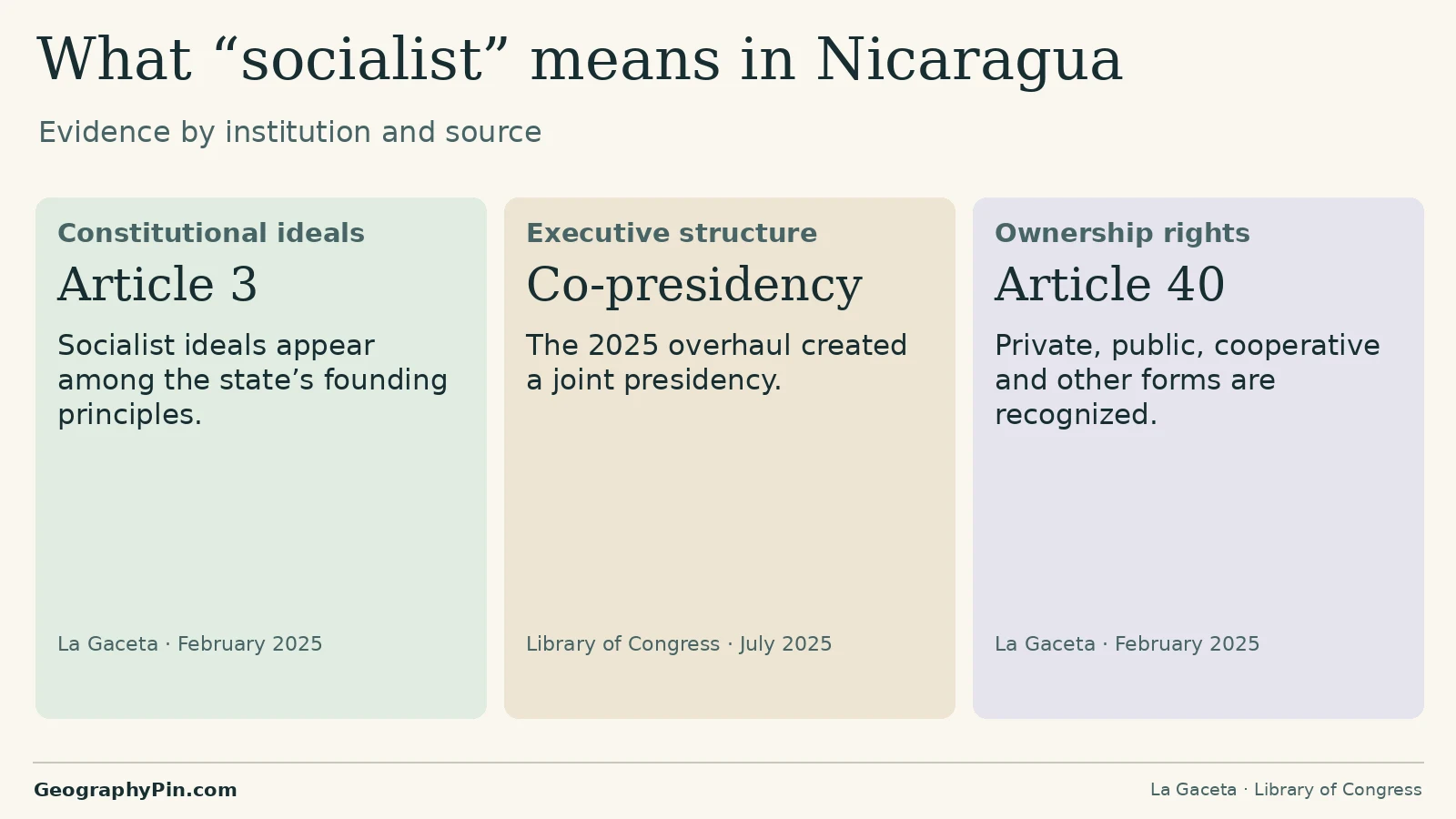
| What are the state’s ideals? | 2025 constitution, Article 3 | Socialist ideals are an explicit principle. |
| Who exercises executive power? | 2025 constitution and institutional history | A co-presidency replaced a single presidency. |
| Who may own an enterprise? | 2025 constitution, Article 40 | Several forms of ownership receive recognition. |
| Who produces a particular crop? | Coffee-sector reporting | Growers, cooperatives and exporters have distinct roles. |

A map that colors countries according to the governing party answers the middle question. A map that colors them according to whether private productive property is permitted answers the third. Nicaragua can receive different colors on those maps even when the authors agree about every fact. GeographyPin’s comparison of socialist countries spells out why the definition changes the group.
What changed in the property clause?
The pre-reform text listed ownership forms in Article 103. The 2025 text places the guarantee in Article 40. A researcher working from the older article number can miss a real continuity. The government reorganized the executive much more dramatically than it changed the basic recognition that different kinds of owners can operate. The same ownership questions arise in Paraguay’s constitutional and economic framework.
From the Sandinista revolution to the co-presidency
The Sandinista National Liberation Front, usually abbreviated FSLN from its Spanish name, came to power in the revolution of 1979. Its association with nationalization and land reform long predates the current constitutional text. There was an electoral transfer of power in 1990, and Daniel Ortega returned to the presidency in 2007. Treating every year since 1979 as a continuous period under one government erases that break.
Which edition matters?
The constitutional overhaul published on February 18, 2025, is the reference point for Articles 3 and 40 here. The U.S. Library of Congress documents the shift to a co-presidency and the presidency’s coordinating role over other state organs. Readers comparing older texts may find a different numbering system and a single executive office. A reference to socialism in a recent source does not by itself establish that the reform created a fully state-owned economy.
The official gazette also published a further reform text in September 2026. A reform approved in a first legislative reading and a consolidated constitution already in force are different records. The economic comparison here rests on the published principles and property provisions, rather than on a prediction about a later legislative term.
Follow the electricity and the coffee
Electricity transmission is a useful public example. ENATREL, the national transmission company, operates the high-voltage network that carries power between producers and local distribution networks. Ownership of the transmission network is a narrower claim than ownership of every generating plant, shop or household appliance that draws electricity from it.
Who owns a coffee shipment?
Growers can cultivate coffee on family holdings, sell through a cooperative or deal with a commercial buyer. A cooperative groups producers for activities such as processing and marketing. A private exporter can buy, prepare and sell beans abroad. The recorded value of Nicaragua’s exports does not tell us that the government owned the beans at any of those stages. USDA coffee reporting describes the producers and the export market separately.
The contrast matters in the highlands, where the coffee-growing economy visible on a map of Nicaragua looks quite different from a diagram of institutions in Managua. A public utility can supply infrastructure to privately organized producers. Neither example supplies a defensible percentage for state ownership across the entire economy.
What survives a change of economic policy?
Article 40 of the constitutional text published in February 2025 recognizes more than one form of ownership, including state, private and cooperative property. The gazette published a further reform at the first legislative stage in September 2026. To establish a change to the operative guarantee, check the subsequent legislative approval and the text promulgated in the gazette.
Frequently Asked Questions
Does the constitution permit a private company to export coffee?
Yes. Private property is among the recognized forms of ownership, and commercial coffee exports are documented. Licensing, tax and trade rules still apply to individual businesses.
Is a cooperative the same thing as a state enterprise?
A cooperative is organized around its members. A state enterprise is owned by the state. Article 40 lists the forms separately, which is particularly relevant in agriculture.
What Did We Learn Today?
An ideological principle, an executive institution and the owner of a productive asset are three different things to identify. Nicaragua’s constitution answers the first two questions directly and allows several answers to the third.
Sources & Data Notes
Evidence checked November 23, 2026. The constitutional comparison uses the February 2025 consolidated text, the preceding edition and the subsequent legislative record. Export evidence describes how a sector operates, without estimating economy-wide ownership.
- La Gaceta, Nicaragua’s February 2025 constitution
- National Assembly, 2024 constitutional edition
- USDA Foreign Agricultural Service, Nicaragua coffee annual report
- Nicaragua, law establishing the national transmission company
- Library of Congress, the 2025 constitutional changes
- La Gaceta, September 2, 2026 legislative record