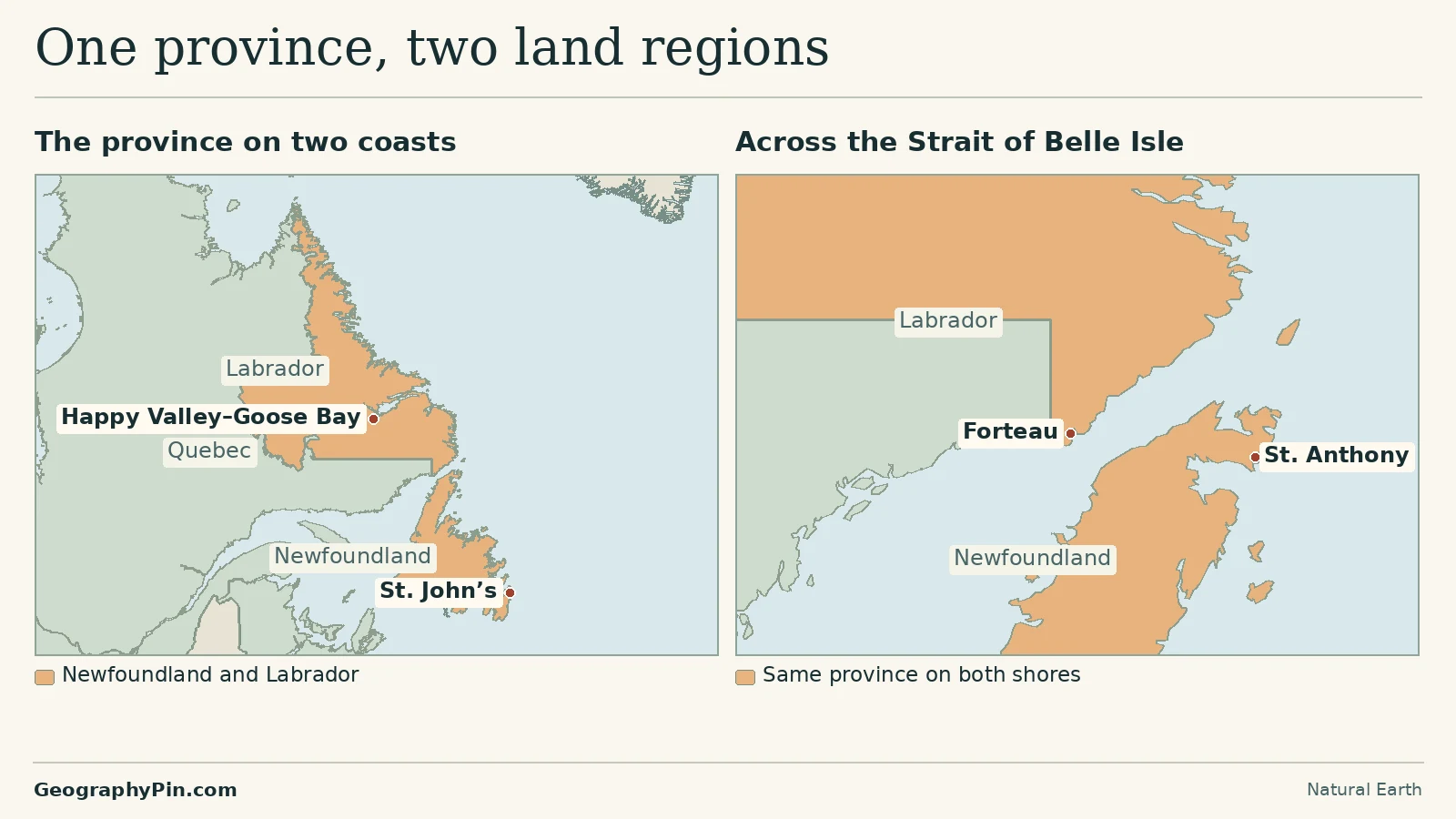
The Strait of Belle Isle divides an island from a mainland coast. It does not divide two Canadian provinces. The island of Newfoundland and mainland Labrador entered Confederation as a single province after two referendums.
Newfoundland joined Canada at the end of March 31, 1949, as the tenth province. Its territory already included Labrador. A referendum in July 1948 had favored Confederation after a first round produced no majority. In 2001 the province formally changed its name to Newfoundland and Labrador. That later date marks a naming change, not a second admission.
How to use this article: Jump to the discussion you need: One province, two pieces of the map, What changed between the two ballots or Why the Quebec boundary sometimes looks different.
An island and a mainland region under one government
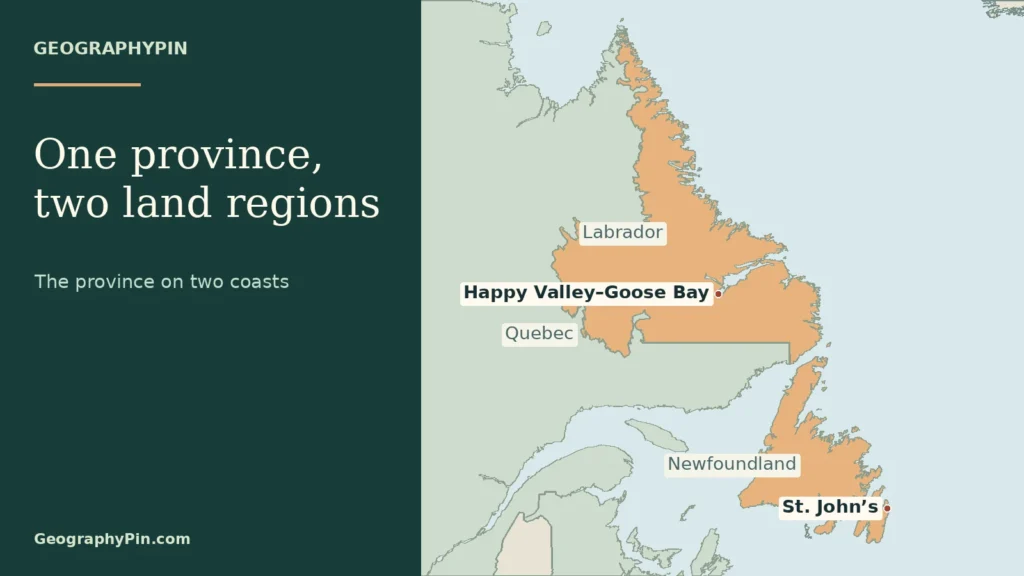
Newfoundland is an island off Canada’s Atlantic coast. Labrador extends along the mainland east and north of Quebec. St. John’s, the provincial capital, lies near the eastern end of Newfoundland, far from much of coastal Labrador. The island and the entire province cannot share the same area or population figure unless a source has accidentally used one name for both.

| Date | Event | What changed |
|---|---|---|
| 1927 | Judicial Committee of the Privy Council decision | The inland extent of Labrador was defined in the boundary case. |
| June 3, 1948 | First referendum | No option won an overall majority. |
| July 22, 1948 | Second referendum | Confederation won roughly 52.3% of the vote. |
| March 31, 1949 | Terms of Union took effect | The territory entered Canada as the province of Newfoundland. |
| December 2001 | Constitutional name amendment | Newfoundland and Labrador became the official provincial name. |
One province, two pieces of the map
St. John’s, the provincial capital, is on the island of Newfoundland. Labrador is on the North American mainland beside Quebec. The Strait of Belle Isle separates their nearest shores. A statement that “Newfoundland joined in 1949” generally refers to the political unit then called Newfoundland, including Labrador. It does not imply that Labrador separately joined Canada in 2001.
Why voters were choosing a form of government
Newfoundland had a separate constitutional history from Canada. Financial and political difficulties had led to government by an appointed commission in 1934. After World War II the choices included restoring responsible government, continuing commission government or joining Canada. “Responsible government” here meant an executive answerable to an elected legislature. It was a constitutional choice, not a judgment about individual conduct.
What changed between the two ballots?
- June 3, 1948. Responsible government, Confederation and continued commission government split the vote. No option won a majority.
- July 22, 1948. In the two-option runoff, Confederation won about 52.3% of valid votes and responsible government about 47.7%.
The Terms of Union made Newfoundland, including mainland Labrador, a Canadian province on March 31, 1949.
What the 2001 amendment recognized
Adding Labrador to the official name made a long-standing part of the province visible in the constitutional label. An atlas printed in 1950 could show a mainland area labeled as part of the Province of Newfoundland and still be correct. Its old label does not demonstrate that Labrador belonged to a different province at the time.
Why the Quebec boundary sometimes looks different
The 1927 decision is the basis for the provincial boundary used by Canada. Quebec has disputed its depiction in some contexts. When comparing maps of Canadian provinces and territories, read the issuing authority and legend before interpreting an unfamiliar line as a recent transfer. The recognition of a provincial name in 2001 did not redraw this mainland boundary.
Frequently Asked Questions
Is every place called Newfoundland on a historical map the island?
No. Depending on the edition, the name can mean the island, the former dominion or the province as officially named before 2001.
Why do some celebrations refer to April 1?
The union took effect at the end of March 31, with April 1 the first full day in Confederation. The legal milestone and the first day after it sit beside each other on the calendar.
What Did We Learn Today?
The water separates Newfoundland from Labrador physically. The Terms of Union joined both to Canada politically in 1949, and the 2001 amendment finally put both names in the province’s official title.
Sources & Data Notes
Referendum percentages are rounded. The timeline separates the 1927 boundary decision, the 1948 votes, the effective union date and the provincial name amendment.