Nepal’s constitution uses the term “socialism-oriented,” and communist parties have played a major role in the republic. Neither fact tells you whether one party controls the state. To answer that, look at how Nepal forms a government, which parties won seats in 2026, and what the constitution says about owning property and running businesses.
Political information checked: November 2026
Nepal is a multiparty federal republic, not a communist party-state. Its constitution describes it as socialism-oriented and provides for public, private and cooperative economic activity. Communist parties can win seats and take part in government, but no party is constitutionally guaranteed power. The March 2026 election gave the Rastriya Swatantra Party a lower-house majority.
How to use this article: Compare the constitutional clauses, jump to the March 2026 result, or see how the three sectors differ.
1. What Nepal’s constitution actually says
A state’s goals are not the same as its rules for choosing a government
Here, communist party-state means a political system in which a communist party has a permanent leading role in the state. That is a narrower idea than an elected communist party taking office. Nepal’s constitution addresses the form of government and the direction of the economy in separate provisions.
Read Nepal’s constitutional wording in context
Article 4
The kind of stateDescribes Nepal as socialism-oriented and as a federal democratic republic.
Constitution of Nepal, p. 3 · September 20, 2015
Articles 74 and 76
Choosing a governmentSet out a competitive multiparty parliamentary system and tie the formation of a government to support in the House of Representatives.
Constitution of Nepal, pp. 53–54 · September 20, 2015
Articles 25, 50(3) and 51(d)
Property and the economyProtect citizens’ property rights subject to law and set an economic policy direction that includes public, private and cooperative activity.
Property rights, p. 17; economic objectives, p. 28; economic policy, p. 31 · September 20, 2015
Reading Article 4 alone leaves out the rules for government formation. Read it alongside Article 74: an economic goal does not give a particular party a permanent right to govern. Nor does the constitutional direction tell us how much of the economy each type of organization actually owns.
2. How Nepal chooses a government
Three dates explain why the labels persist
At its first sitting, the elected Constituent Assembly votes to end the monarchy and establish a federal democratic republic.
United Nations peace-process report
The current constitution is published in the Nepal Gazette, setting out the republican and multiparty framework.
Government of Nepal constitutional edition
Voters elect a new House of Representatives. The Rastriya Swatantra Party wins 182 of 275 seats.
Federal Parliament and March election record
The United Nations reported that the Maoist party was the largest group elected to the 2008 assembly. It was one of several parties negotiating the next government. The vote to establish the republic and the negotiations over who would govern were two different decisions.
The March 2026 result shows the difference
In the March 5, 2026 election, the Rastriya Swatantra Party (RSP) won 182 of the 275 seats in the House of Representatives. The Communist Party of Nepal (Unified Marxist–Leninist, UML) won 25 seats, and the separately listed Nepali Communist Party won 17. These are election results for the lower house, not vote shares or current seat counts. The RSP’s majority met the rule in Article 76(1). Balendra Shah was sworn in as prime minister on March 27, 2026.
The election result can change the government without changing the constitution’s economic wording. The reverse also matters: seats held by parties that have similar names do not make them a single party or prove that they govern together.
3. What the three economic sectors mean
Public ownership can coexist with private business
The directive principles include public bodies, private enterprise and cooperatives. A public enterprise is state-owned; a private enterprise is not owned by the state; a cooperative is organized around its members. Nepal’s property clause protects ownership and business profits subject to law. Those rules do not promise equal activity in each sector or show how effectively any right is enforced.
Electricity makes the distinction concrete. The state-owned Nepal Electricity Authority reported about 2,953 gigawatt-hours from its own generation and 8,606 gigawatt-hours purchased from independent power producers in fiscal year 2024/25. It reports purchases from its subsidiaries and from India separately. Those figures are provisional electricity flows, not shares of company ownership or measures of the whole economy. A government utility can generate power and buy it from other producers at the same time.
Frequently Asked Questions
Does the leader of the largest party automatically become prime minister?
Not always. Article 76 starts with the leader of a party that has a lower-house majority. If no party has one, it first provides for a member who can command a majority with support from two or more parties. A largest-party fallback applies under specified conditions.
Is Nepal’s prime minister the same as its head of state?
No. Article 61 identifies the president as head of state. Article 76 sets out how a prime minister is appointed and heads the Council of Ministers.
What Did We Learn Today?
Nepal’s constitutional economic goal, the parties that hold office, and the sectors that own or run businesses are different things. The 2026 election illustrates how a government can change under a multiparty constitution, while the electricity example shows why government ownership in one part of a sector does not settle how the rest is run.
Sources & Data Notes
Constitutional wording follows the Ministry of Law, Justice and Parliamentary Affairs’ English edition of the 2015 constitution, incorporating the 2016 and 2020 amendments. Election figures are the March 2026 House of Representatives result, not a projected seat total. The electricity figures are the utility’s own provisional fiscal-year estimates.
- Constitution of Nepal, Ministry of Law English edition, especially Articles 4, 25, 50, 51, 61, 74 and 76.
- United Nations Secretary-General report S/2008/454, paragraphs 3–5, on the May 2008 decision.
- Nepal Federal Parliament: House of Representatives roster and Inter-Parliamentary Union: March 2026 election record.
- Office of the Prime Minister and Council of Ministers: Balendra Shah’s official profile.
- Nepal Electricity Authority annual report, fiscal year 2024/25, p. 128, on electricity supply by reported source.
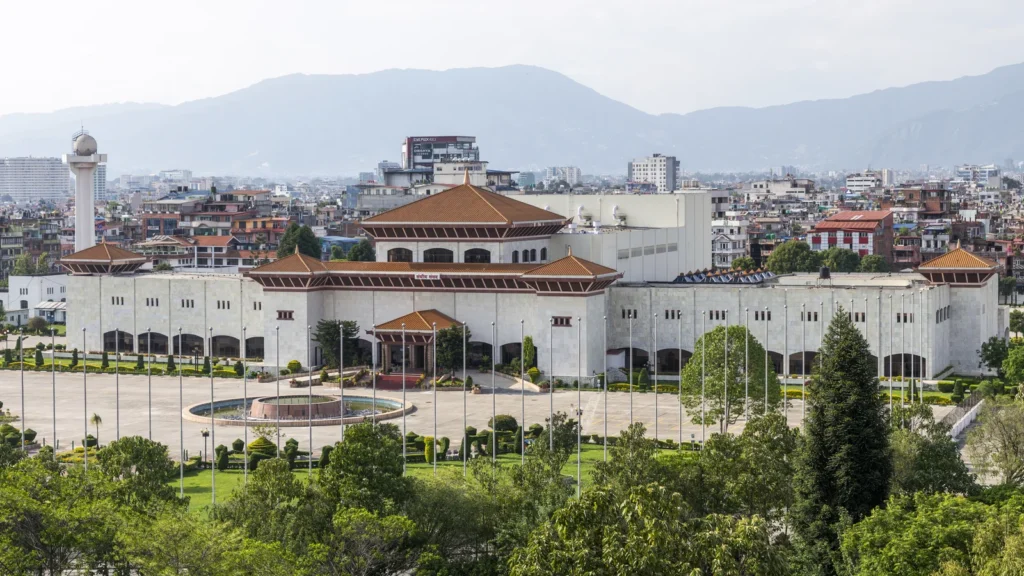
Cover photograph: Bijay Chaurasia Photography, Wikimedia Commons, June 7, 2025. The International Convention Centre in Kathmandu was the former Federal Parliament venue. Cropped and converted to WebP; licensed CC BY-SA 4.0. The photo does not show the March 2026 parliament.