Historical flag guide
Suriname’s Five-Star Flag (1959–1975)
Five differently colored stars joined by a black oval on a white field.

When and how this design was used
Suriname adopted this flag while it was a constituent country of the Kingdom of the Netherlands. The 1959 ordinance specifies each star’s color, position and black outline, including the white star at the hoist. Independence in 1975 brought a single gold star on a striped field.
Dates in Suriname flag history
1959–1975 — Five-star autonomous flag · Five stars on white represented the country’s population groups.
1975 — Single-star independence flag · The new design emphasised shared national unity.
Compare with the current flag of Suriname
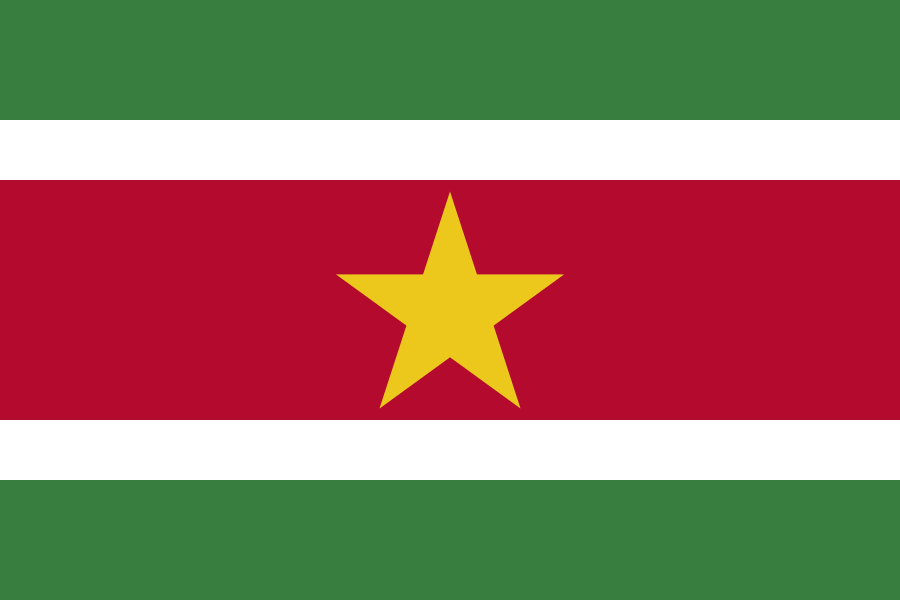
Five horizontal bands of green (top, double-width), white, red (quadruple-width), white, and green (double-width); a five-pointed yellow star is centered on the red band.
What Did We Learn Today?
The five stars on Suriname’s pre-independence flag were joined by an oval. The independence flag replaced the group with one central star.
Sources & Data Notes
View references and illustration credit
- Suriname Legal Information System · 1959 flag ordinance and construction rules
- Government of Suriname, Vooruit met taal, teachers’ book, lesson 2.7a
- Flag history reference and bibliography
Historical illustration
Illustration source · GeographyPin · GPL-2.0-or-later