National flag guide
Flag of Ireland: Meaning, Symbols and History
The Irish tricolour is closely associated with Thomas Francis Meagher, who presented it publicly in 1848 during a period of European revolutionary movements.
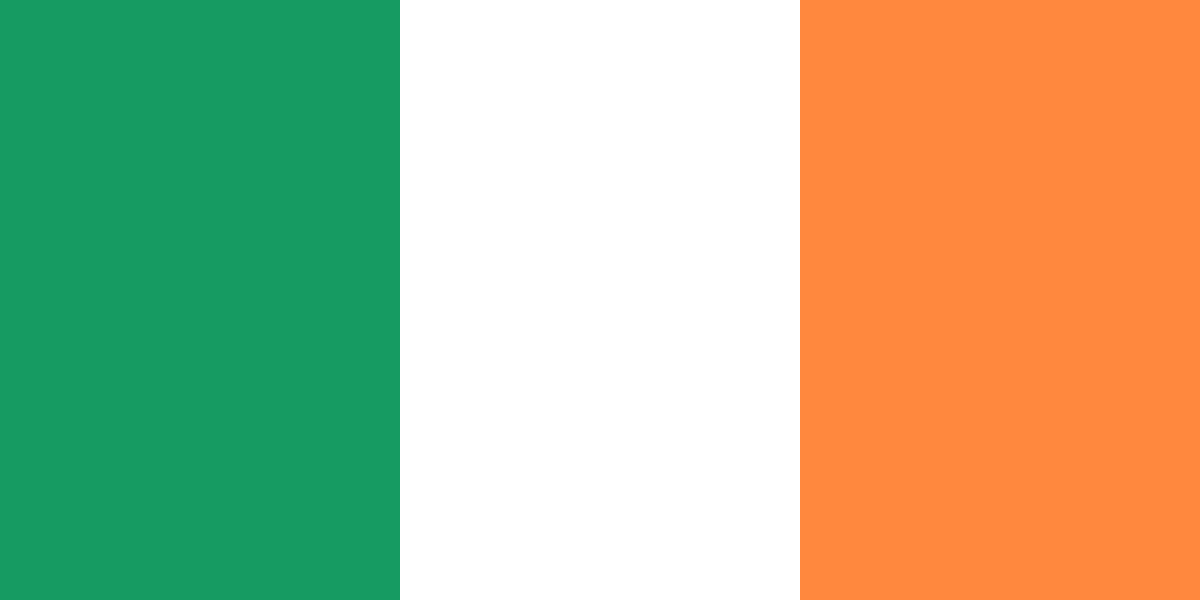
Three equal vertical bands of green (left side), white, and orange. Green is associated with the Irish nationalist tradition, orange with the Williamite or Orange tradition, and white with a hoped-for peace between them. Describing orange as gold erases part of that intended relationship. The proportions of the colored bands are equal.
The design and its details
Three equal vertical bands of green (left side), white, and orange.
| Flag | Ireland |
|---|---|
| Collection | Country flags |
| Adoption or specification | State use from 1922; constitutional recognition in 1937 |
| Browsing region | Europe · Northern Europe |
| Illustrated proportions (height:width) | 1:2 |
What the flag means
Green is associated with the Irish nationalist tradition, orange with the Williamite or Orange tradition, and white with a hoped-for peace between them. Describing orange as gold erases part of that intended relationship. The proportions of the colored bands are equal.
| Element | Meaning or historical connection |
|---|---|
| Green | Associated with the Irish nationalist tradition. |
| Orange | Associated with the Orange tradition and supporters of William of Orange. |
| White | The ideal of peace and lasting accommodation between the traditions. It is not a third population category. |
How the flag developed
The Irish tricolour is closely associated with Thomas Francis Meagher, who presented it publicly in 1848 during a period of European revolutionary movements. It was intended to express a reconciliation of traditions on the island rather than the victory of one color over another. The French tricolour provided a familiar visual model for arranging three vertical bands.
The flag became especially prominent during the independence movement, including the Easter Rising of 1916. It represented the Irish Free State from 1922 and was recognised in the 1937 constitution. Older green flags bearing a harp remain an important part of Irish flag history, but they should be distinguished from the modern national tricolour. The constitutional flag belongs to the state of Ireland; it is not the state flag of Northern Ireland.
The main changes over time
1848 — Tricolour presented
Meagher promoted the green-white-orange flag as a symbol of reconciliation.
1916–1922 — Independence movement and statehood
The tricolour became central to the independence movement and the Irish Free State.
1937 — Constitutional recognition
The constitution identified the national flag as the tricolour.
How to recognise this flag
Ireland runs green-white-orange from the hoist. Côte d’Ivoire runs orange-white-green. The different proportions can help, but stripe order is the clearest distinction.
Compare the relevant designs in these guides:
Earlier designs and other uses
The presidential standard is blue with a golden harp. Historical green harp flags have their own uses and should not replace the national tricolour in a current-country quiz.
Questions about this flag
When was the flag adopted?
State use from 1922; constitutional recognition in 1937. An adoption date can refer to a design, its restoration or a later legal specification; the timeline above separates those stages.
What should I check before identifying an older example?
The presidential standard is blue with a golden harp. Historical green harp flags have their own uses and should not replace the national tricolour in a current-country quiz.
What Did We Learn Today?
Ireland runs green-white-orange from the hoist. Côte d’Ivoire runs orange-white-green. The different proportions can help, but stripe order is the clearest distinction. Its adoption and later changes reflect the national history described in the timeline, while older or specialist flags need their own labels.
Sources & Data Notes
This guide distinguishes first use, national adoption, restoration and later construction standards. Traditional or commonly reported interpretations are identified where they differ from a formal specification. It is a dated reference, not a live record of every change in official flag use.
- Government of Ireland: The National Flag.
- Archived World Factbook country record — background flag description and symbolic interpretations; later changes are explained above.
- Flagpedia: Ireland — flag artwork and comparison reference.
- Flag history reference and bibliography — chronology and links to underlying sources.
The main illustration preserves the selected flag artwork’s proportions; these are a reproduction guide, not a substitute for a legal construction drawing. Color names group shades for browsing.
Current flag artwork is supplied with the original flag collection; the package’s artwork register contains provenance and license details.