National flag guide
Flag of Zambia: Meaning, Symbols and History
Zambia adopted its national flag at independence from Britain in 1964, replacing the colonial symbols of Northern Rhodesia.
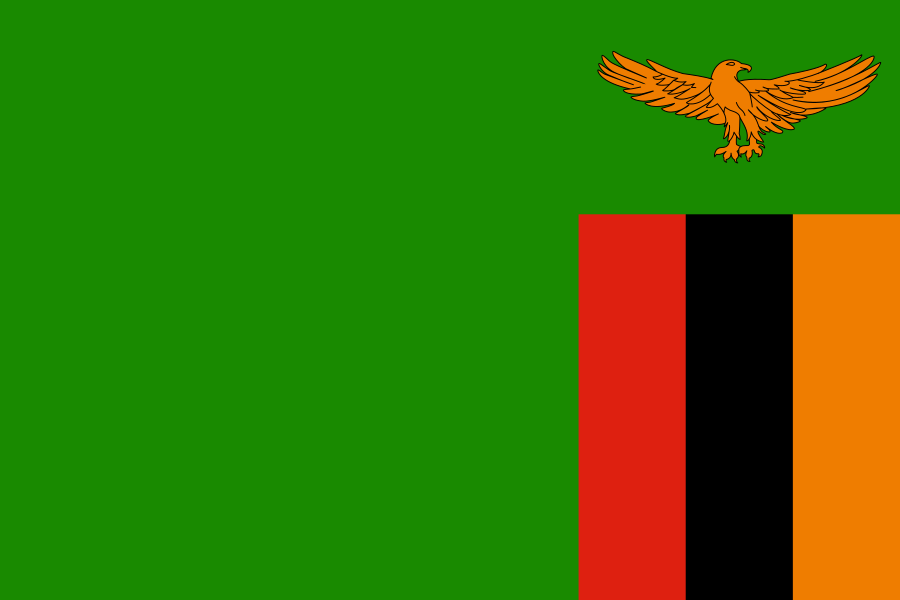
Green field with a soaring orange eagle in the upper-right corner; a panel of three vertical bands is under the eagle, in red (left side), black, and orange. The eagle represents the ability to rise above national difficulties. Green refers to natural resources, red to the independence struggle, black to the people and orange to mineral wealth.
The design and its details
Green field with a soaring orange eagle in the upper-right corner; a panel of three vertical bands is under the eagle, in red (left side), black, and orange.
| Flag | Zambia |
|---|---|
| Collection | Country flags |
| Adoption or specification | 24 October 1964; drawing revised in 1996 |
| Browsing region | Africa · Eastern Africa |
| Illustrated proportions (height:width) | 2:3 |
What the flag means
The eagle represents the ability to rise above national difficulties. Green refers to natural resources, red to the independence struggle, black to the people and orange to mineral wealth.
| Element | Meaning or historical connection |
|---|---|
| Green | Natural resources and vegetation. |
| Red | The struggle for freedom. |
| Black | The people. |
| Orange | Mineral wealth, especially copper. |
| African fish eagle | The ability to rise above national difficulties, placed above the color block at the fly. |
How the flag developed
Zambia adopted its national flag at independence from Britain in 1964, replacing the colonial symbols of Northern Rhodesia. Gabriel Ellison designed the flag and other national emblems.
The unusual placement of an eagle and a three-color panel near the fly leaves most of the flag green. A 1996 revision brightened the green and adjusted the eagle drawing without replacing the basic layout. Older and newer versions therefore share the same composition but differ in details of color and artwork.
The main changes over time
1964 — Independence design
Ellison’s eagle-and-panel flag was adopted.
1996 — Drawing adjustment
The green shade and eagle were revised.
How to recognise this flag
A large green field carries an orange eagle above a red-black-orange panel at the lower fly, away from the pole.
Earlier designs and other uses
The darker-green 1964 version is an earlier drawing of the same basic national design.
Questions about this flag
When was the flag adopted?
24 October 1964; drawing revised in 1996. An adoption date can refer to a design, its restoration or a later legal specification; the timeline above separates those stages.
What should I check before identifying an older example?
The darker-green 1964 version is an earlier drawing of the same basic national design.
What Did We Learn Today?
A large green field carries an orange eagle above a red-black-orange panel at the lower fly, away from the pole. Its adoption and later changes reflect the national history described in the timeline, while older or specialist flags need their own labels.
Sources & Data Notes
This guide distinguishes first use, national adoption, restoration and later construction standards. Traditional or commonly reported interpretations are identified where they differ from a formal specification. It is a dated reference, not a live record of every change in official flag use.
- Archived World Factbook country record — background flag description and symbolic interpretations; later changes are explained above.
- Flagpedia: Zambia — flag artwork and comparison reference.
- Flag history reference and bibliography — chronology and links to underlying sources.
The main illustration preserves the selected flag artwork’s proportions; these are a reproduction guide, not a substitute for a legal construction drawing. Color names group shades for browsing.
Current flag artwork is supplied with the original flag collection; the package’s artwork register contains provenance and license details.