National flag guide
Flag of Vietnam: Meaning, Symbols and History
Vietnam’s yellow-star-on-red flag first appeared in the revolutionary movement around 1940 and was adopted by the Democratic Republic of Vietnam in 1945.
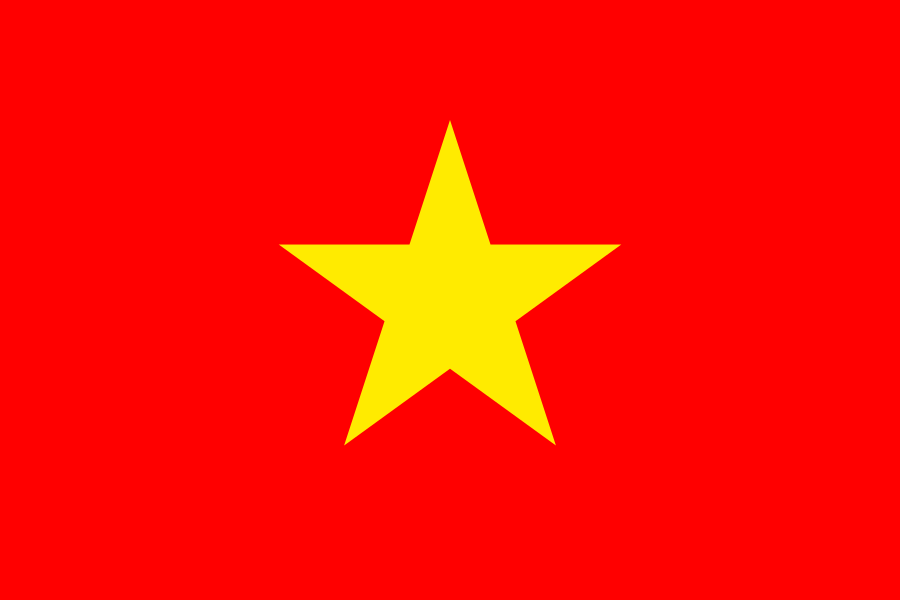
Red field with a five-pointed yellow star in the center. Red is associated with revolution and sacrifice. The five-pointed star is commonly explained through the unity of major social groups. These are political-state interpretations, not a list of modern provinces. Vietnam has one centered yellow star on a plain red field.
The design and its details
Red field with a five-pointed yellow star in the center.
| Flag | Vietnam |
|---|---|
| Collection | Country flags |
| Adoption or specification | 1945 for the Democratic Republic; retained at reunification in 1976 |
| Browsing region | Asia · South-Eastern Asia |
| Illustrated proportions (height:width) | 2:3 |
What the flag means
Red is associated with revolution and sacrifice. The five-pointed star is commonly explained through the unity of major social groups. These are political-state interpretations, not a list of modern provinces.
| Element | Meaning or historical connection |
|---|---|
| Red | Revolution and national sacrifice. |
| Gold five-pointed star | The unity of the people in building the state. |
| Five points | Traditionally associated with workers, peasants, intellectuals, traders and soldiers, rather than five territorial regions. |
How the flag developed
Vietnam’s yellow-star-on-red flag first appeared in the revolutionary movement around 1940 and was adopted by the Democratic Republic of Vietnam in 1945. A later drawing adjustment in 1955 established the familiar shape of the star.
During the division of Vietnam, the southern Republic of Vietnam used a yellow flag with three red horizontal stripes. The red-star flag became the national flag of the reunified Socialist Republic in 1976. Both flags therefore have important twentieth-century histories, but they represent different states and political traditions.
The main changes over time
1940–1945 — Revolutionary design
The yellow star on red developed and became the Democratic Republic’s flag.
1955 — Star drawing revised
The familiar modern star shape was established.
1976 — Reunified state
The Socialist Republic retained the red-star flag.
How to recognise this flag
Vietnam has one centered yellow star on a plain red field. China has five stars grouped near the upper hoist.
Compare the relevant designs in these guides:
Earlier designs and other uses
The yellow flag with three red stripes is the historical South Vietnamese flag and remains in diaspora use. It is not the current Socialist Republic’s national flag.
Questions about this flag
When was the flag adopted?
1945 for the Democratic Republic; retained at reunification in 1976. An adoption date can refer to a design, its restoration or a later legal specification; the timeline above separates those stages.
What should I check before identifying an older example?
The yellow flag with three red stripes is the historical South Vietnamese flag and remains in diaspora use. It is not the current Socialist Republic’s national flag.
What Did We Learn Today?
Vietnam has one centered yellow star on a plain red field. China has five stars grouped near the upper hoist. Its adoption and later changes reflect the national history described in the timeline, while older or specialist flags need their own labels.
Sources & Data Notes
This guide distinguishes first use, national adoption, restoration and later construction standards. Traditional or commonly reported interpretations are identified where they differ from a formal specification. It is a dated reference, not a live record of every change in official flag use.
- Archived World Factbook country record — background flag description and symbolic interpretations; later changes are explained above.
- Flagpedia: Vietnam — flag artwork and comparison reference.
- Flag history reference and bibliography — chronology and links to underlying sources.
The main illustration preserves the selected flag artwork’s proportions; these are a reproduction guide, not a substitute for a legal construction drawing. Color names group shades for browsing.
Current flag artwork is supplied with the original flag collection; the package’s artwork register contains provenance and license details.