National flag guide
Flag of Tajikistan: Meaning, Symbols and History
Tajikistan adopted its present flag after independence from the Soviet Union, replacing the Tajik Soviet republic’s red, white and green design with communist devices.
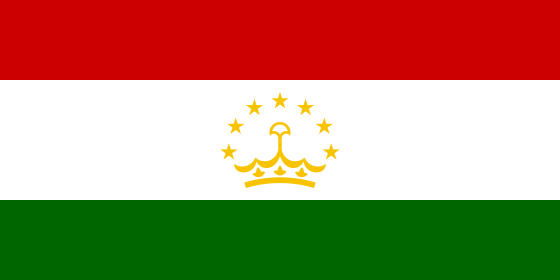
Three horizontal stripes of red (top), a wider stripe of white, and green; a gold crown under seven five-pointed gold stars is in the center of the white stripe. The crown refers to the Tajik people and the name’s traditional association with a crown. Seven has a symbolic cultural role; the stars should not be presented as a straightforward count of present provinces.
The design and its details
Three horizontal stripes of red (top), a wider stripe of white, and green; a gold crown under seven five-pointed gold stars is in the center of the white stripe.
| Flag | Tajikistan |
|---|---|
| Collection | Country flags |
| Adoption or specification | 24 November 1992 |
| Browsing region | Asia · Central Asia |
| Illustrated proportions (height:width) | 1:2 |
What the flag means
The crown refers to the Tajik people and the name’s traditional association with a crown. Seven has a symbolic cultural role; the stars should not be presented as a straightforward count of present provinces.
| Element | Meaning or historical connection |
|---|---|
| Red | National unity, victory and sacrifice in common explanations. |
| White | Purity, cotton and the snow-covered mountains. |
| Green | The land, agriculture and natural abundance. |
| Gold crown | Tajik national identity and the traditional association of the national name with a crown. |
| Seven stars | The cultural importance of seven as a number of completeness and happiness; they do not simply count present administrative divisions. |
How the flag developed
Tajikistan adopted its present flag after independence from the Soviet Union, replacing the Tajik Soviet republic’s red, white and green design with communist devices. The new flag retained the broad color family but changed its arrangement and central emblem.
The crown and seven stars established a distinctive national identity in the post-Soviet state. The wider white band is part of the construction, so the flag is not simply an equal-stripe red-white-green tricolour with a badge added.
The main changes over time
Soviet period — Tajik republican flag
Soviet devices appeared on a different red-white-green arrangement.
1991 — Independence
The separate republic required new state symbols.
1992 — Crown-and-stars flag
The present national design was adopted.
How to recognise this flag
A gold crown and arc of seven stars sit in the wider white middle band. Iran has different border writing and a red central emblem.
Earlier designs and other uses
The presidential standard includes an additional historical-style device and has a separate institutional purpose.
Questions about this flag
When was the flag adopted?
24 November 1992. An adoption date can refer to a design, its restoration or a later legal specification; the timeline above separates those stages.
What should I check before identifying an older example?
The presidential standard includes an additional historical-style device and has a separate institutional purpose.
What Did We Learn Today?
A gold crown and arc of seven stars sit in the wider white middle band. Iran has different border writing and a red central emblem. Its adoption and later changes reflect the national history described in the timeline, while older or specialist flags need their own labels.
Sources & Data Notes
This guide distinguishes first use, national adoption, restoration and later construction standards. Traditional or commonly reported interpretations are identified where they differ from a formal specification. It is a dated reference, not a live record of every change in official flag use.
- Archived World Factbook country record — background flag description and symbolic interpretations; later changes are explained above.
- Flagpedia: Tajikistan — flag artwork and comparison reference.
- Flag history reference and bibliography — chronology and links to underlying sources.
The main illustration preserves the selected flag artwork’s proportions; these are a reproduction guide, not a substitute for a legal construction drawing. Color names group shades for browsing.
Current flag artwork is supplied with the original flag collection; the package’s artwork register contains provenance and license details.