National flag guide
Flag of Philippines: Meaning, Symbols and History
The Philippine flag was made in Hong Kong by Marcela Agoncillo, Lorenza Agoncillo and Delfina Herbosa de Natividad for the independence movement led by Emilio Aguinaldo.
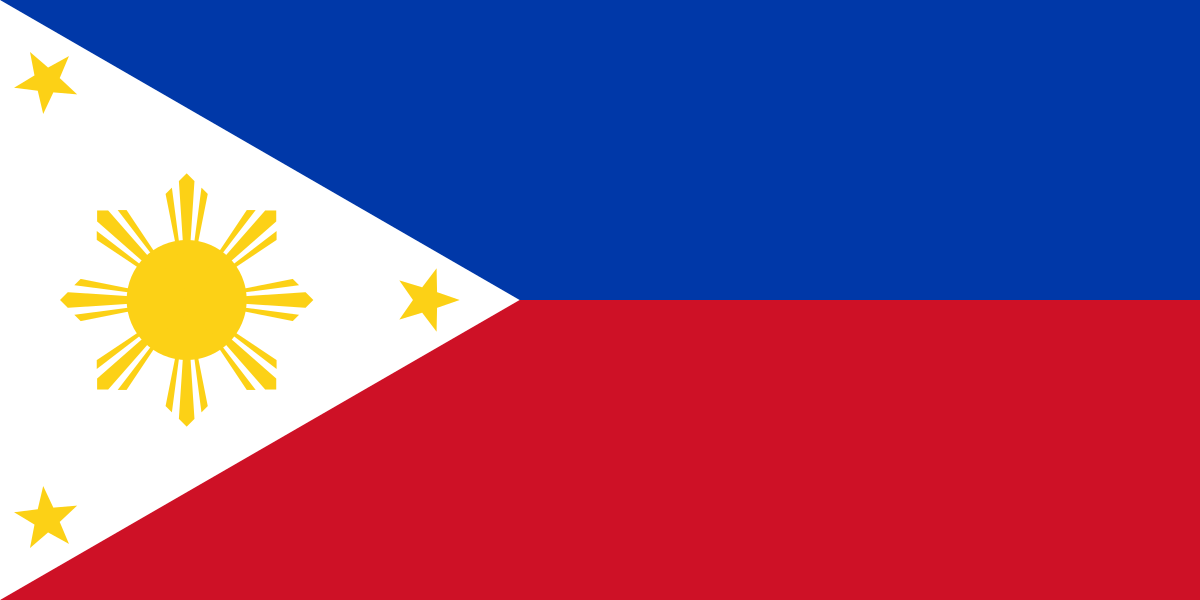
Two equal horizontal bands of blue (top) and red; a white equilateral triangle is based on the left side; the center of the triangle has a yellow sun with eight rays, each split into smaller rays; the triangle's corners each have a small five-pointed yellow star.
The design and its details
Two equal horizontal bands of blue (top) and red; a white equilateral triangle is based on the left side; the center of the triangle has a yellow sun with eight rays, each split into smaller rays; the triangle's corners each have a small five-pointed yellow star.
| Flag | Philippines |
|---|---|
| Collection | Country flags |
| Adoption or specification | 12 June 1898; present statutory code from 1998 |
| Browsing region | Asia · South-Eastern Asia |
| Illustrated proportions (height:width) | 1:2 |
What the flag means
The sun’s eight principal rays recall the first eight provinces associated with the revolution. The three stars represent the main island groupings, with historical wording and interpretation requiring context.
| Element | Meaning or historical connection |
|---|---|
| Blue | Peace, truth and justice. |
| Red | Patriotism and valor. |
| White triangle | Equality and fraternity. |
| Golden sun and eight rays | The first eight provinces associated with the 1896 revolution against Spanish rule. |
| Three stars | The principal island groupings; historical wording concerning Panay and later Visayas explanations needs context. |
| Reversed wartime position | Red above blue signals a state of war under the flag rules; it is not an accidental upside-down display. |
How the flag developed
The Philippine flag was made in Hong Kong by Marcela Agoncillo, Lorenza Agoncillo and Delfina Herbosa de Natividad for the independence movement led by Emilio Aguinaldo. It was first used in the revolutionary period of 1898 and became a central national symbol.
Colonial restrictions and later restorations interrupted its public use. Twentieth-century laws clarified the colors and construction, with the 1998 Flag and Heraldic Code setting out the modern framework. The national flag also has a distinctive wartime display: the red band is placed above the blue when flown horizontally in a state of war.
The flag’s wartime orientation
In ordinary peacetime horizontal display, the Philippine flag has blue above red. In a state of war the red band is above the blue. This is a distinctive legally recognised use of orientation, so an inverted color order is not automatically an accidental mistake.
The white triangle remains at the hoist and carries the sun and three stars. The arrangement of those devices has a specific construction; a reversed or redrawn small icon can lose details that matter to a correctly produced flag.
Historical explanations also distinguish the sun’s eight rays from the three stars. The rays refer to the first eight revolutionary provinces, while the stars represent major island groupings. They are two separate symbolic counts, neither of which should be replaced by the current number of administrative regions.
The main changes over time
1898 — Revolutionary flag
The sun-and-three-stars design entered national use.
Twentieth century — Restoration and standards
National laws clarified flag use and drawing details.
1998 — Flag and Heraldic Code
The modern statutory framework was established.
How to recognise this flag
The white hoist triangle contains a gold sun and three stars. In ordinary peacetime horizontal display, blue is above red.
Earlier designs and other uses
The red-over-blue arrangement has a specific wartime meaning; it is not simply an upside-down error in every context.
Questions about this flag
When was the flag adopted?
12 June 1898; present statutory code from 1998. An adoption date can refer to a design, its restoration or a later legal specification; the timeline above separates those stages.
What should I check before identifying an older example?
The red-over-blue arrangement has a specific wartime meaning; it is not simply an upside-down error in every context.
What Did We Learn Today?
The white hoist triangle contains a gold sun and three stars. In ordinary peacetime horizontal display, blue is above red. Its adoption and later changes reflect the national history described in the timeline, while older or specialist flags need their own labels.
Sources & Data Notes
This guide distinguishes first use, national adoption, restoration and later construction standards. Traditional or commonly reported interpretations are identified where they differ from a formal specification. It is a dated reference, not a live record of every change in official flag use.
- Archived World Factbook country record — background flag description and symbolic interpretations; later changes are explained above.
- Flagpedia: Philippines — flag artwork and comparison reference.
- Flag history reference and bibliography — chronology and links to underlying sources.
The main illustration preserves the selected flag artwork’s proportions; these are a reproduction guide, not a substitute for a legal construction drawing. Color names group shades for browsing.
Current flag artwork is supplied with the original flag collection; the package’s artwork register contains provenance and license details.