National flag guide
Flag of Nicaragua: Meaning, Symbols and History
Nicaragua’s blue-white-blue and triangular arms continue the visual heritage of the Central American federation.
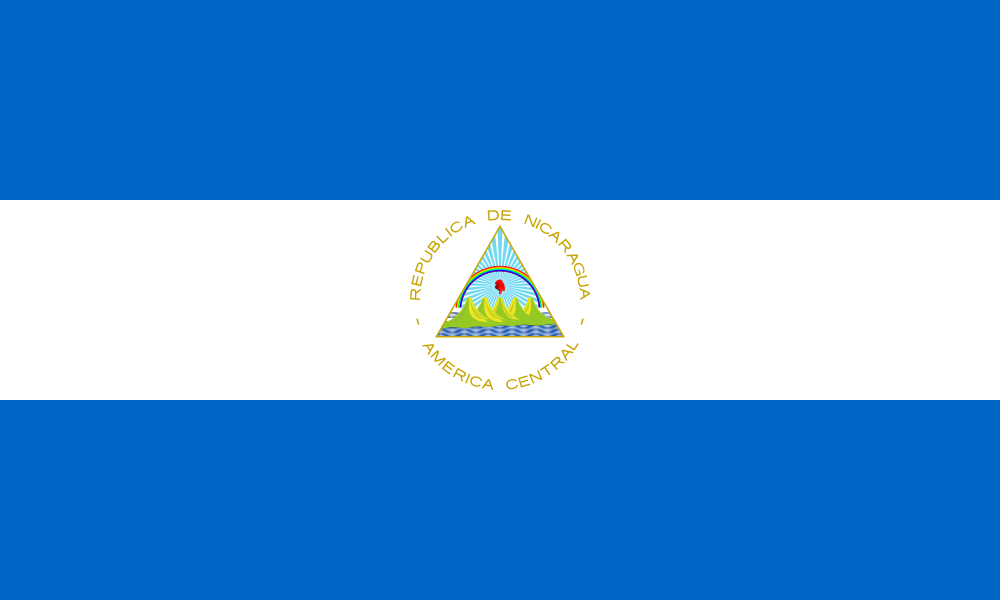
Three equal horizontal bands of blue (top), white, and blue, with the national coat of arms centered in the white band; the coat of arms has a triangle with the words Republica DE Nicaragua in an arc over it and America Central in an arc underneath.
The design and its details
Three equal horizontal bands of blue (top), white, and blue, with the national coat of arms centered in the white band; the coat of arms has a triangle with the words Republica DE Nicaragua in an arc over it and America Central in an arc underneath.
| Flag | Nicaragua |
|---|---|
| Collection | Country flags |
| Adoption or specification | 1908 design; national-symbols law in 1971 |
| Browsing region | North America · Central America |
| Illustrated proportions (height:width) | 3:5 |
What the flag means
The five volcanoes recall the historic federal states. The rainbow and liberty cap belong to the emblem’s republican symbolism. The words around the triangle identify Nicaragua in Central America.
| Element | Meaning or historical connection |
|---|---|
| Blue bands | The Pacific and Caribbean setting of the Central American land bridge. |
| White | Peace and the land between the oceans. |
| Five volcanoes | The countries of the former Central American federation. |
| Triangle, rainbow and liberty cap | Equality, peace and freedom in the republican arms. |
How the flag developed
Nicaragua’s blue-white-blue and triangular arms continue the visual heritage of the Central American federation. After the federation ended, the country used several changing national designs, including a nineteenth-century yellow-white variant.
The familiar blue-white-blue arrangement returned in 1908, with later national-symbols legislation in 1971. The central emblem deliberately preserves five volcanoes and other federal-era imagery. Those references express regional history and aspiration; they do not mean Nicaragua remains a province of a present-day Central American federation.
The main changes over time
1820s–1830s — Central American federation
The shared blue-white-blue design and emblem family developed.
1908 — Present design returns
The modern national arrangement was restored.
1971 — National-symbols law
Legislation set out the flag and its associated symbols.
How to recognise this flag
A triangular coat of arms is centered on the white stripe. The surrounding text distinguishes Nicaragua’s flag from the closely related Salvadoran arms-bearing flag.
Compare the relevant designs in these guides:
Earlier designs and other uses
Historical flags and modern arms-bearing drawings must be distinguished. Small emblem details can disappear in thumbnails, so a full-size image is useful.
Questions about this flag
When was the flag adopted?
1908 design; national-symbols law in 1971. An adoption date can refer to a design, its restoration or a later legal specification; the timeline above separates those stages.
What should I check before identifying an older example?
Historical flags and modern arms-bearing drawings must be distinguished. Small emblem details can disappear in thumbnails, so a full-size image is useful.
What Did We Learn Today?
A triangular coat of arms is centered on the white stripe. The surrounding text distinguishes Nicaragua’s flag from the closely related Salvadoran arms-bearing flag. Its adoption and later changes reflect the national history described in the timeline, while older or specialist flags need their own labels.
Sources & Data Notes
This guide distinguishes first use, national adoption, restoration and later construction standards. Traditional or commonly reported interpretations are identified where they differ from a formal specification. It is a dated reference, not a live record of every change in official flag use.
- Archived World Factbook country record — background flag description and symbolic interpretations; later changes are explained above.
- Flagpedia: Nicaragua — flag artwork and comparison reference.
- Flag history reference and bibliography — chronology and links to underlying sources.
The main illustration preserves the selected flag artwork’s proportions; these are a reproduction guide, not a substitute for a legal construction drawing. Color names group shades for browsing.
Current flag artwork is supplied with the original flag collection; the package’s artwork register contains provenance and license details.