Flag Explorer
Maryland State Flag
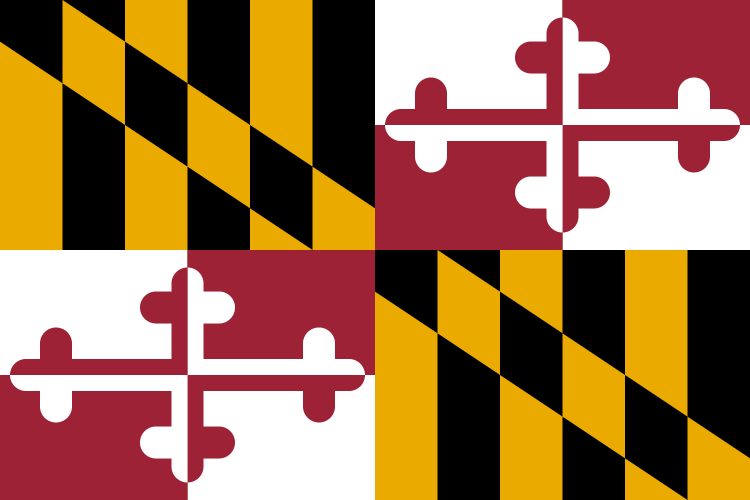
The Maryland state flag combines two family coats of arms in four quarters. Black and gold identify the Calverts. Red and white identify the Crosslands. The design looks like a single intricate pattern until you notice that the opposite corners repeat. Maryland officially adopted it on March 9, 1904.
How to read the four quarters
Start in the upper corner nearest the flagpole. Six vertical bars alternate gold and black. A diagonal band cuts across them, switching the colors at each intersection. Follow that pattern diagonally across the center of the flag and you find the same design in the lower corner at the free end.
The upper corner at the free end and the lower corner by the pole form the other pair. Each contains a cross on a red-and-white background. The four arms end in three rounded lobes. The cross changes color wherever it crosses a boundary, so a red part lies on white and a white part lies on red. Heraldry calls this switching of colors counterchanging.
What the Calvert and Crossland patterns mean
George Calvert, the first Lord Baltimore, combined his father’s Calvert arms and his mother’s Crossland arms in a single shield. The state flag takes the pattern from that shield and spreads it across the entire piece of cloth. There is no shield outline to find in the middle.
In heraldry the yellow represents gold and the white represents silver. The cross with the rounded tips is called a cross bottony. It turns up in another place outside the cloth. Under Maryland law, an ornament on a staff carrying the state flag must take the form of a gold cross bottony.
Why the four quarters came together after the Civil War
The family arms predate the American Civil War, but the present flag arrangement took on a new significance after it. During the war, Maryland remained in the Union. Black and gold were widely associated with the state. Maryland Confederate supporters used the red-and-white Crossland colors, and some Maryland-born Confederate soldiers wore cross-shaped pins to identify their home state.
The combined flag appeared at Baltimore’s anniversary parade in October 1880 and at Gettysburg during the 1888 dedication of monuments to Maryland Union regiments. Maryland’s secretary of state interprets the pairing as a postwar gesture of reconciliation. The exact date and designer of the first combined banner remain uncertain. The legislative record supplies a firmer milestone: official adoption in 1904.
Which corner goes up?
Look for the black part of the diagonal band at the top next to the staff. The 1904 adoption act uses that detail to specify the flag’s position. A red-and-white cross in the upper corner by the staff is a clue to check the orientation before using a diagram or hanging the flag.
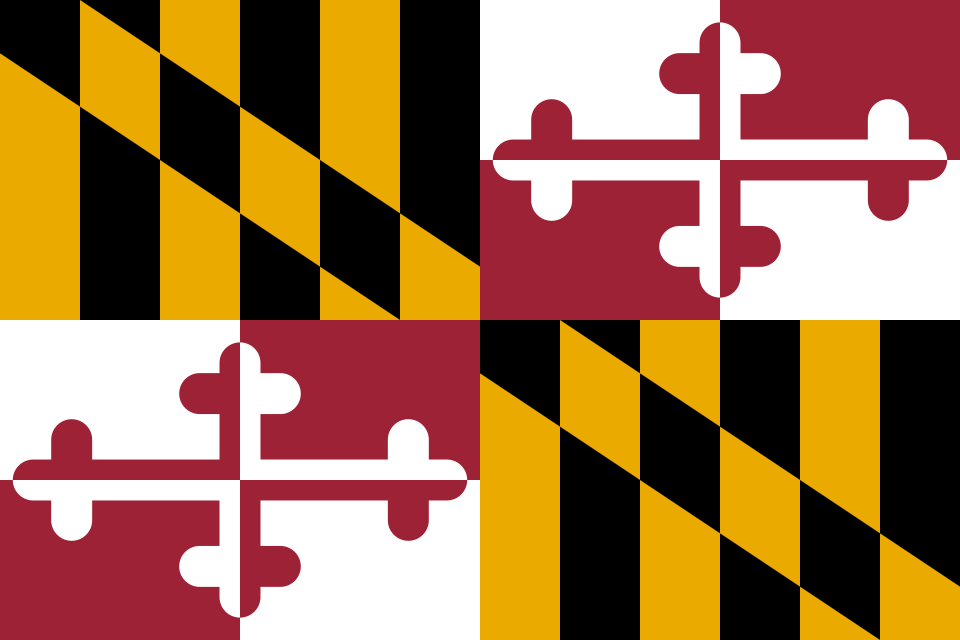
Download the Maryland state flag
Sources & Data Notes
- Maryland State Archives, Maryland State Flag · names of the arms, early public appearances and adoption date.
- Maryland Secretary of State, History of the Maryland Flag · Civil War uses of the two patterns and the subsequent four-quarter flag.
- Maryland Flag Protocol · design, counterchanged colors and cross shape.
- Maryland General Assembly, Chapter 48, Acts of 1904 · orientation and adoption.
The flag drawing by Michael Wheeler is available under CC0. The PNG is a raster export of the vector drawing.
