National flag guide
Flag of Libya: Meaning, Symbols and History
Libya’s red-black-green flag was introduced with independence in 1951 under King Idris.
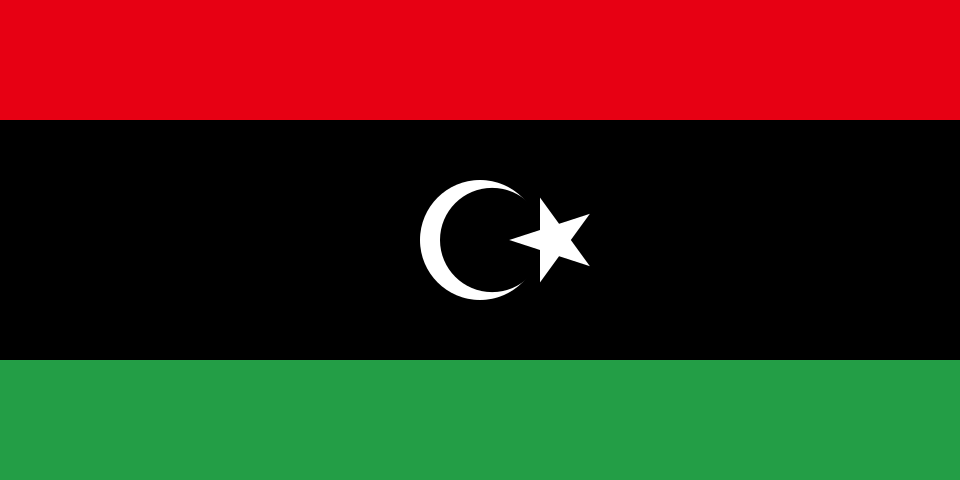
Three horizontal bands of red (top), black (double-width), and green, with a white crescent and star centered on the black stripe. The colors are often connected with Libya’s historical regions, while the crescent and star have Islamic associations. The black middle band is twice the height of each outer band.
The design and its details
Three horizontal bands of red (top), black (double-width), and green, with a white crescent and star centered on the black stripe.
| Flag | Libya |
|---|---|
| Collection | Country flags |
| Adoption or specification | 24 December 1951; restored in 2011 |
| Browsing region | Africa · Northern Africa |
| Illustrated proportions (height:width) | 1:2 |
What the flag means
The colors are often connected with Libya’s historical regions, while the crescent and star have Islamic associations. The black middle band is twice the height of each outer band.
| Element | Meaning or historical connection |
|---|---|
| Red, black and green | Colors of the restored independence-era flag. Common regional readings connect them with Fezzan, Cyrenaica and Tripolitania, while accounts of their origins vary. |
| Broad black band | Preserves the prominent color of the Cyrenaican Senussi tradition. |
| White crescent and star | Islamic symbols. They are part of the independence-era design, rather than additions made after the 2011 restoration. |
How the flag developed
Libya’s red-black-green flag was introduced with independence in 1951 under King Idris. Its broad black stripe and white crescent-and-star drew on the Cyrenaican tradition within the newly united kingdom.
After the monarchy fell in 1969, the state used an Arab Liberation tricolour and then a federation-era hawk flag. Muammar Gaddafi’s government adopted a plain green national flag in 1977. During the 2011 uprising the earlier royal-era tricolour returned and became the national flag again. Its restoration retained a historical design without restoring the monarchy.
The main changes over time
1951 — Independence flag
The kingdom adopted the present basic design.
1969–1977 — Republican and federation flags
Arab Liberation and hawk designs replaced it.
1977–2011 — Plain green flag
The Jamahiriya used an uncharged green field.
2011 — Tricolour restored
The earlier design returned as the national flag.
Historical flags in pictures

How to recognise this flag
Red above a wide black band and green below; the white crescent and star sit on black. The plain green flag belongs to 1977–2011.
Compare the relevant designs in these guides:
Earlier designs and other uses
The plain green flag is an important historical national flag, not the current Libyan design.
Questions about this flag
When was the flag adopted?
24 December 1951; restored in 2011. An adoption date can refer to a design, its restoration or a later legal specification; the timeline above separates those stages.
What should I check before identifying an older example?
The plain green flag is an important historical national flag, not the current Libyan design.
What Did We Learn Today?
Red above a wide black band and green below; the white crescent and star sit on black. The plain green flag belongs to 1977–2011. Its adoption and later changes reflect the national history described in the timeline, while older or specialist flags need their own labels.
Sources & Data Notes
This guide distinguishes first use, national adoption, restoration and later construction standards. Traditional or commonly reported interpretations are identified where they differ from a formal specification. It is a dated reference, not a live record of every change in official flag use.
- Archived World Factbook country record — background flag description and symbolic interpretations; later changes are explained above.
- Flagpedia: Libya — flag artwork and comparison reference.
- Flag history reference and bibliography — chronology and links to underlying sources.
The main illustration preserves the selected flag artwork’s proportions; these are a reproduction guide, not a substitute for a legal construction drawing. Color names group shades for browsing.
Illustration credits
- Flag of Libya (1977–2011).svg — Zscout370; Public domain.
