National flag guide
Flag of Grenada: Meaning, Symbols and History
Grenada’s national flag was designed by Anthony C.
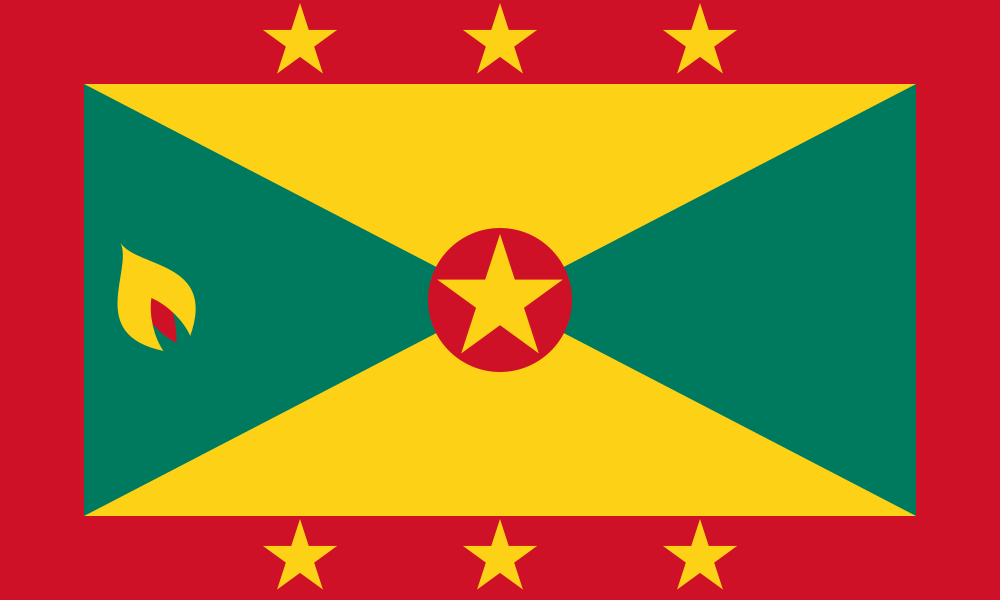
A rectangle divided diagonally into yellow triangles (top and bottom) and green triangles (left and right), with a wide red border around the flag; three five-pointed yellow stars are centered on the top and bottom of the red border, with one larger yellow star on a red disk at the center of the flag; a small yellow-and-red nutmeg pod is on the left triangle.
The design and its details
A rectangle divided diagonally into yellow triangles (top and bottom) and green triangles (left and right), with a wide red border around the flag; three five-pointed yellow stars are centered on the top and bottom of the red border, with one larger yellow star on a red disk at the center of the flag; a small yellow-and-red nutmeg pod is on the left triangle.
| Flag | Grenada |
|---|---|
| Collection | Country flags |
| Adoption or specification | 7 February 1974 |
| Browsing region | North America · Caribbean |
| Illustrated proportions (height:width) | 3:5 |
What the flag means
The stars are associated with Grenada’s parishes and capital. The nutmeg device refers to an important crop and should not be mistaken for a flame.
| Element | Meaning or historical connection |
|---|---|
| Red | Commonly associated with courage, unity and the people’s vitality. |
| Yellow | Sunshine and warmth. |
| Green | Vegetation and agriculture. |
| Seven stars | Six traditional parishes and the capital, St George’s, rather than a simple count of all present administrative units. |
| Nutmeg | A characteristic agricultural product and a familiar national association. |
How the flag developed
Grenada’s national flag was designed by Anthony C. George for independence in 1974. It replaced the blue-yellow-green flag used during the associated-state period from 1967.
The nutmeg carried forward an element of the earlier flag and placed the island’s agricultural identity within a more distinctive geometric arrangement. The red border and seven stars gave the new design a strong frame, while yellow and green triangles suggested the country’s natural and social symbolism.
The main changes over time
1967–1974 — Associated-state flag
A blue-yellow-green flag included a nutmeg emblem.
1974 — Independence design
Anthony C. George’s red-bordered flag was adopted.
How to recognise this flag
A red border surrounds yellow and green triangles. Three stars sit at the top, three at the bottom and one on the central red disc; the nutmeg is near the hoist.
Earlier designs and other uses
The previous associated-state design is historical. Modern government or maritime flags can have separate purposes.
Questions about this flag
When was the flag adopted?
7 February 1974. An adoption date can refer to a design, its restoration or a later legal specification; the timeline above separates those stages.
What should I check before identifying an older example?
The previous associated-state design is historical. Modern government or maritime flags can have separate purposes.
What Did We Learn Today?
A red border surrounds yellow and green triangles. Three stars sit at the top, three at the bottom and one on the central red disc; the nutmeg is near the hoist. Its adoption and later changes reflect the national history described in the timeline, while older or specialist flags need their own labels.
Sources & Data Notes
This guide distinguishes first use, national adoption, restoration and later construction standards. Traditional or commonly reported interpretations are identified where they differ from a formal specification. It is a dated reference, not a live record of every change in official flag use.
- Archived World Factbook country record — background flag description and symbolic interpretations; later changes are explained above.
- Flagpedia: Grenada — flag artwork and comparison reference.
- Flag history reference and bibliography — chronology and links to underlying sources.
The main illustration preserves the selected flag artwork’s proportions; these are a reproduction guide, not a substitute for a legal construction drawing. Color names group shades for browsing.
Current flag artwork is supplied with the original flag collection; the package’s artwork register contains provenance and license details.