National flag guide
Flag of Equatorial Guinea: Meaning, Symbols and History
Equatorial Guinea established its green-white-red flag at independence from Spain in 1968.
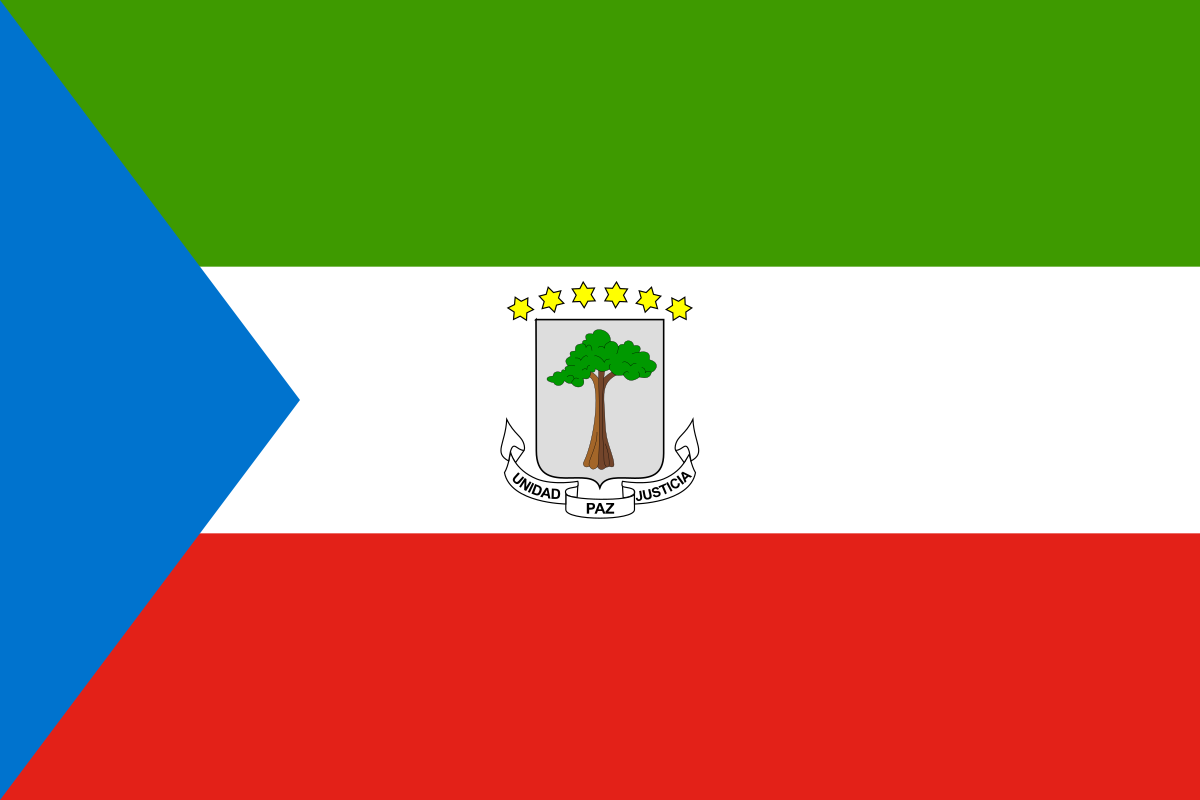
Three equal horizontal bands of green (top), white, and red, with a blue isosceles triangle based on the left side and the coat of arms centered in the white band; the coat of arms has six six-pointed yellow stars (representing the mainland and five offshore islands) above a gray shield with a silk-cotton tree; below is a scroll with the motto Unidad, Paz, Justicia (Unity, Peace, Justice).
The design and its details
Three equal horizontal bands of green (top), white, and red, with a blue isosceles triangle based on the left side and the coat of arms centered in the white band; the coat of arms has six six-pointed yellow stars (representing the mainland and five offshore islands) above a gray shield with a silk-cotton tree; below is a scroll with the motto Unidad, Paz, Justicia (Unity, Peace, Justice).
| Flag | Equatorial Guinea |
|---|---|
| Collection | Country flags |
| Adoption or specification | 12 October 1968 for independence; earlier arms restored in 1979 |
| Browsing region | Africa · Middle Africa |
| Illustrated proportions (height:width) | 2:3 |
What the flag means
Six stars above the shield represent the mainland and principal island territories. The motto means Unity, Peace, Justice. The tree is a silk-cotton tree, not a palm.
| Element | Meaning or historical connection |
|---|---|
| Green | Forests and natural resources. |
| White | Peace. |
| Red | The independence struggle. |
| Blue triangle | The sea connecting the mainland and islands. |
| Arms and six stars | A silk-cotton tree with stars representing the mainland and principal island components, above a motto of unity, peace and justice. |
How the flag developed
Equatorial Guinea established its green-white-red flag at independence from Spain in 1968. The central arms show a silk-cotton tree, connecting the modern state emblem with a tree associated with an agreement between local leadership and Spain.
During Francisco Macías Nguema’s rule the arms changed, and the earlier tree emblem was restored in 1979. The field colors thus continued while the device changed. Some early independence displays lacked the arms, so an unlabeled plain tricolour should not automatically be treated as an accurate modern state flag.
The main changes over time
1968 — Independence design
The national colors and tree arms were established.
1970s — Altered state arms
The central emblem changed under Macías Nguema.
1979 — Earlier arms restored
The tree emblem returned.
How to recognise this flag
Green, white and red bands meet a blue hoist triangle; a tree-bearing coat of arms is centered in the white band.
Compare the relevant designs in these guides:
Earlier designs and other uses
Date the central arms carefully when comparing flags from the 1970s.
Questions about this flag
When was the flag adopted?
12 October 1968 for independence; earlier arms restored in 1979. An adoption date can refer to a design, its restoration or a later legal specification; the timeline above separates those stages.
What should I check before identifying an older example?
Date the central arms carefully when comparing flags from the 1970s.
What Did We Learn Today?
Green, white and red bands meet a blue hoist triangle; a tree-bearing coat of arms is centered in the white band. Its adoption and later changes reflect the national history described in the timeline, while older or specialist flags need their own labels.
Sources & Data Notes
This guide distinguishes first use, national adoption, restoration and later construction standards. Traditional or commonly reported interpretations are identified where they differ from a formal specification. It is a dated reference, not a live record of every change in official flag use.
- Archived World Factbook country record — background flag description and symbolic interpretations; later changes are explained above.
- Flagpedia: Equatorial Guinea — flag artwork and comparison reference.
- Flag history reference and bibliography — chronology and links to underlying sources.
The main illustration preserves the selected flag artwork’s proportions; these are a reproduction guide, not a substitute for a legal construction drawing. Color names group shades for browsing.
Current flag artwork is supplied with the original flag collection; the package’s artwork register contains provenance and license details.