Historical flag guide
East Germany Flag: Meaning and History
When the German Democratic Republic was established in 1949, it used the same plain black-red-gold national colors as West Germany.
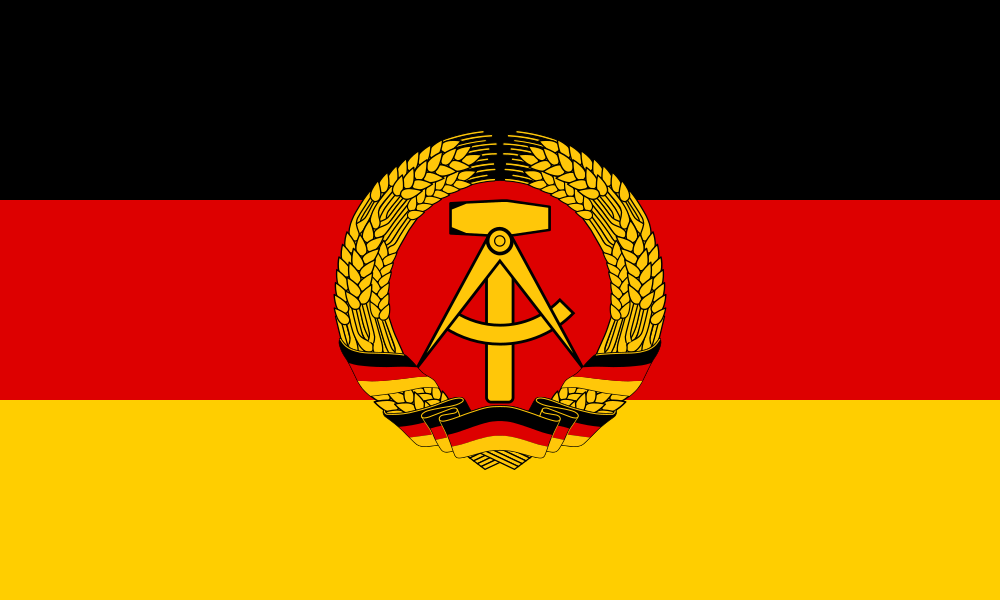
Black, red and gold horizontal bands with a central state emblem containing a hammer, compass and grain wreath. The hammer symbolised workers, the compass the intelligentsia and the grain wreath farmers. The compass is the key difference from a hammer-and-sickle emblem. Look for the hammer-and-compass emblem centered across black-red-gold.
The design and its details
Black, red and gold horizontal bands with a central state emblem containing a hammer, compass and grain wreath.
| Flag | East Germany |
|---|---|
| Collection | Historical flags |
| Adoption or specification | 1 October 1959 for the emblem-bearing flag |
| Browsing region | Europe · Central Europe |
| Illustrated period | 1959–1990 |
What the flag means
The hammer symbolised workers, the compass the intelligentsia and the grain wreath farmers. The compass is the key difference from a hammer-and-sickle emblem.
| Element | Meaning or historical connection |
|---|---|
| Black, red and gold | The German national color tradition, also used by the Federal Republic. |
| Hammer | Industrial workers. |
| Compass | The intelligentsia, including technical and intellectual professions. |
| Grain wreath | Farmers and agricultural labor. |
| Combined emblem | The official alliance of those groups; it is a hammer-and-compass device, not the Soviet hammer and sickle. |
How the flag developed
When the German Democratic Republic was established in 1949, it used the same plain black-red-gold national colors as West Germany. For a decade, the ordinary flags of the two German states were visually identical.
In 1959 East Germany added its state emblem to distinguish its national flag. The device combined a hammer, compass and wreath of grain, expressing the official alliance of workers, intellectuals and farmers. The new emblem made the political division visible on the flag itself.
During the peaceful revolution of 1989, demonstrators sometimes cut the emblem out of flags, leaving a hole. The GDR ceased to exist at reunification in 1990, and the plain black-red-gold flag continued as the national flag of the united Federal Republic. The cut-out protest flag is a historical act of modification, not a separately legislated national design.
The main changes over time
1949 — German Democratic Republic
The new state used plain black-red-gold.
1959 — State emblem added
The hammer-and-compass design distinguished East Germany.
1989 — Protest modifications
Some demonstrators removed the central emblem.
1990 — Reunification
The GDR flag ceased to be a current state flag.
How to recognise this flag
Look for the hammer-and-compass emblem centered across black-red-gold. The Federal Republic’s ordinary national flag has no central emblem.
Compare the relevant designs in these guides:
Earlier designs and other uses
The plain 1949–1959 GDR flag and the later emblem-bearing design are separate phases.
Questions about this flag
Which period does this historical flag represent?
1959–1990. During the peaceful revolution of 1989, demonstrators sometimes cut the emblem out of flags, leaving a hole. The GDR ceased to exist at reunification in 1990, and the plain black-red-gold flag continued as the national flag of the united Federal Republic. The cut-out protest flag is a historical act of modification, not a separately legislated national design.
What should I check before identifying an older example?
The plain 1949–1959 GDR flag and the later emblem-bearing design are separate phases.
What Did We Learn Today?
Look for the hammer-and-compass emblem centered across black-red-gold. The Federal Republic’s ordinary national flag has no central emblem. The historical label identifies a particular state or version; related modern flags have their own national histories.
Sources & Data Notes
This guide distinguishes first use, national adoption, restoration and later construction standards. Traditional or commonly reported interpretations are identified where they differ from a formal specification. It is a dated reference, not a live record of every change in official flag use.
Illustration credits
- Flag of East Germany.svg — Flaggenentwurf: unbekannt
diese Datei: Jwnabd; Public domain. - Flag of East Germany.svg — Flaggenentwurf: unbekannt
diese Datei: Jwnabd; Public domain.
