National flag guide
Flag of Belize: Meaning, Symbols and History
Belize’s flag developed from a blue-and-white national movement flag and the older arms of British Honduras.
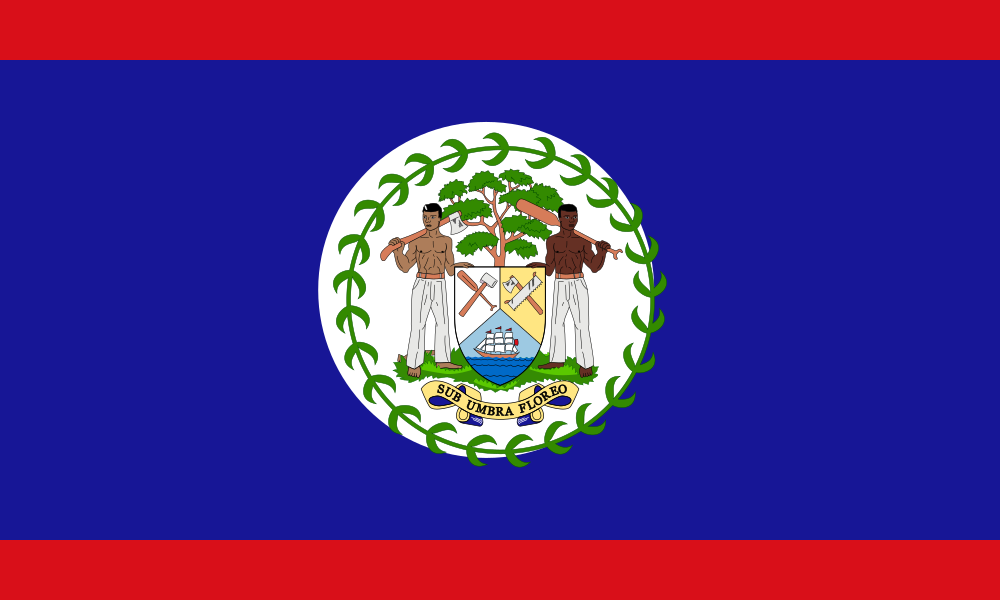
Royal blue with a narrow red stripe along the top and the bottom edges; the coat of arms is on a large white disk at the center and shows a shield flanked by two workers in front of a mahogany tree, with the motto Sub Umbra Floreo (I Flourish in the Shade) on a scroll at the bottom; a green garland of 50 mahogany leaves rings the coat of arms.
The design and its details
Royal blue with a narrow red stripe along the top and the bottom edges; the coat of arms is on a large white disk at the center and shows a shield flanked by two workers in front of a mahogany tree, with the motto Sub Umbra Floreo (I Flourish in the Shade) on a scroll at the bottom; a green garland of 50 mahogany leaves rings the coat of arms.
| Flag | Belize |
|---|---|
| Collection | Country flags |
| Adoption or specification | 21 September 1981; graphic standardisation in 2019 |
| Browsing region | North America · Central America |
| Illustrated proportions (height:width) | 3:5 |
What the flag means
The two human supporters, mahogany tree and tools refer to the timber industry. The motto Sub Umbra Floreo means “Under the shade I flourish.” The detailed emblem should be read as a whole rather than reduced to the background colors.
| Element | Meaning or historical connection |
|---|---|
| Blue and red | Colors associated with the two principal political traditions brought into the national design. |
| Mahogany tree and tools | The forestry and logging history central to the colony’s economy. |
| Two human supporters | People engaged in that shared working history, shown holding a paddle and an axe. |
| Ship | Maritime trade and the export economy. |
| Motto and wreath | Sub Umbra Floreo means Under the Shade I Flourish; the surrounding leaves frame the national arms. |
How the flag developed
Belize’s flag developed from a blue-and-white national movement flag and the older arms of British Honduras. The addition of red bands broadened the design’s political representation as the country approached independence in 1981.
The central arms preserve the history of the logging economy through mahogany, tools and the two workers. Later graphic standardisation addressed inconsistent drawings and colors without replacing the basic independence-era design. The flag therefore combines a new independent state’s colors with an emblem whose economic history reaches back into the colonial period.
The main changes over time
1907 — Arms of British Honduras
The logging-related arms preceded the modern national flag.
1981 — Independence flag
Red bands and the arms formed the present national arrangement.
2019 — Graphic standardisation
A standard drawing addressed inconsistent reproductions.
How to recognise this flag
Belize has narrow red borders at the top and bottom and a large central white disc containing two people and a tree. The human figures are an unusually distinctive identification cue.
Earlier designs and other uses
Older colonial flags and simplified unofficial drawings can differ in their arms. The current national design retains the full central emblem.
Questions about this flag
When was the flag adopted?
21 September 1981; graphic standardisation in 2019. An adoption date can refer to a design, its restoration or a later legal specification; the timeline above separates those stages.
What should I check before identifying an older example?
Older colonial flags and simplified unofficial drawings can differ in their arms. The current national design retains the full central emblem.
What Did We Learn Today?
Belize has narrow red borders at the top and bottom and a large central white disc containing two people and a tree. The human figures are an unusually distinctive identification cue. Its adoption and later changes reflect the national history described in the timeline, while older or specialist flags need their own labels.
Sources & Data Notes
This guide distinguishes first use, national adoption, restoration and later construction standards. Traditional or commonly reported interpretations are identified where they differ from a formal specification. It is a dated reference, not a live record of every change in official flag use.
- Archived World Factbook country record — background flag description and symbolic interpretations; later changes are explained above.
- Flagpedia: Belize — flag artwork and comparison reference.
- Flag history reference and bibliography — chronology and links to underlying sources.
The main illustration preserves the selected flag artwork’s proportions; these are a reproduction guide, not a substitute for a legal construction drawing. Color names group shades for browsing.
Current flag artwork is supplied with the original flag collection; the package’s artwork register contains provenance and license details.