National flag guide
Flag of Antigua and Barbuda: Meaning, Symbols and History
Antigua and Barbuda adopted Reginald Samuel’s design in 1967 when Antigua became an associated state with internal self-government.
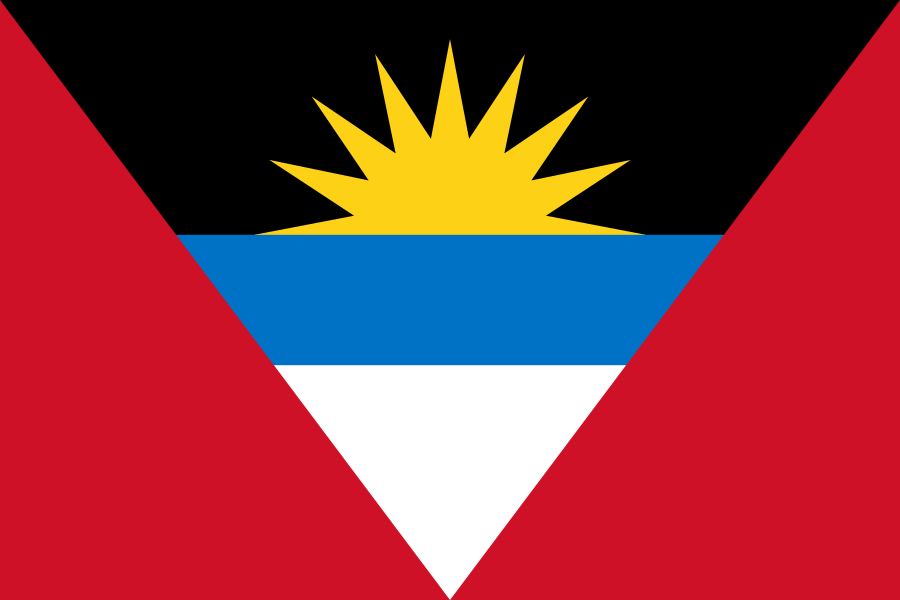
Red, with an inverted isosceles triangle in the center that spans the flag from top to bottom; the triangle contains three horizontal bands of black (top), light blue, and white, with a yellow rising sun in the black band. The inverted triangle makes a V associated with victory.
The design and its details
Red, with an inverted isosceles triangle in the center that spans the flag from top to bottom; the triangle contains three horizontal bands of black (top), light blue, and white, with a yellow rising sun in the black band.
| Flag | Antigua and Barbuda |
|---|---|
| Collection | Country flags |
| Adoption or specification | 27 February 1967 |
| Browsing region | North America · Caribbean |
| Illustrated proportions (height:width) | 2:3 |
What the flag means
The inverted triangle makes a V associated with victory. Yellow, blue and white can also be read together as sun, sea and sand; they are not simply three unrelated stripes.
| Element | Meaning or historical connection |
|---|---|
| Rising gold sun | A new era after colonial rule, also evoking the sunshine of the islands. |
| Black | African heritage. |
| Blue | Hope and the sea. |
| White | Associated with sand and the island setting. |
| Red and V-shaped layout | The people’s energy and a victory-shaped arrangement opening toward the top of the flag. |
How the flag developed
Antigua and Barbuda adopted Reginald Samuel’s design in 1967 when Antigua became an associated state with internal self-government. A public competition produced the winning design, replacing the visual language of British colonial ensigns with a distinctive sun-and-triangle flag.
The flag was retained at full independence in 1981. Confusing those dates can make a correct 1967 adoption date appear inconsistent with the country’s later independence. Its design looks forward through the rising sun while recognising the African heritage of much of the population.
The main changes over time
Before 1967 — Colonial ensigns
British and territorial flags represented the colonial administration.
1967 — Self-government flag
Reginald Samuel’s competition design was adopted.
1981 — Independence
The independent state retained the existing flag.
How to recognise this flag
Look for the rising yellow sun above blue and white inside a large V-shaped opening in the red field. It is unlike a conventional horizontal tricolour.
Earlier designs and other uses
The naval ensign is a separate white-and-red cross design with the national flag in the canton.
Questions about this flag
When was the flag adopted?
27 February 1967. An adoption date can refer to a design, its restoration or a later legal specification; the timeline above separates those stages.
What should I check before identifying an older example?
The naval ensign is a separate white-and-red cross design with the national flag in the canton.
What Did We Learn Today?
Look for the rising yellow sun above blue and white inside a large V-shaped opening in the red field. It is unlike a conventional horizontal tricolour. Its adoption and later changes reflect the national history described in the timeline, while older or specialist flags need their own labels.
Sources & Data Notes
This guide distinguishes first use, national adoption, restoration and later construction standards. Traditional or commonly reported interpretations are identified where they differ from a formal specification. It is a dated reference, not a live record of every change in official flag use.
- Government of Antigua and Barbuda: National symbols.
- Archived World Factbook country record — background flag description and symbolic interpretations; later changes are explained above.
- Flagpedia: Antigua and Barbuda — flag artwork and comparison reference.
- Flag history reference and bibliography — chronology and links to underlying sources.
The main illustration preserves the selected flag artwork’s proportions; these are a reproduction guide, not a substitute for a legal construction drawing. Color names group shades for browsing.
Current flag artwork is supplied with the original flag collection; the package’s artwork register contains provenance and license details.