National flag guide
Flag of Andorra: Meaning, Symbols and History
Andorra’s flag grew from its position between French and Iberian political traditions.
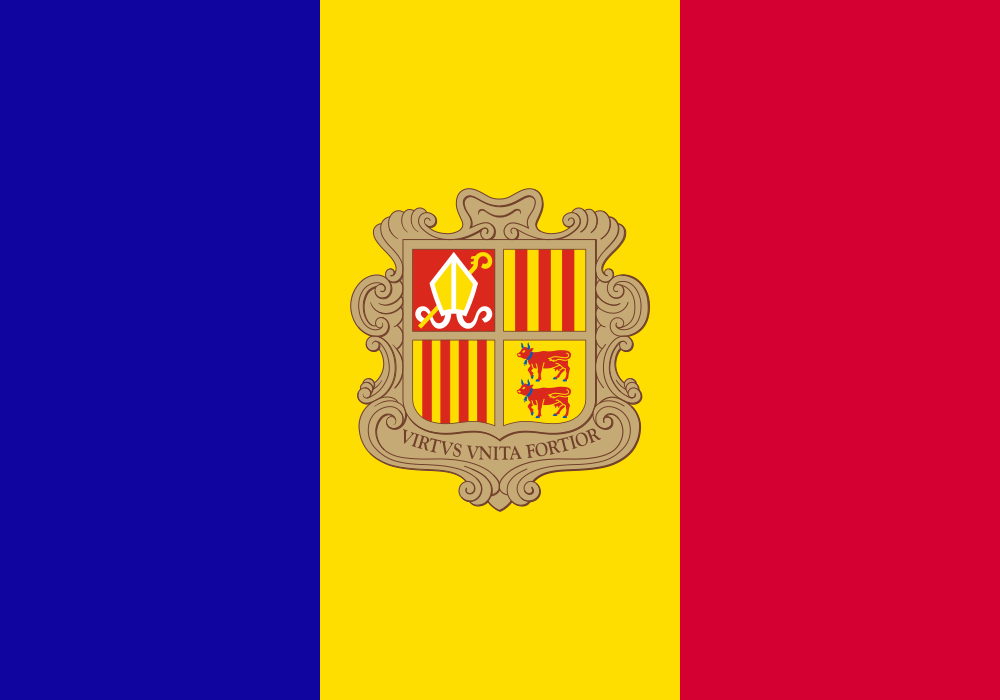
Three vertical bands of blue (left side), yellow, and red, with the national coat of arms centered in the yellow band, which is slightly wider than the other two; the coat of arms features a quartered shield with the emblems of Urgell, Foix, Bearn, and Catalonia; the motto reads Virtus Unita Fortior (Strength United is Stronger).
The design and its details
Three vertical bands of blue (left side), yellow, and red, with the national coat of arms centered in the yellow band, which is slightly wider than the other two; the coat of arms features a quartered shield with the emblems of Urgell, Foix, Bearn, and Catalonia; the motto reads Virtus Unita Fortior (Strength United is Stronger).
| Flag | Andorra |
|---|---|
| Collection | Country flags |
| Adoption or specification | Tricolour introduced in 1866; arms standardised in 1993 |
| Browsing region | Europe · Southern Europe |
| Illustrated proportions (height:width) | 7:10 |
What the flag means
The shield brings together Urgell’s mitre and staff, the bars of Foix and Catalonia, and the cows of Béarn. These are historical heraldic references, not a count of today’s administrative districts. The Latin motto, Virtus Unita Fortior, expresses strength through unity.
| Element | Meaning or historical connection |
|---|---|
| Blue, yellow and red | The palette connects French blue and red with the yellow and red associated with Spain. |
| Bishop’s mitre and staff | The arms recall the Bishop of Urgell, one of Andorra’s co-princes. |
| Bars and cows in the shield | Heraldic references to Catalonia, Foix and Béarn. |
| Motto | Virtus Unita Fortior expresses the strength of united virtue. |
How the flag developed
Andorra’s flag grew from its position between French and Iberian political traditions. Earlier red-and-yellow designs reflected the heraldry of the area; adding blue produced the familiar tricolour in the nineteenth century. The design is generally dated to 1866, but surviving versions varied in the arrangement of their stripes and coats of arms.
The 1993 constitutional settlement provides a second important date. Andorra became a parliamentary co-principality, and the modern arms-bearing design was standardised. The French president and the bishop of Urgell remained co-princes: the flag’s French and Iberian references did not disappear when the constitution changed. This distinction explains why 1866 and 1993 both appear in accounts of the flag.
The main changes over time
Before 1866 — Red and yellow precedents
Earlier designs used red and yellow associated with local and Iberian heraldry.
1866 — Blue joins the design
The nineteenth-century tricolour introduced the three-color family used today.
1993 — Modern standardisation
The arms-bearing design was standardised in the constitutional era.
How to recognise this flag
Look for the shield and the slightly wider yellow stripe. Without that central device, a small blue-yellow-red image can be confused with Romania or Chad; Moldova also uses an arms-bearing tricolour, but its eagle-and-shield emblem is different.
Earlier designs and other uses
The plain tricolour is a civil variant. The arms-bearing version is the most useful reference for identifying the national design.
Questions about this flag
When was the flag adopted?
Tricolour introduced in 1866; arms standardised in 1993. An adoption date can refer to a design, its restoration or a later legal specification; the timeline above separates those stages.
What should I check before identifying an older example?
The plain tricolour is a civil variant. The arms-bearing version is the most useful reference for identifying the national design.
What Did We Learn Today?
Look for the shield and the slightly wider yellow stripe. Without that central device, a small blue-yellow-red image can be confused with Romania or Chad; Moldova also uses an arms-bearing tricolour, but its eagle-and-shield emblem is different. Its adoption and later changes reflect the national history described in the timeline, while older or specialist flags need their own labels.
Sources & Data Notes
This guide distinguishes first use, national adoption, restoration and later construction standards. Traditional or commonly reported interpretations are identified where they differ from a formal specification. It is a dated reference, not a live record of every change in official flag use.
- Archived World Factbook country record — background flag description and symbolic interpretations; later changes are explained above.
- Flagpedia: Andorra — flag artwork and comparison reference.
- Flag history reference and bibliography — chronology and links to underlying sources.
The main illustration preserves the selected flag artwork’s proportions; these are a reproduction guide, not a substitute for a legal construction drawing. Color names group shades for browsing.
Current flag artwork is supplied with the original flag collection; the package’s artwork register contains provenance and license details.